What is an FSRU?
Key highlights:
-
FSRUs provide a flexible alternative to traditional LNG import terminals by storing and regasifying LNG offshore.
-
The vessels can help countries expand natural gas import capacity more quickly than building permanent onshore facilities.
-
FSRUs have become an important energy security tool in Europe and emerging markets around the world.
Editor’s note: Welcome to Offshore’s new educational “What Is…?” series. If you’re interested in contributing your insights and sharing industry knowledge with the next generation of offshore energy professionals, contact Chief Editor Ariana Hurtado at [email protected] for more information.
By Mohammad Sadegh Amini, International Energy Club
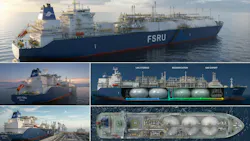
As countries around the world look for more flexible and reliable energy solutions, floating storage and regasification units (FSRUs) have become an important part of the global liquefied natural gas (LNG) infrastructure.
An FSRU is a specialized vessel that receives LNG, stores it onboard and converts it back into its gaseous form before delivering it into a local natural gas network.
Unlike traditional onshore LNG terminals, which can take several years to design and construct, FSRUs provide a faster solution for countries seeking access to global LNG markets. By combining storage and regasification capabilities in a single floating facility, these vessels allow nations to establish LNG import capacity without waiting for large permanent infrastructure projects.
The importance of FSRUs has increased significantly in recent years as countries focus on energy security, supply diversification and reducing dependence on single energy sources. The global energy crisis following disruptions to European pipeline gas supplies demonstrated how quickly floating LNG (FLNG) terminals could help countries secure alternative energy routes.
Today, FSRUs serve as both LNG import facilities and strategic assets for national energy security.
How does an FSRU work?
To understand the role of an FSRU, it is important to first understand LNG transportation. Natural gas is cooled to approximately -162°C (-259.6°F), transforming it from a gas into a liquid. This process reduces its volume by about 600 times, allowing large quantities of energy to be transported efficiently by specialized LNG carriers.
When an LNG carrier arrives at an FSRU, the LNG is transferred into the vessel’s insulated storage tanks. These tanks are designed to maintain extremely low temperatures and safely store the LNG until it is required.
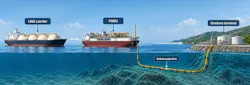
The regasification process begins when LNG is pumped from the storage tanks into heating systems called vaporizers. These systems increase the temperature of the LNG, converting it back into natural gas. The gas is then measured, pressure-controlled, and transferred through subsea or onshore pipelines into the existing natural gas network.
An FSRU combines several technologies in one floating platform, including LNG storage systems, pumps, regasification equipment, safety systems and advanced control technologies.
Some FSRUs are purpose-built, while others are converted from existing LNG carriers.
Why FSRUs matter offshore
Many FSRUs are deployed at offshore or nearshore mooring locations, where they receive LNG from carriers, regasify it and send natural gas to shore through subsea pipelines. Their ability to be deployed more quickly and at lower cost than permanent onshore terminals has made them an important link between global LNG trade and national energy infrastructure. FSRUs are increasingly used to support energy security, supply diversification and access to natural gas in regions with limited import infrastructure.
What economic advantages are offered by FSRUs?
One of the biggest advantages of FSRUs is speed.
Developing a conventional onshore LNG terminal requires major investment, extensive permitting, land preparation and large-scale construction. These projects can take many years before becoming operational.
FSRUs provide a faster alternative because most of the required technology is already integrated into the vessel. Once port facilities and pipeline connections are prepared, an FSRU can often begin operations within a much shorter timeframe.
This fast-track approach provides several benefits:
- Lower initial investment compared with large onshore LNG terminals;
- Faster access to international LNG markets;
- Greater flexibility because the vessel can potentially be relocated; and
- The ability to respond quickly to changing energy demands.
For countries with limited coastal infrastructure or uncertain long-term energy requirements, FSRUs provide a flexible solution without requiring immediate commitment to permanent facilities.
Global FSRU fleet
-
More than 50 FSRUs are operating or available for deployment worldwide.
-
FSRUs account for roughly 20% of global LNG regasification capacity.
-
Demand has grown in recent years as countries seek faster and more flexible LNG import solutions, particularly following Europe's efforts to strengthen energy security.
How have FSRUs helped address recent global energy challenges?
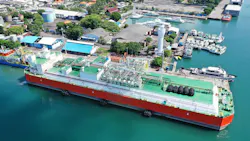
The strategic importance of FSRUs became especially clear during Europe’s recent energy challenges. Following disruptions to traditional pipeline gas supplies, several European countries accelerated the development of FLNG terminals to secure alternative sources of natural gas.
Germany, for example, deployed multiple FSRUs as part of its strategy to rapidly establish LNG import capacity. Other countries have also used floating terminals to strengthen energy independence and improve supply reliability.
Beyond Europe, FSRUs are supporting energy development in emerging markets across Asia, Africa and Latin America. For countries that need additional natural gas capacity but cannot wait years for large infrastructure projects, floating terminals provide a practical solution.
Despite these advantages, FSRUs are not without challenges. Most projects still require pipeline connections to shore and supporting infrastructure. Operations can also be affected by weather conditions, port constraints, regulatory requirements and environmental considerations, depending on the location.
Future fuels: Could FSRUs support ammonia and hydrogen?
As the energy transition continues, the role of FSRUs may expand beyond natural gas. Energy companies and technology developers are exploring whether FLNG infrastructure could be adapted for future fuels such as ammonia and hydrogen.
Ammonia is attracting attention as a potential low-carbon energy carrier because it can be transported and stored more easily than pure hydrogen. The experience gained from LNG transportation and offshore operations could support the development of future ammonia-based energy systems.
Hydrogen presents greater technical challenges due to its extremely low storage temperature and unique handling requirements. However, advances in technology may create opportunities for floating facilities capable of supporting hydrogen-related energy systems.
Although FSRUs were originally developed to support LNG markets, their flexible design and offshore capabilities could allow them to become part of the next generation of energy infrastructure.
In the future, these floating terminals may evolve from LNG import facilities into multi-purpose energy hubs supporting a wider range of fuels.
Whether supporting energy security today or enabling future fuel imports, FSRUs remain one of the most flexible and rapidly deployable tools available for expanding natural gas infrastructure.
Seeking additional resources on this topic?
Check out these exclusive Offshore features:
How modular floating production is reshaping FPSO, FLNG and FSRU project delivery
FLNG designs evolve to meet market needs
Importance of FSRUs for a dynamic LNG market
Offshore's "What Is...?" series
Young professionals in the offshore energy industry often encounter technical terms and acronyms that seasoned subject matter experts (SMEs) know by heart—but aren’t always clear to the next generation. Offshore’s new “What Is…?” educational series aims to bridge that gap by providing concise, practical explainers for emerging professionals and newcomers to the industry.
Some of the topics we've already covered include:
- What is an FPSO?
- What is a dynamic positioning (DP) system?
- What is an SOV?
- What is directional drilling?
- What is CCS?
- What is floating wind?
- What is an offshore substation (OSS)?
- What is a digital twin?
- What is the deepwater oil and gas field development life-cycle?
- What is subsea electrification?
- What is a mooring system?
- What is offshore vessel water and waste management?
If there’s an offshore energy subject you’d like to highlight in a brief explainer article (600-1,000 words), reach out to Chief Editor Ariana Hurtado at [email protected] for more information.
About the Author
 Mohammad Sadegh Amini
Mohammad Sadegh Amini
Mohammad Sadegh Amini is founder and director of projects at International Energy Club, a specialized industrial animation studio serving the offshore, marine, subsea and renewable energy sectors. With over nearly two decades in the offshore industry, he has combined experience in journalism, engineering communications and technical visualization to help energy companies explain complex technologies through 3D animation and digital media. Amini has led animation projects for more than 150 companies across 33 countries, with a focus on offshore oil and gas, offshore wind and marine infrastructure. He is a frequent writer and commentator on offshore technologies, energy innovation and industrial communication.