What is a mooring system?
Why mooring systems matter:
-
Mooring systems keep floating offshore assets such as FPSOs, semisubmersibles, drillships and floating wind platforms safely positioned, allowing them to operate without drifting.
-
Advances in mooring technology are helping operators develop deeper-water oil and gas fields while supporting the growth of floating offshore wind projects.
-
Reliable station-keeping systems are critical to offshore safety, asset integrity and uninterrupted production.
Editor’s note: Welcome to Offshore’s new educational “What Is…?” series. If you’re interested in contributing your insights and sharing industry knowledge with the next generation of offshore energy professionals, contact Chief Editor Ariana Hurtado at [email protected] for more information.
By Tom Fulton, Intermoor
Most people see the floating asset. Fewer see the mooring system keeping it on station.
Whether the asset is an FPSO, a semisubmersible drilling rig, a floating LNG facility or a floating renewables facility, it cannot operate safely unless it remains within defined limits. That is the job of the mooring system.
Glossary
-
Station keeping: Maintaining a floating facility within predefined movement limits
-
Excursion: Movement of a floating asset away from its intended position
-
Catenary mooring: A system that relies primarily on line weight and geometry
-
Taut-leg mooring: A system that relies more heavily on line tension and elasticity
-
Turret mooring: A configuration that allows a vessel to rotate or "weathervane" with environmental conditions
-
Metocean data: Environmental information describing wind, wave and current conditions used in offshore design
- Spread mooring: A mooring arrangement using multiple lines positioned around a floating asset to maintain station
A mooring system connects a floating facility to the seabed. Its purpose is station keeping: resisting wind, wave and current loads while controlling vessel excursions within the limits required by the facility and the systems connected to it.
Mooring systems are designed to withstand extreme environmental conditions, including hurricanes, cyclones and severe storms, based on location-specific metocean criteria.
For offshore oil and gas facilities, the mooring system must control vessel excursions so drilling risers, production risers, flowlines, umbilicals and other subsea infrastructure can operate safely. Excessive excursion increases loads on these systems and can affect production, reliability and safety.
For floating renewables, the same principle applies, but excursion limits are often driven by dynamic power cables and associated electrical infrastructure connecting the facility to the seabed and ultimately to the grid.
What are the main components of a mooring system?
Most offshore mooring systems have three main elements that transfer load from the floating facility to the seabed:
- Anchors
- Mooring lines
- Connectors
Anchors provide the holding capacity required to resist loads from the floating facility. Anchor selection depends on soil conditions, installation method, design loads, water depth and project economics. Common solutions include drag embedment anchors, suction piles, plate anchors and driven piles.
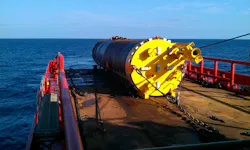
Connectors and other hardware complete the load path between the floating facility and the anchor. Shackles, H-links and other connectors joining anchors, chain, wire rope, synthetic rope and associated components may look simple, but their reliability is critical. A mooring system is only as strong as its weakest component.
Mooring lines may be constructed from steel chain, wire rope, synthetic fiber rope or combinations of these materials. Selection depends on water depth, environmental conditions, required stiffness, weight, fatigue performance and cost.
What types of mooring systems are used offshore?
Offshore mooring systems are commonly described as catenary or taut-leg systems.
Catenary systems rely on the weight of the mooring line, usually steel chain for at least part of the system, and the line geometry to generate restoring force.
Taut-leg systems rely more on line tension and the elastic properties of the mooring components to maintain station.
Catenary systems are typically used in shallower water, while taut-leg moorings are commonly used in deeper water, although the final selection depends on environment, facility type, installation method and project economics.
Offshore moorings are also described by arrangement:
- Spread mooring systems use multiple lines arranged around the floating facility and are the most common arrangement.
- Turret moorings connect the lines through a turret buoy, allowing FPSOs and similar vessels to weathervane with prevailing wind, wave and current conditions.
- Single-point moorings (SPMs) provide a single connection point between the vessel and the mooring system and are commonly used for offshore loading and offloading operations.
What is the difference between permanent and temporary moorings?
Permanent or long-term mooring systems are designed to keep a floating facility on station for many years, often supporting energy production. Design lives can range from 10 years to more than 25 years, with some projects now targeting 40 to 50 years. Because these systems need to last longer, they typically use different and often larger components than temporary moorings.
Temporary or mobile mooring systems are used for shorter periods, usually weeks or months. They are commonly deployed by mobile offshore drilling units (MODUs) during exploration and drilling campaigns before being recovered and used again elsewhere.
How are offshore mooring designs changing?
As offshore developments move into deeper water and new sectors, mooring designs are becoming more specialized. In deeper water, longer mooring lines, increased loads and installation complexity often require different materials and anchor solutions than those used in traditional shelf developments.
Floating renewables are increasing demand for lower-cost anchors, optimized mooring layouts and installation methods suitable for large-scale deployment.
The objective remains the same: keep the floating asset safely on station while controlling excursions within acceptable operating limits.
How is a mooring system more than hardware?
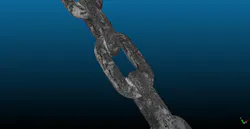
A mooring system is not just equipment installed during offshore construction. It is a life-cycle asset. The work starts well before installation, with geotechnical investigations, metocean data, engineering analysis and anchor selection. Installation is one stage in a process that also includes inspection, integrity management, maintenance, repair, life extension and decommissioning.
Mooring systems are designed and assessed in accordance with industry standards developed by class organizations such as API, ISO, DNV and ABS.
Decisions made during concept selection and early engineering influence installation vessel requirements, procurement, inspection access and future maintenance.
As more floating assets operate beyond their original design life, understanding the condition and remaining capacity of mooring components has become as important as the original design.
Why is mooring integrity important?
When a mooring system performs as intended, it gets little attention. When it does not, the consequences can be significant.
A mooring failure can interrupt production, damage equipment and, in severe cases, create major safety or environmental incidents. Therefore, operators rely on mooring integrity management programs that combine inspection data, engineering assessment and risk-based decision making.
The objective is straightforward: understand the condition of the system and manage risk before it affects operations.
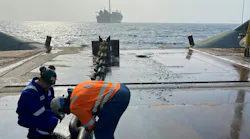 Ground chain inspection
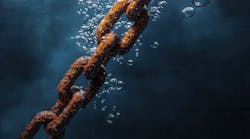 mooring
How are offshore mooring systems evolving?
The offshore industry continues to evolve, and mooring systems are evolving with it.
Advances in anchor technology, synthetic rope systems, connector design, digital monitoring and inspection methods are helping operators improve performance and reduce installation complexity and life-cycle costs.
At the same time, growth in deepwater oil and gas, floating renewables and other offshore sectors is creating new demands on mooring technology. Future systems will need to support larger floating assets, operate in more challenging environments and remain reliable over long design lives.
Key takeaway
The mooring system is rarely the most visible part of an offshore development, but it is one of the most important.
Without effective station keeping, drilling operations cannot be performed safely, production risers cannot operate within their design limits and dynamic power cables cannot be protected from excessive loading.
Every floating facility ultimately depends on a reliable connection to the seabed. The mooring system provides that connection.
Offshore's "What Is...?" series
Young professionals in the offshore energy industry often encounter technical terms and acronyms that seasoned subject matter experts (SMEs) know by heart—but aren’t always clear to the next generation. Offshore’s new “What Is…?” educational series aims to bridge that gap by providing concise, practical explainers for emerging professionals and newcomers to the industry.
Some of the most-searched topics we've already covered include:
- What is an FPSO?
- What is a dynamic positioning (DP) system?
- What is an SOV?
- What is directional drilling?
- What is CCS?
- What is floating wind?
- What is an offshore substation (OSS)?
- What is a digital twin?
- What is the deepwater oil and gas field development life-cycle?
- What is subsea electrification?
If there’s an offshore energy subject you’d like to highlight in a brief explainer article (600-1,000 words), reach out to Chief Editor Ariana Hurtado at [email protected] for more information.
About the Author
 Tom Fulton
Tom Fulton
Tom Fulton is the global director of Strategic Mooring Solutions for Intermoor, an Acteon company. With more than 35 years of experience in the design, provision, installation, inspection and maintenance of mooring systems, as well as general marine operations, he is a technical authority in the mooring of floating offshore energy production systems. He has been involved with more than 30 studies related to floating renewables over the past two years. During his career, Fulton has been extensively involved with research, development and implementation of new mooring technology, especially with novel anchor systems, connectors and synthetic rope. He has been listed on six patents and has patents pending.