What is a digital twin?
Key highlights:
- A digital twin pairs a physical asset with a virtual model and a flow of data between them.
- For the offshore industry, in both oil and gas and wind/renewable energy, digital twins support engineers and operators to sharpen day-to-day operations by predicting how an asset will respond to changing loads and conditions. Digital twins also let operators direct maintenance and resources to where the risks are highest.
- The value of a digital twin rests on whether its data and models can be trusted. Its output can only support real operating decisions once enough confidence has been built in them.
Editor’s note: Welcome to Offshore’s new educational “What Is…?” series. If you’re interested in contributing your insights and sharing industry knowledge with the next generation of offshore energy professionals, contact Chief Editor Ariana Hurtado at [email protected] for more information.
By Jose Guilherme Moraes, DNV
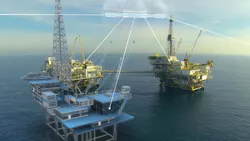
For decades, engineers building and designing offshore structures have refined the models used to predict how those structures respond to waves, wind and the loads experienced during operation. Today, many make use of so-called “digital twins" for complex offshore assets.
Definition: A digital twin is a virtual representation of a specific asset, maintained across its lifecycle and available at any time, to help engineers understand how a structure will behave to make better-informed decisions about the asset’s design, safety and upkeep.
What makes a digital twin different from a digital model?
Not every detailed model is a twin. A 3D model or a one-off simulation is a digital model.
Generally speaking, three properties turn a model into a digital twin:
- It has a unique physical counterpart that it mirrors;
- It reflects changes to that counterpart over time, whether from modification or ordinary wear; and
- It serves a purpose through some behavioral logic, usually a simulation, that lets it support predictions and decisions.
A digital twin is better understood as a connected set of models and records that evolve as the asset does. Used this way, it becomes a shared reference where the various engineering teams can work with the same information, reducing the errors and rework that come from fragmented data.
What is inside a digital twin?
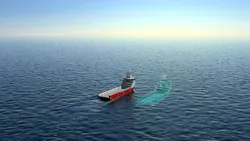
Again, to generalize, a digital twin consists of three distinct parts:
- The details of the physical offshore structure;
- The computational capacity to create a virtual representation of it; and
- The data connection between the two.
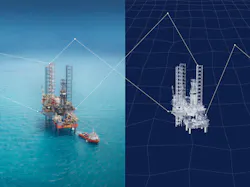
The digital twin starts with a reliable mathematical representation of the structure. This is usually built by describing the structure as a group of 3D points, much like wrapping it in a fishing net where every knot stands for a point in space. The resulting mesh always carries some inaccuracy, because the spacing between the points does not capture the shape exactly. Engineers can then increase or reduce the mesh size in specific areas to refine this representation, but they have to choose the size with care—fine enough for accurate results, without consuming too much computational processing time.
Alongside the geometry, the material properties of the structure are usually loaded into the model. There is often extensive research on how various materials react to load, impacts and corrosion. For example, studies on the properties of laminated carbon steel plating, which has been extensively researched, helps the digital twin represent real events on the model.
The third part is the data connection, which links the physical structure to its virtual representation and carries the information that keeps the digital twin current. Basic inputs might include weather forecasts, cargo tank loading levels, wave characteristics, etc.
How capable are digital twins?
Digital twins differ in what they can do. At the simplest level, a digital twin describes the current state of an asset. A more capable digital twin adds interpretation, offering condition monitoring and fault detection.
A predictive digital twin forecasts how the structure will behave and where damage is likely to develop, supported by statistical assessment of the probability and consequence of failure.
The current direction of travel is toward prescriptive behavior, where the digital twin proposes actions, and toward agents that can act within defined limits. Many offshore digital twins today are hybrid, combining physics-based numerical models with recorded sensor data, rather than relying on either alone.
How are digital twins used offshore?
For the offshore oil and gas industry, one of the most established use cases is structural integrity management.
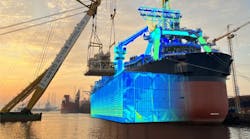
A digital twin allows the usual calendar-based inspection program to be replaced by risk-based inspection, which prioritizes the elements most likely to fail. This suits assets such as floating production, storage and offloading (FPSO) units, which are not designed to leave the field for repair and where offshore intervention is slow and expensive.
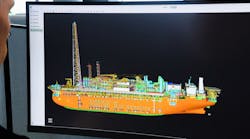
Real-world case: A digital twin of the Aoka Mizu, Bluewater's FPSO at the Lancaster Field, West of Shetland, allows the company to monitor the structure in dashboards that shows hull stress levels and indicates where cracks or deformations are most likely to occur.
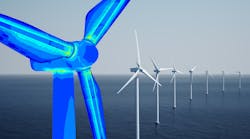
Digital twins are also being applied to offshore wind, where they help manage the fatigue life of foundations and support structures. Design assumptions are deliberately conservative, so a digital twin fed with real load data can show if fatigue is accumulating more slowly than the design predicted. That can support a case for keeping a structure in service beyond its initial design life.
What are the benefits and challenges?
Better visibility of the structural behavior of an asset can support more informed decisions.
By deploying digital twin technology, operators can:
- Predict how the structure will behave, supported by statistical risk analysis, the probability of structural failure (coating breakdown, corrosion, crack induced by fatigue, buckling) and its consequences;
- Prioritize resources in the structural integrity plan, defining how often the inspection team in risk-based approach plan; and
- Determine the structural fatigue life by replacing conservative estimates from conventional mathematical models to confirm the reliability of the structure to extend the time in the offshore environment beyond the initial design lifespan.
When thinking about the challenges to overcome, the main target is trust, because a decision is only as sound as the trustworthiness of the data quality, sensor reliability and modeling choices.
What is the future outlook?
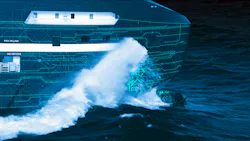
The direction is toward digital twins that do more than describe and diagnose.
Machine learning is being used to bring digital twin outputs closer to the conclusions a structural engineer would reach after hours or days of work.
The natural next step is AI agents, supported by high-bandwidth ship-to-shore connectivity. This will allow operators to monitor performance and build confidence, and the degree of automation in the system helps them spend less time processing data and more on making the right decisions.
Key takeaway: A digital twin is more than a virtual copy of an offshore structure. With the right data and modeling inputs, it becomes a practical tool for optimizing maintenance, supporting integrity management, and helping operators avoid costly, even potentially catastrophic, material or asset failures.
Want more content on digital twins?
 ABS launches new web-based structural digital twin solution
 ABS to lead digital twin, condition monitoring project for Petrobras FPSO
 aize
aize digital
 Wind Turbine Imagination Model (1)
 Digital Twin Credit Akselos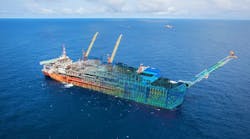
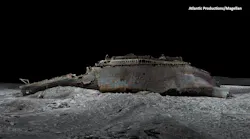 5 Digital Twin Titanic
Offshore's "What Is...?" series
Young professionals in the offshore energy industry often encounter technical terms and acronyms that seasoned subject matter experts (SMEs) know by heart—but aren’t always clear to the next generation. Offshore’s new “What Is…?” educational series aims to bridge that gap by providing concise, practical explainers for emerging professionals and newcomers to the industry.
Some of the most-searched topics we've already covered include:
- What is an FPSO?
- What is a dynamic positioning (DP) system?
- What is an SOV?
- What is directional drilling?
- What is CCS?
- What is floating wind?
- What is an offshore substation (OSS)?
If there’s an offshore energy subject you’d like to highlight in a brief explainer article (600-1,200 words), reach out to Chief Editor Ariana Hurtado at [email protected] for more information.
About the Author
 José Guilherme Moraes
José Guilherme Moraes
José Guilherme Moraes is a regional offshore manager with extensive experience in offshore asset integrity management and the deployment of advanced remote inspection techniques. With a strong background in offshore operations, he has led multidisciplinary teams responsible for ensuring structural integrity, safety and compliance across complex offshore assets. He has been at the forefront of adopting remote and digital inspection solutions—such as drone and micro ROVs, advanced NDT, robotics, and data-driven integrity assessments—to reduce risk, optimize inspection campaigns and accelerate decision-making in challenging offshore environments.