What is offshore vessel water and waste management?
Why offshore water and waste management matters:
-
Offshore assets must function as self-contained communities, producing water and managing waste far from shore-based infrastructure.
-
Water and waste systems affect regulatory compliance, environmental performance, crew welfare and operational uptime.
-
Failures can disrupt offshore operations and create significant environmental and financial risks.
Editor’s note: Welcome to Offshore’s new educational “What Is…?” series. If you’re interested in contributing your insights and sharing industry knowledge with the next generation of offshore energy professionals, contact Chief Editor Ariana Hurtado at [email protected] for more information.
By Fraser Scott, Hamworthy
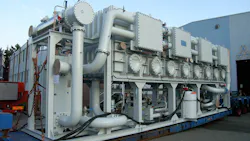
Offshore vessels and production facilities operate at sea for extended periods without access to shore-based water or waste infrastructure. Therefore, potable water production, wastewater treatment, oily bilge water management and solid waste handling must be managed safely and efficiently onboard while meeting stringent environmental regulations. Effective water and waste management underpins operational continuity, crew health and welfare, environmental protection and the long-term performance of offshore assets.
Efficient water and waste systems can also reduce operating costs, support sustainability goals and minimize environmental impacts throughout an asset's lifecycle.
What does offshore water and waste management include?
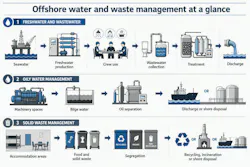
Water and waste management covers several different onboard waste streams and utility systems, each requiring specialist treatment:
-
Potable water, produced and treated onboard for safe consumption;
-
Wastewater, including blackwater and greywater, requiring treatment before discharge;
-
Bilge water and sludge, containing oil and other contaminants that require specialized treatment and disposal; and
-
Food and solid waste, managed in accordance with environmental regulations.
Modern offshore vessels increasingly integrate these systems into a coordinated environmental management approach.
Why is offshore different?
Offshore assets may operate for years without access to shore-based infrastructure or waste reception facilities. Water and waste systems must therefore be designed to accommodate limited space and weight, variable personnel onboard (POB), vessel motion and changing sea conditions, restricted maintenance access, the high cost of unplanned downtime, and reliable operation in remote locations.
What challenges do operators face?
Offshore water and waste systems must operate reliably in demanding marine environments while occupying limited space onboard. Operators must balance environmental compliance, operational efficiency and crew welfare while managing multiple waste streams far from shore-based support.
Common challenges include:
- Limited space and weight allowances for equipment;
- Corrosion, fouling and scaling caused by seawater and marine conditions;
- Variable POB that affect water consumption and wastewater loads;
- Restricted maintenance opportunities in remote locations;
- Stringent discharge regulations and reporting requirements; and
- The need to minimize energy consumption while maintaining system performance.
These challenges drive the development of compact, automated and highly reliable treatment systems designed specifically for offshore service.
How do offshore water and waste systems work?
Freshwater production: Reverse osmosis or thermal evaporation systems produce potable water onboard for accommodation, galleys, medical facilities and other domestic services, reducing reliance on shore-based supplies.
Wastewater treatment: Blackwater and graywater are collected and treated using biological processes, membrane filtration and disinfection to meet discharge standards.
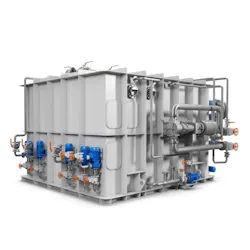
Oily water treatment: Bilge water is processed through oily water separators and oil content monitors before discharge, with recovered oil retained onboard for disposal ashore.
Sludge and solid waste management: Sludge is dewatered or dried, while food and solid waste is segregated, compacted, recycled or incinerated to reduce volume before disposal ashore.
What regulations apply?
Offshore operators must comply with international, flag state and regional environmental regulations. The principal international framework is MARPOL, with Annex I for oil pollution, including oily bilge water, Annex IV for sewage and Annex V for garbage.
Additional regional and national requirements may also apply, including those under the OSPAR Convention (North Sea), US environmental regulations, and national legislation in countries such as Brazil and Indonesia.
As offshore developments expand into more environmentally sensitive areas, operators increasingly specify systems capable of meeting the most stringent applicable discharge standards.
Compliance is increasingly verified through automated monitoring, digital recordkeeping and reporting systems that provide operators and regulators with greater transparency over onboard environmental performance.
Did you know?
Offshore assets cannot simply discharge untreated sewage, oily water or garbage overboard. International regulations prescribe how different waste streams must be treated, stored and disposed of before discharge or transfer ashore.
How are water and waste systems integrated onboard?
Water and waste systems integrate with electrical power, vessel automation, tank monitoring, alarm systems, planned maintenance and digital reporting platforms. Remote monitoring, condition-based maintenance and automation help reduce crew workload, identify performance issues early and support regulatory compliance.
How do water and waste systems operate on an FPSO?
These facilities may remain on station for decades, producing freshwater, treating wastewater, managing oily residues and handling solid waste continuously while supporting large crews. With limited maintenance opportunities, system reliability is critical to maintaining accommodation services, environmental compliance and uninterrupted operations.
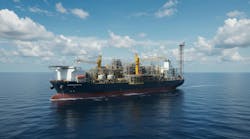 AI-generated FPSO image
What trends are shaping the future?
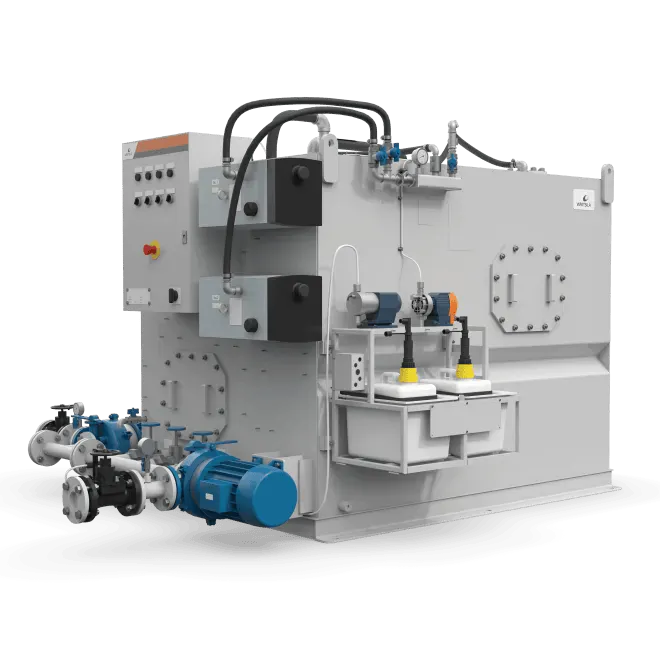
Several developments are reshaping offshore water and waste management systems as operators seek to improve efficiency, environmental performance and long-term reliability.
Smaller, more compact systems: Space and weight remain at a premium on offshore vessels and production facilities. As a result, manufacturers are developing more compact treatment technologies that reduce equipment footprints, simplify installation and lower construction costs without compromising performance.
Smarter, more connected systems: Automation, remote diagnostics and condition-based maintenance are becoming standard features of modern water and waste management systems. Digital monitoring and reporting platforms help operators identify performance issues earlier, reduce crew workload and support environmental compliance through improved data collection and documentation.
More sustainable operations: Growing emphasis on environmental stewardship is driving adoption of advanced membrane technologies, improved treatment processes and more energy-efficient equipment. Operators are also exploring water reuse opportunities to reduce freshwater demand and minimize wastewater discharge while maintaining safe and reliable operations.
Designed for the full asset lifecycle: System designs are increasingly focused on long-term operability, with easier maintenance, modular upgrades and lifecycle management considerations incorporated from the outset. These approaches can help extend equipment life, improve reliability and reduce total ownership costs over decades of offshore service.
 offshore oil and gas operations
Key takeaways
Offshore water and waste management is a critical onboard utility that enables offshore assets to operate safely, efficiently and responsibly over long periods.
-
Offshore assets must function as self-contained water production and waste management hubs while operating far from shore-based infrastructure.
-
Water and waste systems support environmental compliance, operational continuity and crew welfare.
-
Compact design, automation, reliability and long service life are essential where space, maintenance opportunities and uptime are constrained.
-
International regulations provide the framework for compliance, with additional regional requirements in some operating areas.
-
Digital monitoring, advanced treatment technologies and system integration continue to improve efficiency and environmental performance.
-
As offshore operations evolve, effective water and waste management will remain central to offshore asset performance and environmental stewardship.
Seeking additional resources on this topic?
Check out these explainer articles from our sister publications:
What is Wastewater? | Wastewater Digest
Offshore's "What Is...?" series
Young professionals in the offshore energy industry often encounter technical terms and acronyms that seasoned subject matter experts (SMEs) know by heart—but aren’t always clear to the next generation. Offshore’s new “What Is…?” educational series aims to bridge that gap by providing concise, practical explainers for emerging professionals and newcomers to the industry.
Some of the most-searched topics we've already covered include:
- What is an FPSO?
- What is a dynamic positioning (DP) system?
- What is an SOV?
- What is directional drilling?
- What is CCS?
- What is floating wind?
- What is an offshore substation (OSS)?
- What is a digital twin?
- What is the deepwater oil and gas field development life-cycle?
- What is subsea electrification?
- What is a mooring system?
If there’s an offshore energy subject you’d like to highlight in a brief explainer article (600-1,000 words), reach out to Chief Editor Ariana Hurtado at [email protected] for more information.
About the Author
 Fraser Scott
Fraser Scott
Fraser Scott is CEO of Hamworthy, a specialist provider of marine water and waste treatment systems. He has more than 20 years of experience in the marine and energy sectors and has held senior leadership roles focused on environmental technologies, operational excellence and regulatory compliance.
Related
