What is an offshore substation (OSS)?
Key highlights:
- Offshore substations (OSS) serve as electrical hubs, aggregating power from multiple turbines and transforming voltage levels for efficient transmission.
- Modern OSS platforms are supporting more than 1 GW of capacity, with larger transformers and advanced automation features.
- Installation involves heavy-lift vessels and complex logistics, with challenges posed by marine environment conditions and high costs.
Editor’s note: Welcome to Offshore’s new educational “What Is…?” series. If you’re interested in contributing your insights and sharing industry knowledge with the next generation of offshore energy professionals, contact Chief Editor Ariana Hurtado at [email protected] for more information.
By Hélia Briaud, Spinergie
As offshore wind farms become larger and move farther from shore, offshore substations are becoming increasingly critical to the development of the sector. These electrical hubs play a central role in collecting, transforming and transmitting electricity generated offshore to onshore grids.
This article explains offshore substations in offshore wind: their function, main components, engineering constraints, and how they are evolving alongside the rapid growth of offshore wind.
What is an offshore substation?
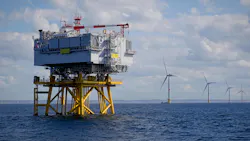
An offshore substation (OSS) is an electrical installation located at sea that gathers electricity produced by offshore wind turbines before transmitting it to shore.
The OSS acts as the central hub of the wind farm. Electricity generated by multiple turbines travels through inter-array cables to the substation, where power is aggregated, voltage is increased and electricity is prepared for transmission to shore.
Most large offshore wind farms rely on at least one offshore substation. Smaller projects located close to shore can sometimes connect directly to land without offshore transformation, although this is becoming less common as projects grow in size and move farther offshore.
Why are offshore substations needed?
The main reason is transmission efficiency.
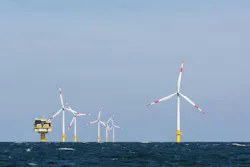
Offshore wind turbines typically generate electricity at medium voltage levels, usually between 33 kV and 66 kV. These voltages are suitable within the wind farm but inefficient for long-distance transmission because electrical losses increase over distance.
The offshore substation increases the voltage, often to 220 kV or higher, allowing electricity to be transmitted more efficiently to shore. In some cases, the OSS also converts alternating current (AC) into direct current (DC) before export to optimize long-distance power transmission and reduce electrical losses.
Offshore substations also reduce the number of export cables needed. Instead of connecting every turbine directly to shore, the OSS consolidates power flows into a smaller number of high-capacity export cables.
As offshore wind farms continue to scale, substations are evolving to handle larger amounts of electricity and longer transmission distances.
How does an offshore substation work?
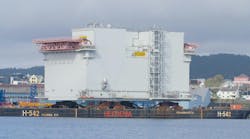
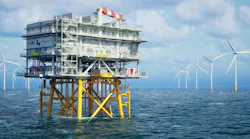
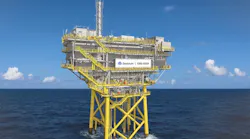
An offshore substation generally consists of two main parts: the topsides and the substructure.
The topside contains the electrical equipment such as transformers, switchgear, control systems, and in some cases HVDC converter equipment.
The substructure supports the topside above sea level, usually using a jacket or monopile foundation fixed to the seabed. Like offshore wind turbines, offshore substations require dedicated foundations capable of withstanding harsh marine conditions and heavy structural loads.
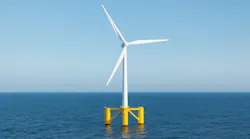
Today, commercial offshore substations are almost exclusively fixed-bottom structures, including those used in most floating offshore wind projects.
 floating offshore wind
What's the difference between HVAC and HVDC offshore substations?
Two main technologies are used to transmit offshore wind power:
- High-voltage alternating current (HVAC)
- High-voltage direct current (HVDC)
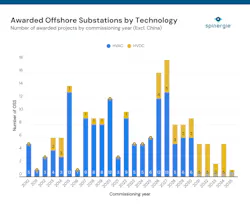
HVAC systems are the most common solution for projects located relatively close to shore.
In this configuration, the OSS increases the voltage and exports electricity through AC export cables.
For large offshore wind farms located far from shore, HVDC systems become more efficient than HVAC by reducing transmission losses over long distances.
In this configuration, the offshore substation includes converter equipment that transforms AC power into DC before export. An onshore converter station then converts the electricity back into AC for integration into the grid.
HVDC significantly reduces transmission losses but requires larger, heavier and more expensive infrastructures.
How are offshore substations evolving?
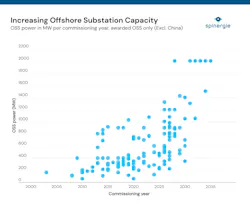
Offshore substations are becoming larger and more powerful as offshore wind farms grow in size and move farther offshore.
Early offshore projects used relatively small HVAC substations for nearshore developments. Today, modern OSS platforms can support more than 1 GW of transmission capacity.
This evolution is driving several trends:
- larger transformers and higher-voltage systems;
- heavier and more complex topsides;
- increased use of HVDC technology;
- more automation and digital monitoring systems; and
- research into future floating substations.
Modern designs are also evolving from open-deck layouts toward enclosed structures that better protect electrical equipment from harsh marine conditions.
What are the main installation and logistics steps?
Offshore substations are among the heaviest structures installed in offshore wind farms.
Installation generally involves two main steps:
- Installation of the foundation using heavy-lift vessels and piling equipment; and
- Transport and lifting of the topside onto the offshore structure.
Large HVDC substations can weigh several thousand tonnes, with some modern topsides exceeding 20,000 tonnes. Installation operations are therefore particularly complex and highly dependent on vessel availability and weather conditions.
 offshore wind market update
What are the main challenges?
- Harsh offshore conditions: Offshore substations operate in demanding marine environments exposed to waves, wind, corrosion, salt and humidity.
- Weight and size: Electrical equipment, such as transformers and converters, is extremely heavy, leading to very large offshore structures and challenging installation campaigns.
- High costs: OSS platforms represent a significant share of offshore wind farm investment costs, especially for HVDC projects.
- Maintenance: Access offshore depends heavily on weather conditions and often requires specialized vessels or helicopters.
 offshore charging
What is the outlook for offshore substations?
Offshore substations will remain essential to the growth of offshore wind.
As projects become larger and move farther offshore, demand for both HVAC and HVDC substations is expected to increase significantly.
Future developments may also include floating or subsea substations for floating wind farms and interconnected offshore power grids linking multiple wind farms and countries together.
As offshore wind projects continue to industrialize, offshore substations are evolving from simple transmission hubs into critical elements of future offshore power networks.
Latest OSS news:
 East Anglia 2 OSS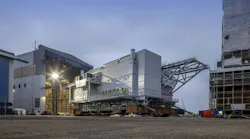
 offshore wind farm sunset
 offshore wind
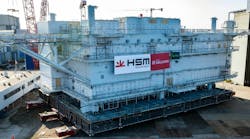 HSM Offshore Energy Rolls Out Jasmund Offshore High-voltage Substation
Offshore's "What Is...?" series
Young professionals in the offshore energy industry often encounter technical terms and acronyms that seasoned subject matter experts (SMEs) know by heart—but aren’t always clear to the next generation. Offshore’s new “What Is…?” educational series aims to bridge that gap by providing concise, practical explainers for emerging professionals.
Some of the most-searched topics include:
- What is an FPSO?
- What is a dynamic positioning (DP) system?
- What is an SOV?
- What is directional drilling?
- What is CCS?
- What is floating wind?
- What is an offshore substation (OSS)?
- What is a subsea production system?
- What is a blowout preventer (BOP)?
- What is a subsea tree (christmas tree)?
- What is an offshore riser system?
- What is a jackup rig?
- What is a subsea tieback?
If there’s an offshore energy subject you’d like to highlight in a brief explainer article (600-1,200 words), reach out to Chief Editor Ariana Hurtado at [email protected] for more information.
About the Author
 Hélia Briaud
Hélia Briaud
Hélia Briaud is an offshore analyst at Spinergie, specializing in data analytics and market intelligence for the subsea power cable industry. She brings field expertise from her experience as an officer in the French Navy and ongoing service as a reservist, combining operational insight with data-driven analysis. Her work focuses on supply-demand modeling, predictive forecasting and cable repair analysis to support offshore energy stakeholders in their strategic decisions.