What offshore trials reveal about charging electric CTVs and SOVs
Key highlights:
- Offshore challenges include safe charging in high sea states, vessel stability and emergency disconnect capabilities.
- Trials showed successful, rapid connection times of under three minutes in demanding sea conditions, with no operational delays or reliability issues during repeated testing cycles.
- Environmental data indicates daily fuel savings of nearly 2 tonnes for CTVs and over 4.5 tonnes for larger SOVs, translating into substantial CO2 emission reductions and operational cost savings annually.
- Designing offshore assets to be "charger ready" from the outset simplifies installation, reduces costs and avoids complex retrofits.
In this exclusive Q&A with Offshore, Dimitri de Gunzbourg, CTO at Charge Offshore (by MJR Power & Automation), outlines the operational, regulatory and technical hurdles shaping the electrification of offshore crew transfer and service vessels.
He discusses the safety-critical nature of offshore charging, the importance of reliable connections in challenging sea states, and the role of automated systems, motion compensation and early infrastructure planning. Recent offshore trials, he notes, demonstrate fast, repeatable connection times and robust system performance, even in dynamic marine conditions.
Offshore: From an operations standpoint, what specific technical or environmental conditions offshore present the greatest challenges for electric CTVs and SOVs, and how are operators addressing those constraints?
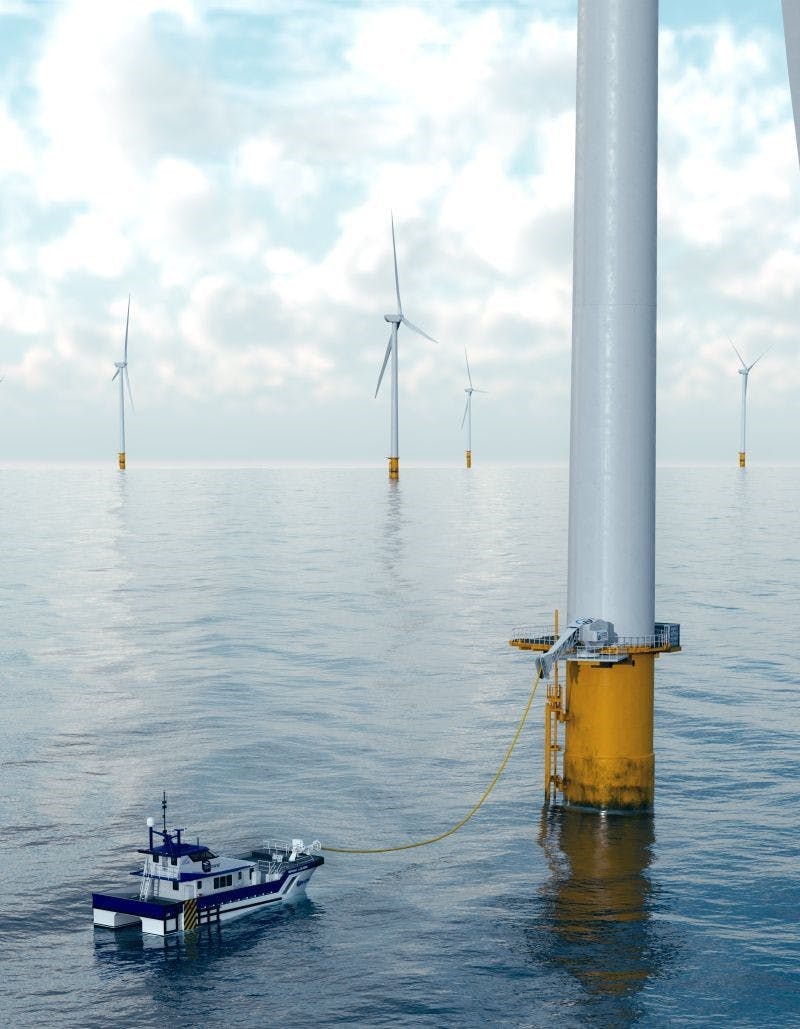
de Gunzbourg: Operating offshore presents several challenges for electric CTVs and SOVs, particularly when it comes to charging safely in a dynamic marine environment. One key requirement is the ability to connect and charge in sea states that may exceed the conditions typically required for personnel transfer or cargo handling.
Safety is paramount throughout the charging process. Crew must not be exposed to moving mechanical components or high voltages, and vessels must be able to disengage from the charging system instantly in the event of an emergency, regardless of weather conditions.
Another challenge is maintaining a safe vessel position relative to the offshore asset. Vessels must remain downwind to minimize the risk of collision in the unlikely event of a blackout, while still being able to charge effectively despite changing tides and wind directions.
To address these issues, charging systems incorporate multiple layers of both automated and manual release mechanisms that remain functional even during a full power loss. Advanced motion and load-control design features also help maintain stable connections. Crucially, the entire process should be operable from the vessel bridge, enabling fully unmanned connection and charging from start to finish, ensuring the highest possible safety standards.
Offshore: What have offshore trials revealed about charging reliability, connection performance and vessel turnaround times in varying sea states and weather conditions?
de Gunzbourg: During offshore trials, connections were successfully completed in sea states of up to 1 m significant wave height (Hs), which represented the most demanding conditions encountered during the testing period.
Once the vessel approached the connection point beneath the offshore asset, the vessel master was able to establish the connection and move into the charging position consistently within 3 minutes. This demonstrated that the system can deliver quick, repeatable connections without introducing operational delays.
Offshore: Were there any unexpected engineering or environmental challenges encountered during offshore testing, and how were they addressed?
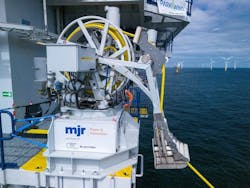
de Gunzbourg: One issue identified during testing related to the connector ejection procedure. Initially, there was a risk that the connector could swing after release and potentially make contact with the offshore structure.
To address this, the procedure was modified so that the connector is ejected away from the structure, allowing it to enter the water where the movement is naturally dampened. Because the connector is designed with subsea-rated protection (IP-rated for underwater use), it can then be retrieved and reconnected immediately without any need for cleaning, inspection or maintenance.
Offshore: What performance metrics have been recorded during Charge Offshore's offshore energy-related field trials, and how do those results compare with pre‑deployment modeling or expectations?
de Gunzbourg: Extensive testing was carried out, including repeated connection cycles, charging operations, and both normal and emergency disconnections. These were performed consecutively with no limitations observed in turnaround time or connection reliability.
During the trials, the system charged a smaller battery bank installed on the test vessel, as fully electric CTVs were not yet in operation at the time. The first such vessel is now being commissioned by Tidal Transit, expected to enter service in June 2026, with several additional electric vessels currently under development.
In December 2025, we also delivered a fully tested commercial charging unit capable of supplying up to 2 MW to support Tidal Transit’s electric fleet. Workshop testing was carried out at the system’s maximum power transfer capacity to assess duty cycle limits.
This confirmed a current capability of approximately four consecutive hours of charging operation at maximum output, which comfortably exceeds the 1.5 hours of maximum charging time typically required for a CTV.
Offshore: Can you share any quantifiable outcomes from offshore wind field trials?
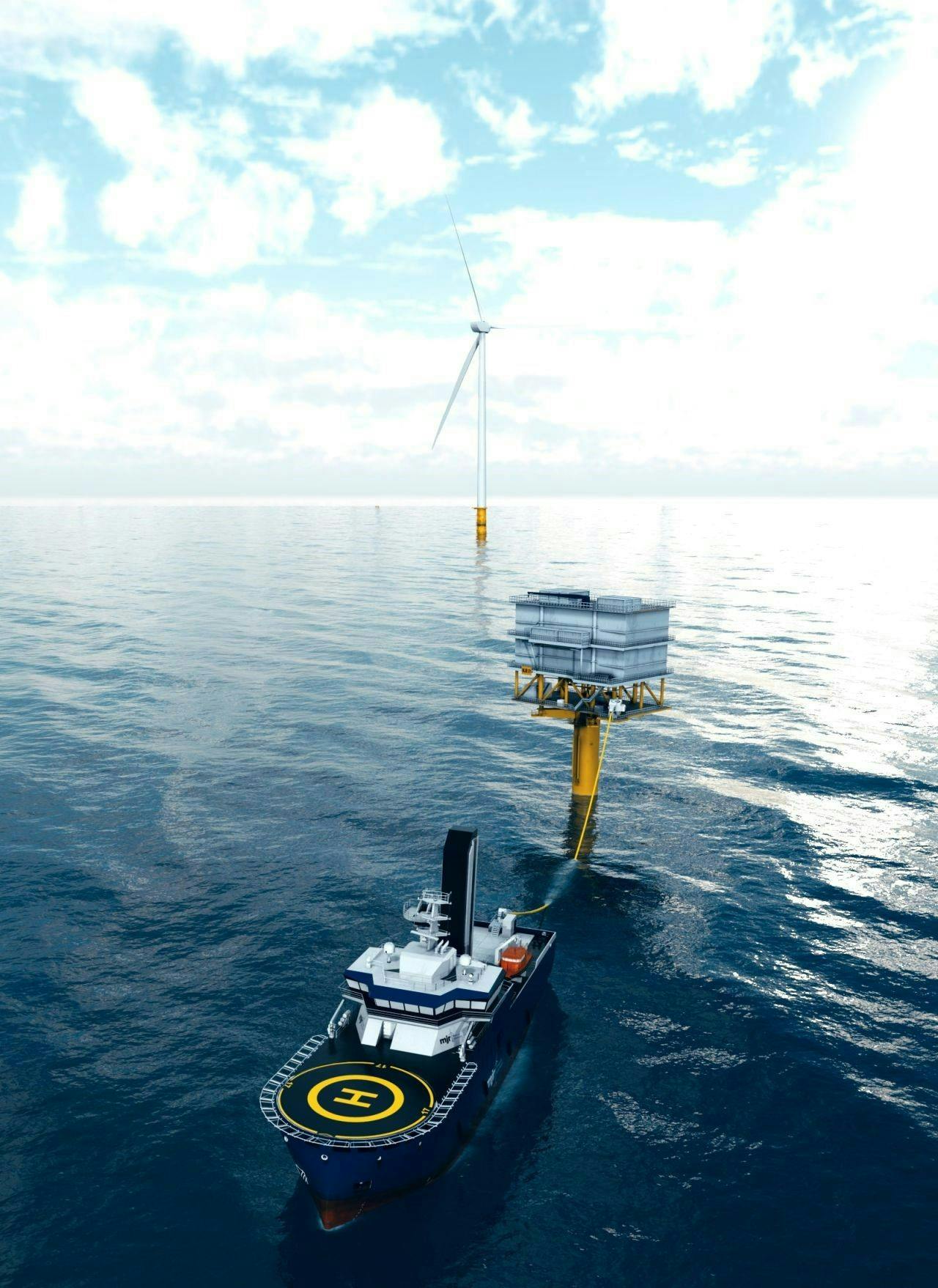
de Gunzbourg: For electric CTVs, around 1.9 tonnes of marine fuel can be saved per operational day, reducing emissions by approximately 6 tonnes of CO2 equivalent. This represents roughly £650 [US$870] in daily energy cost savings, equating to approximately £163,000 [US$218,224] per year. It’s worth noting that the European Emissions Trading Scheme (ETS) is not currently applied to CTVs.
For larger electric SOVs, daily savings increase to around 4.5 tonnes of fuel, equating to 14.5 tonnes of CO2 equivalent emissions avoided each day. In energy cost terms, this represents around £2,800 [US$3,749] per day, or roughly £900,000 [US$1.2 million] per year in operational savings. SOVs over 5,000 gross tonnes are expected to fall within ETS regulations, which further strengthens the economic case for electrification.
Offshore: How do foundation type, turbine layout and offshore substation configuration influence the feasibility and design of offshore charging infrastructure within a wind farm?
de Gunzbourg: A key consideration is ensuring that offshore assets are designed to be 'charger ready' from the outset. This means considering charging infrastructure during the initial design phase of turbines, substations or other offshore structures.
In practice, this involves incorporating the charger’s loading parameters into the structural design. These loads are typically negligible compared to the overall weight of the turbine or platform, but accounting for them early makes integration straightforward.
Developers can also include simple mounting interfaces that allow charging systems to be installed quickly when required, along with a protected high-voltage inter-array power feed that will supply the charger.
Planning for these elements early significantly simplifies later installation and avoids costly retrofits.
Offshore: What engineering lessons have emerged around grid stability, load management or power‑quality issues when vessels draw energy directly from offshore assets?
de Gunzbourg: The power required for vessel charging is relatively small compared to the overall output of a wind farm. Even the largest electric SOVs require around 6 MW, while CTVs typically draw up to 2 MW. By comparison, a modern offshore wind farm typically produces 1-1.5 GW, meaning the charging load is negligible in system terms.
During the offshore trials, the charging system was installed and connected at a live wind farm without any interruption to production. Electrical design verification was carried out by the charger supplier, the wind farm operator and independent third parties to ensure that faults in any one component (vessel, charger or asset) cannot propagate to the others.
This ensures that grid stability and power quality remain within acceptable limits at all times.
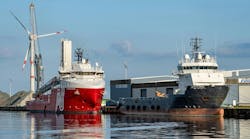 Service operation vessel (SOV)
Offshore: From a life-cycle perspective, how should offshore wind developers evaluate the long-term cost-benefit trade-offs of building wind farms “charger-ready” from the outset versus retrofitting electrification infrastructure later?
de Gunzbourg: Retrofitting charging systems onto offshore assets that were not designed with electrification in mind can be technically challenging and often uneconomic. In particular, it may limit the charging capacity that can be installed due to constraints around transformer sizing and electrical integration.
By contrast, designing assets to be charger ready during the initial development stage is relatively simple and low cost, and it does not introduce operational constraints. Several detailed FEED studies conducted with major developers have confirmed the practicality of this approach, with strong support from offshore substation design teams.
Exclusive content:
 Indeximate cloud-based cable condition monitoring
 Export cable-laying vessel
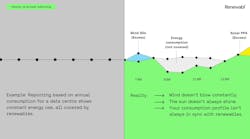 Annual vs hourly reporting visualization
About the Author
 Ariana Hurtado
Ariana Hurtado
Editor-in-Chief
With more than a decade of copy editing, project management and journalism experience, Ariana Hurtado is a seasoned managing editor born and raised in the energy capital of the world—Houston, Texas. She currently serves as editor-in-chief of Offshore, overseeing the editorial team, its content and the brand's growth from a digital perspective.
Utilizing her editorial expertise, she manages digital media for the Offshore team. She also helps create and oversee new special industry reports and revolutionizes existing supplements, while also contributing content to Offshore's magazine, newsletters and website as a copy editor and writer.
Prior to her current role, she served as Offshore's editor and director of special reports from April 2022 to December 2024. Before joining Offshore, she served as senior managing editor of publications with Hart Energy. Prior to her nearly nine years with Hart, she worked on the copy desk as a news editor at the Houston Chronicle.
She graduated magna cum laude with a bachelor's degree in journalism from the University of Houston.