The US Gulf's latest production gains face a tougher test beyond 2030
Key highlights:
-
US Gulf production surged in 2025, but longer-term risks remain.
-
Fewer floaters are reshaping the Gulf’s growth outlook, and its investment cycles are slowing as tiebacks take center stage.
- Declining discoveries challenge the Gulf’s long-term outlook, but new finds offer hope.
-
Seismic advances and leasing are reviving optimism for the US Gulf.

By Thomas Liles, Rystad Energy
The Gulf of America (GoA) experienced a standout 2025.
Oil and three-stream production both increased by an estimated 7% year over year, driven by the startup of three new floater-based projects (Whale, Shenandoah and Salamanca) and five subsea tiebacks. Together, these developments are expected to achieve aggregate peak annual production rates of 370,000 boe/d by the late 2020s, representing the most consequential vintage of startups since 2009 and helping maintain the region’s oil production at or above 2 MMbbl/d toward the end of the decade.
New projects deliver a banner production year
Still, other trends raise questions around the GoA’s resilience as a deepwater global oil province beyond 2030.

On the exploration front, the region has witnessed a long-term decline in discovered resources, reflecting broader trends in global conventional discoveries on display since 2010.
To be sure, 2025 saw a slight rebound with an estimated 150 MMboe in discovered resources, up 32% from 2024 and driven by the bp-operated Far South and Talos-operated Daenerys finds.
Year to-date announcements also suggest some upside for 2026, with Oxy, Chevron and Woodside waxing bullish on the recent completion of the Bandit well in Green Canyon and Murphy confirming smaller discoveries at Banjo and Cello in January.
However, the rolling five-year average in discovered volumes has continued to trend downward, and the GoA will require a higher sustained level of new resource finds to achieve a full reversal in this trend.

Exploration results improve, but discovery trends remain weak
Meanwhile, the lack of new discoveries and the timing of investment cycles have led to a limited pipeline of new capacity additions.
In terms of floater projects, the GoA is coming off an eight-year investment run that saw positive final investment decisions (FIDs) for seven floating production units (FPUs) with combined nameplate capacity of nearly 800,000 boe/d. Another three FPUs—Sparta, Kaskida, and Tiber—were sanctioned from 2023 to 2025 with annual sequential startups from 2028 to 2030. However, the combined capacity of these FPUs stands at only 270,000 boe/d, representing the lowest figure among floater FID cycles in recent memory.
Accordingly, end-of-decade FPU commissioning will be geared toward decline mitigation rather than outright production growth.
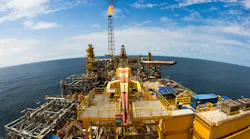
 Shell's Appomattox platform in the Gulf of Mexico
There are few pre-FID FPU opportunities remaining after bp’s sanctioning of Tiber-Guadalupe in September 2025.
The Blacktip Field in Alaminos Canyon has been considered as a potential FPU development since its discovery by Shell in 2019, although there is some uncertainty around the project’s resources potential. Shell sold Blacktip to private operator LLOG in 2023, which appears to have relinquished Blacktip in December 2025, according to regulatory filings.
 Top 5 projects to watch -- operators advance field development plans
Fewer floaters push development focus toward tiebacks
The dearth of new FPU candidates signals a likely pullback in sanctioned greenfield spending over the next few years, with subsea tiebacks and secondary recovery projects taking the lead. The Who Dat East and Tiberius Phase 1 tiebacks are the most prominent FID candidates for 2026, while the smaller Longclaw single-well development has effectively been sanctioned in light of positive operator communication and regulatory filings.
While the total amount of sanctioned development spending is not expected to exceed $1 billion this year, the 2027-2028 timeframe could bring more bullish FID activity as bp progresses waterflood activities at Mad Dog and tiebacks such as Gettysburg West and Ocotillo are matured.

With conflict raging in the Middle East, it is worth considering the contours of a hypothetical accelerated FID outlook for tieback projects. If all tiebacks with higher assessed near-term potential received a positive FID today with development schedules following the latest median FID-to-startup cycle times, Rystad Energy estimates that associated upside would likely emerge from the second half of 2027.
Under this scenario, production from accelerated tiebacks could peak at an estimated 400,000 boe/d in 2029 to 2030. Incremental volumes above Rystad's current base case could increase to approximately 200,000 boe/d in 2028 and 285,000 boe/d in 2029, before falling back toward the 200,000-boe/d mark in 2030 and less than 100,000 boe/d in 2031.

Leasing momentum and new seismic revive long‑term upside
Limited FID potential notwithstanding, early-stage green shoots may be emerging elsewhere.
To this end, the first GoA lease sales in two years – BBG1 and BBG2 – were held in December 2025 and March 2026, respectively, together generating nearly $350 million in high bids. While total bids fell compared to Lease Sale 261, per-acre figures climbed in both rounds, with BBG1 attracting 30 contested bids and BBG2 featuring several rare five-way contests.
From a company perspective, bp dominated BBG1 with aggregate bids exceeding $60 million across 51 blocks, while Chevron clocked in second and clinched the priciest bid in Keathley Canyon Block 25 for $18.6 million. In BBG2, four contiguous blocks in western Green Canyon generated 70% of total high bids, with bp’s $21-million bid on GC404 taking first place.
A closer look at the majors, which have historically accounted for between 50% and 80% of GoA deepwater high bids, reveals some early-stage potential for new standalone hubs. For context, infrastructure-led exploration (ILX) opportunities accounted for nearly 30 of the 100 high bids submitted by the majors in BBG1, although Rystad Energy analysis indicates that frontier-lite exploration ambitions could likewise be top of mind. To this end, potential frontier blocks accounted for over half of absolute high bids submitted by the majors, suggesting up to 10 new standalone hubs in a bullish discovery scenario.
Paleogene prospectivity stood out especially, accounting for more than 60% of frontier-oriented high bid blocks and raising the prospect of new hubs across Walker Ridge, Keathley Canyon, Garden Banks and East Breaks, should large discoveries materialize.
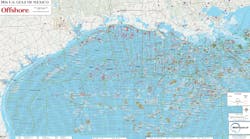 Gulf of Mexico map 2026
Perhaps the most exciting story going forward is what remains unseen in the US Gulf, at least up until very recently. In this respect, the spread of ocean-bottom node (OBN) seismic across the region has been nothing short of miraculous, with multi-client surveys ballooning from less than 1 million acres covered annually from 2019 to 2022 to more than 6 million acres in 2025.
With the recent launch of TGS’ APEX 1 survey in East Breaks and Alaminos Canyon and Engagement 9 (TGS and SLB) in Walker Ridge, cumulative coverage has increased to nearly 17 million acres, helping operators obtain a more accurate picture of subsurface conditions under thick salt canopies.
Improved subsurface imaging, in conjunction with a return to more regular leasing schedules, may yet entail more upside and keep the US Gulf in the game beyond 2030, but large new discoveries with reasonable cycle times will need to emerge to turn this possibility into reality.
This article is part of Offshore's 2026 Gulf of Mexico Regional Report.
About the Author
 Thomas Liles
Thomas Liles
Thomas Liles is a senior vice president of Upstream Research at Rystad Energy, an independent research and business intelligence company headquartered in Oslo, Norway. Liles has more than a decade of experience in oil and gas analysis spanning the global upstream space and currently heads research and product development for the US deepwater space as part of Rystad’s flagship Upstream Solution. He regularly publishes and advises clients on production forecasting, upstream asset valuation, E&P corporate strategy, and North America energy policy dynamics.