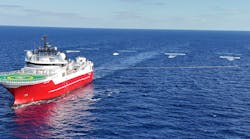
TGS deploys denser node grid for US Gulf OBN survey
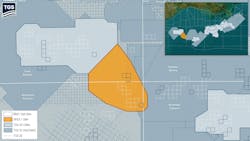
TGS is acquiring a multi-client long-offset ocean-bottom node (OBN) survey in the US Gulf of Mexico.
The APEX 1 project, which started last month, should be completed in late June, with early processing results expected this summer.
It involves a standalone deployment of a denser node grid, using the company’s Gemini enhanced frequency source, without dependence on underlying streamer seismic coverage, and Dynamic Matching FWI (DM-FWI).
By combining dense node spacing, ultra-long offsets and advanced imaging workflows, TGS expects to deliver improved subsurface resolution, velocity accuracy, and overall confidence for exploration and appraisal in the area covered.
The approach could be extended to other offshore basins globally, the company added.