ROG.e 2026: TechnipFMC executive reflects on 15 years of Brazil presalt development
Key highlights:
-
Brazil's presalt development underscored the importance of standardization, integrated project execution and local industrial capability.
-
Subsea processing and CO2 separation technologies are emerging as practical tools for reducing emissions intensity in deepwater developments.
-
Competitiveness, supply chain readiness and technology innovation will be critical to sustaining Brazil's offshore growth over the next decade.
Brazil's presalt fields have become one of the offshore industry's most significant deepwater success stories. During ROG.e 2026, Offshore interviewed Leonardo Ribeiro, TechnipFMC's commercial senior director, about lessons learned from Brazil's presalt development, opportunities to reduce emissions from offshore operations and the factors likely to shape the country's next phase of offshore growth.
Offshore: Brazil's presalt developments continue to mature more than 15 years after the first major discoveries. What are the most significant technical and operational lessons the offshore industry has learned during that period?

Ribeiro: One of the most important lessons is that scale and complexity can only be managed through continuous innovation and close collaboration across the value chain. The Brazilian presalt challenged the industry with ultradeepwater environments, high pressures, high CO2 concentrations and increasingly demanding production targets.
Over the past 15 years, the industry has learned the value of standardization, industrialization and integrated execution models that reduce interfaces and improve delivery certainty. We have also seen that local engineering, manufacturing capacity and long-term investment in technology are critical to sustaining large-scale offshore development.
For companies like TechnipFMC, which has operated in Brazil for 70 years, the growth of the presalt reinforced the importance of building capabilities close to the market. Large-scale projects and long-term demand have supported sustained investments in local manufacturing, engineering expertise, workforce development and technology qualifications. More than a decade ago, major subsea awards helped accelerate this industrial development, creating capabilities that continue to support offshore projects today.
As a result, Brazil has become not only one of the world's leading offshore producing regions, but also a global center for the development, manufacturing and deployment of advanced subsea technologies. The experience gained here is shaping solutions that can be applied in offshore basins around the world.
Offshore: As operators work to reduce emissions from offshore activities, what practical opportunities do you see for lowering the carbon intensity of deepwater field developments without compromising reliability or production performance?
Ribeiro: The most effective solutions are those that improve both operational and environmental performance. The industry is increasingly adopting technologies that reduce emissions intensity while helping operators maximize production efficiency and asset utilization.
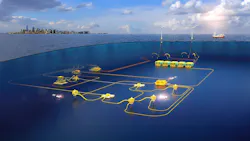
One example is the subsea processing solution being deployed on Petrobras' Mero 3 project. Through our partnership with Petrobras, we are helping execute a pioneering decarbonization initiative that will enable subsea separation and reinjection of CO2-rich streams, illustrating how innovation can simultaneously support emissions reduction, production efficiency and asset performance.
More broadly, we see significant potential in subsea solutions that enable more processing to occur on the seabed, reducing topside constraints and allowing operators to manage increasingly complex production streams more efficiently. By moving part of the separation and reinjection process subsea, these technologies can help reduce emissions intensity while increasing production efficiency and improving overall asset utilization.
Beyond specific technologies, integrated project designs, equipment standardization and life-cycle optimization can all contribute to lowering carbon intensity while maintaining the reliability and production performance that offshore developments require.
Offshore: Brazil continues to attract significant offshore investment and exploration activity. What factors do you believe will have the greatest influence on offshore project development in the country over the next decade?
Ribeiro: Brazil is home to some of the world's most promising offshore resources, including the prolific presalt basins, which continue to attract significant long-term investment and exploration activity. What has enabled this potential to be realized over the years is the combination of technological innovation, engineering expertise, industrial capability and strong collaboration across the industry.
Looking ahead, the most important factors will be the industry's ability to maintain competitiveness, accelerate project execution and continue developing technologies that address increasingly complex offshore challenges.
A stable investment environment, local industrial capability, workforce development, innovation and supply chain readiness will all be critical. We believe Brazil is uniquely positioned to remain one of the world's most important offshore markets, not only because of its resource potential, but because of the ecosystem of companies, people and technologies that has been built over decades of offshore development.
ROG.e 2026:
Offshore is an official media partner of ROG.e 2026 (formerly Rio Oil & Gas), taking place Sept. 21-24 in Rio de Janeiro, Brazil.
TechnipFMC is one of the sponsors of ROG.e 2026. For more information on the topics addressed in this article, visit the company at Pavilion 3, booth M14.
Related content:
ROG.e 2026: ABS sees larger, more complex FPSOs reshaping Brazil's offshore future
ROG.e 2026: MODEC executives discuss AI, FPSO decarbonization and project delivery challenges
ROG.e 2026: TGS CEO discusses the prospects and challenges facing Brazil's frontier basins
ROG.e 2026: Remote subsea inspections move from pilot projects to operational reality
ROG.e 2026: Subsea infrastructure enters new growth phase, says JDR Deputy CEO
ROG.e 2026: CoreMarine CEO says execution is becoming Brazil's next offshore challenge
About the Author
 Ariana Hurtado
Ariana Hurtado
Editor-in-Chief
With more than a decade of copy editing, project management and journalism experience, Ariana Hurtado is a seasoned managing editor born and raised in the energy capital of the world—Houston, Texas. She currently serves as editor-in-chief of Offshore, overseeing the editorial team, its content and the brand's growth from a digital perspective.
Utilizing her editorial expertise, she manages digital media for the Offshore team. She also helps create and oversee new special industry reports and revolutionizes existing supplements, while also contributing content to Offshore's magazine, newsletters and website as a copy editor and writer.
Prior to her current role, she served as Offshore's editor and director of special reports from April 2022 to December 2024. Before joining Offshore, she served as senior managing editor of publications with Hart Energy. Prior to her nearly nine years with Hart, she worked on the copy desk as a news editor at the Houston Chronicle.
She graduated magna cum laude with a bachelor's degree in journalism from the University of Houston.