ROG.e 2026: TGS CEO discusses the prospects and challenges facing Brazil's frontier basins
Key highlights:
-
The Equatorial Margin combines large resource potential with improving subsurface understanding from modern seismic technologies.
-
TGS views Pelotas as a distinct frontier basin with similarities to Namibia but requiring drilling to confirm key petroleum system elements.
-
New well results and advanced 3D seismic are helping shift industry focus from petroleum system presence to commercial scale and repeatability.
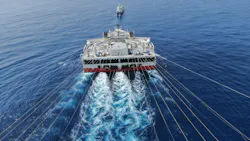
Some of the world's most closely watched offshore exploration opportunities are emerging off Brazil's coast.
In this exclusive pre-ROG.e 2026 interview, TGS CEO Kristian Johansen discusses how new seismic data and recent drilling results are shaping industry perspectives on the Equatorial Margin and Pelotas Basin.
Johansen will lead a "Strategic Talk" session at the conference on Sept. 22 about the growing importance of geoscience and subsurface intelligence in offshore exploration.
Offshore: Why is Brazil’s Equatorial Margin so compelling?

Johansen: The Equatorial Margin combines scale, multiple play types and growing evidence of working petroleum systems. Modern seismic is also giving explorers a much clearer view of deepwater reservoirs, sediment pathways and prospect risk. It remains a complex and varied region, but that combination of potential and improving subsurface understanding makes it one of the world’s most attractive frontier opportunities.
Offshore: How do the Equatorial Margin and Pelotas Basin differ?
Johansen: The Equatorial Margin is more mature, with greater well control and direct evidence of hydrocarbons in parts of the region. The focus is increasingly on identifying the best fairways and prospects.
Pelotas is earlier-stage and more dependent on geological analogies, particularly with Namibia. Our recent projects have revealed extensive channel systems, basin-floor fans, structural complexity and localized carbonate potential, but key petroleum system elements still require drilling confirmation.
Offshore: What should stakeholders understand about the Namibia comparison?
Johansen: Namibia is a useful calibration point, but Pelotas should not be viewed as a direct replica. The two margins share elements of their tectonic and depositional history, yet Pelotas has its own burial, sedimentation and magmatic evolution.
We also see Brazil's Equatorial Margin as more analogous to the Guyana-Suriname Basin, where large discoveries and production have demonstrated the potential of underexplored Atlantic margin systems. The prolonged regulatory deadlock in the Equatorial Margin likely delayed exploration activity that could have derisked parts of the basin much earlier. Modern seismic can now rank the remaining uncertainties more effectively, but drilling will ultimately determine commercial potential.
Offshore: Where has new subsurface intelligence changed industry understanding?
Johansen: The Morpho well in Foz do Amazonas is a strong recent example. The reported hydrocarbon-bearing interval provided direct evidence in an area previously assessed largely through seismic interpretation and regional analogy.
Combined with modern 3D data, the result shifts the focus from whether a petroleum system exists to how extensive, repeatable and commercially significant the play may be.
Offshore: What message will you share at the ROG.e Strategic Talk?
Johansen: My key message is that geoscience is investment infrastructure. High-quality seismic and integrated subsurface intelligence help companies decide where to invest, which risks to accept and where additional work is required.
They do not remove uncertainty, but they make it measurable and manageable—supporting better acreage selection, portfolio ranking, well placement and more responsible offshore development.
ROG.e 2026:
TGS will be sponsoring, presenting and exhibiting at the ROG.e 2026 conference next week (Sept. 21-24) in Rio de Janeiro, Brazil. In addition, CEO Kristian Johansen will participate in a Strategic Talk with EnerGeo Alliance on Tuesday, Sept. 22. For more information, visit TGS at booth Y52 in Pavilion 4.
About the Author
 Ariana Hurtado
Ariana Hurtado
Editor-in-Chief
With more than a decade of copy editing, project management and journalism experience, Ariana Hurtado is a seasoned managing editor born and raised in the energy capital of the world—Houston, Texas. She currently serves as editor-in-chief of Offshore, overseeing the editorial team, its content and the brand's growth from a digital perspective.
Utilizing her editorial expertise, she manages digital media for the Offshore team. She also helps create and oversee new special industry reports and revolutionizes existing supplements, while also contributing content to Offshore's magazine, newsletters and website as a copy editor and writer.
Prior to her current role, she served as Offshore's editor and director of special reports from April 2022 to December 2024. Before joining Offshore, she served as senior managing editor of publications with Hart Energy. Prior to her nearly nine years with Hart, she worked on the copy desk as a news editor at the Houston Chronicle.
She graduated magna cum laude with a bachelor's degree in journalism from the University of Houston.