ROG.e 2026: MODEC executives discuss AI, FPSO decarbonization and project delivery challenges
Key highlights:
-
AI, digital twins and predictive maintenance are improving FPSO reliability and uptime.
-
MODEC sees FPSO decarbonization as a combination of operational improvements, digital tools and lower-carbon technologies.
-
Future FPSO delivery models will depend on adaptability, life-cycle thinking and early project planning.
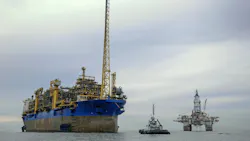
Demand for increasingly complex FPSOs continues to grow, but operators are also facing pressure to improve efficiency, reduce emissions and execute projects amid supply chain constraints.
In exclusive interviews with Offshore during ROG.e 2026, three MODEC executives discussed how digital technologies, decarbonization strategies and evolving project delivery models are shaping the future of floating production systems.
AI and digital twins move beyond pilot projects
Rei Yasumuro, global director of digital and analytics with MODEC Offshore Production Systems (Singapore), highlighted the Lighthouse predictive maintenance platform, which was built by MODEC spin-off Shape Digital.
"It monitors equipment health across our operating fleet using AI and analytics, and flags early signs of possible failure before it turns into an actual failure," he said.
Yasumuro said the Lighthouse platform has delivered up to a 25-fold return on investment, helped maintain fleet uptime above 98% and reduced downtime by more than 30%.
"Digital isn't a tool we bolt on to make things a bit more efficient. It's part of our culture," Yasumuro added. "Design and operations discipline still sets the foundation, but the digital layer is what's pushing performance further from there. Catching issues earlier, giving teams more lead time to act. That's the piece we're leaning into hardest, because it's where we see the most room to keep improving."
He also explained that digital twins now support turnaround planning, startup optimization and operational decision-making.
"Five years ago, digital twins were largely used as a visualization and training aid," he said. "Looking ahead, we want to push digital twins further upstream, so they inform design decisions earlier in a project, and further into operations, so they become a standing decision support tool for the life of the asset rather than a one-time exercise at startup."
Multiple pathways to FPSO decarbonization
Fernando Siqueira, technical director at MODEC Americas Operations, said that FPSO decarbonization will not be achieved through a single technology, but rather through a combination of operational improvements, digital tools, more efficient power generation and emerging low-carbon solutions.
"Rather than relying on a single technology, our approach is to combine operational efficiency, digitalization, more efficient power generation and new decarbonization technologies," he said.
He noted that many of the most immediate emissions reductions are coming from practical operational and engineering improvements on existing assets.
On FPSO Cidade de Angra dos Reis MV22, MODEC enhanced the carbon-capture system for fuel gas used in power-generation turbines and installed a more efficient flare tip. Together, the initiatives have the potential to avoid about 3,200 tonnes of CO2e emissions annually.
Siqueira also explained how existing and newbuild FPSOs require different strategies.
"The main difference is the degree of freedom you have to make changes," he added.
While newbuild FPSOs can incorporate emissions-reduction technologies during the design phase, existing units must accommodate constraints related to space, weight, safety and operational continuity.
On new-generation FPSOs, gas turbine combined cycle (GTCC) systems are already improving efficiency by recovering exhaust heat to generate additional power, a technology MODEC has deployed on FPSO Bacalhau.
Digitalization is also playing a growing role. MODEC's Shape Aura platform uses AI and machine learning to optimize operations and improve energy efficiency, while Shape Lumen is being tested to automatically classify flare events using data from more than 450 sensors.
Looking ahead, Siqueira said MODEC is evaluating technologies such as post-combustion carbon capture and solid oxide fuel cells (SOFC) through pilot projects designed to validate their performance under offshore conditions.
"In the near term, the opportunity is not necessarily to retrofit every available technology onto an existing FPSO," he said. "It is to understand each asset, use operational data to identify where the greatest gains are, and implement solutions that can deliver a positive impact over the asset's remaining operating life."
Designing and delivering the next generation of FPSOs
While digitalization and decarbonization are helping improve FPSO performance, delivering increasingly complex projects remains an industry challenge. Soichi Ide, MODEC's head of Floating Production Solutions, said the industry's focus is shifting toward adaptability, execution flexibility and life-cycle performance.
He believes the future of FPSOs is less about building bigger facilities and more about building smarter, more adaptable projects that can be delivered efficiently and operated successfully over decades.
"By the 2030s, I think the defining characteristic won't be size, it'll be adaptability," Ide said.
He also emphasized early engagement, life-cycle thinking and the integration of operational experience into both FPSO design and project execution.
Early planning is the best defense against project-delivery risks, according to Ide. While engineering resources, shipyard capacity and supply chain constraints remain challenges, he continued, early engagement before FID allows developers to identify bottlenecks and structure projects around them.
"What matters more than any single constraint is how early we're able to plan around it," Ide said.
Execution flexibility is also becoming increasingly important. MODEC uses approaches such as parallel hull construction at multiple shipyards, digital engineering tools and strategic supplier partnerships to reduce schedule risk and improve project delivery.
"Delivery resilience comes from early planning, execution flexibility, and the ability to carry knowledge and data from EPC into operations," he said.
Ide added that life-cycle thinking is reshaping FPSO design.
"We need to design to operate, not just design to build," he added.
Rather than designing solely for construction and startup, MODEC is designing assets with 20-plus years of operations in mind, incorporating considerations such as operability, reliability, maintenance and emissions performance from the outset.
ROG.e 2026:
Offshore is an official media partner of ROG.e 2026 (formerly Rio Oil & Gas), taking place Sept. 21-24 in Rio de Janeiro, Brazil.
For more information on the topics discussed in this article, visit MODEC in Pavilion 4 at booth S38. The company will have three executives speaking at ROG.e this week:
- Rei Yasumuro, Global Digital & Analytics Director, participated in the Sept. 21 "Energy Reinvention - Technology, transition and new business model: Is innovation changing the technology or the business model of the sector?" panel session;
- Fernando Siqueira, Technical Director at MODEC Americas Operations, participated in the Sept. 21 "Upstream Decarbonization Roadmap" panel session; and
- Soichi Ide, Head of Floating Production Solutions, will take part in the Sept. 22 "Rethinking the FPSO Model - Scale, Complexity and Supply Constraints" panel discussion.
Related content:
ROG.e 2026: TGS CEO discusses the prospects and challenges facing Brazil's frontier basins
ROG.e 2026: Remote subsea inspections move from pilot projects to operational reality
ROG.e 2026: Subsea infrastructure enters new growth phase, says JDR Deputy CEO
ROG.e 2026: CoreMarine CEO says execution is becoming Brazil's next offshore challenge
ROG.e 2026: ABS sees larger, more complex FPSOs reshaping Brazil's offshore future
About the Author
 Ariana Hurtado
Ariana Hurtado
Editor-in-Chief
With more than a decade of copy editing, project management and journalism experience, Ariana Hurtado is a seasoned managing editor born and raised in the energy capital of the world—Houston, Texas. She currently serves as editor-in-chief of Offshore, overseeing the editorial team, its content and the brand's growth from a digital perspective.
Utilizing her editorial expertise, she manages digital media for the Offshore team. She also helps create and oversee new special industry reports and revolutionizes existing supplements, while also contributing content to Offshore's magazine, newsletters and website as a copy editor and writer.
Prior to her current role, she served as Offshore's editor and director of special reports from April 2022 to December 2024. Before joining Offshore, she served as senior managing editor of publications with Hart Energy. Prior to her nearly nine years with Hart, she worked on the copy desk as a news editor at the Houston Chronicle.
She graduated magna cum laude with a bachelor's degree in journalism from the University of Houston.