Principle Power VP: Ports, policy and supply chains will determine floating wind's next phase
By Ariana Hurtado, Editor-in-Chief
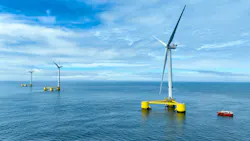
Floating offshore wind has progressed significantly over the past decade, moving from technology demonstrations to early commercial projects operating in Europe. For Greg Campbell-Smith, vice president of commercial at Principle Power, the industry's focus is no longer proving that floating wind works. The next challenge is creating the conditions needed for widespread commercial deployment.

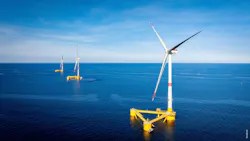
Drawing on lessons from projects including WindFloat Atlantic in Portugal, Kincardine in Scotland and Éoliennes Flottantes du Golfe de Lion (EFGL) in France, Campbell-Smith told Offshore that the sector now has valuable operational experience that is helping developers refine designs, improve execution strategies and prepare for larger projects.
"With proven performance across multiple sites, turbine sizes and fabrication yards, the industry has a handful of validated technologies needed to advance to industrial deployment," he said.
Demonstration projects have validated floating wind technology
According to Campbell-Smith, one of the most important developments over the past five years has been the accumulation of operational data from floating wind projects operating in challenging offshore environments.
Engineers have used this data to validate and refine numerical models, while operators have gained greater visibility into maintenance requirements and performance trends. The industry's growing experience base is also helping developers design projects around the next generation of 20-plus-MW turbines.
"These projects have helped engineers to validate and refine numerical models, and the lessons are systematically fed back into the design process, ensuring the design of 20+ MW projects start from a very mature basis," he added.
At the same time, developers and fabricators have identified opportunities to simplify component designs, reduce welding requirements and increase modularity. Campbell-Smith said such improvements are helping shorten construction schedules and improve manufacturing efficiency as the industry prepares for larger deployment volumes.
Next barriers are regulatory and commercial
While technology continues to evolve, Campbell-Smith believes the biggest obstacles facing floating wind today are largely outside the engineering realm.
"Floating wind has proven feasible and bankable through the successful deployment of early commercial projects in Portugal, Scotland and France," he said. "With strong technical fundamentals, the main challenges are now mainly related to policy-driven decisions."
He pointed to auction visibility, permitting timelines and regulatory certainty as some of the industry's most pressing issues. Without a clear pipeline of projects, he said developers face challenges making investment decisions, while suppliers and infrastructure owners have little incentive to expand capacity.
"Developers need long-term procurement visibility on auctions, stable regulatory frameworks and streamlined permitting processes," he added.
Campbell-Smith also warns that procurement frameworks focused solely on the lowest price can undermine project viability. Instead, he said governments should place greater emphasis on project deliverability and realistic execution planning, particularly as the industry establishes its commercial foundations.
Ports and supply chains will shape the industry's growth
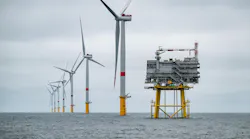
If policy provides the roadmap, ports and industrial infrastructure will determine how quickly floating wind can scale.
Campbell-Smith described ports and marshalling facilities as a critical part of the floating wind ecosystem, noting that developers, port operators and governments often find themselves caught in a cycle of uncertainty. Port owners need confidence that projects will proceed before investing in upgrades, he added, while developers are hesitant to assume the risks associated with first-mover infrastructure investments.
"Projects can only make financial commitments after they have taken the FID decision," he said. "This does not give the facilities adequate time to make the necessary infrastructure investments ready before the work needs to commence."
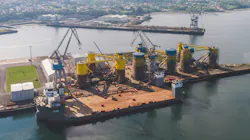
That challenge extends across global supply chains. While some regions are better positioned than others, Campbell-Smith said relatively few locations currently have the infrastructure needed to efficiently support commercial-scale floating wind assembly and turbine integration.
In France, limited port space and load-bearing capacity remain constraints. The UK faces similar challenges, although government-backed port upgrades are beginning to address the issue. South Korea's floating wind sector is competing with strong demand from shipbuilding, LNG and offshore oil and gas projects, while the US West Coast still requires significant infrastructure development.
"Across all these regions, there's only one common need: policy predictability," he said.
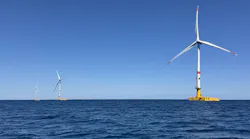 floating Eolmed turbines
Without long-term visibility, he believes supply chain companies cannot justify the major capex required to expand facilities and manufacturing capacity.
Offshore oil and gas offers a blueprint for execution
Many of the industry's future gains may come from applying lessons already learned in offshore oil and gas.
Campbell-Smith advocates for early engagement between developers, installation contractors and equipment suppliers, arguing that project teams often focus too narrowly on optimizing individual scopes of work rather than overall project economics.
Using mooring systems as an example, he said the lowest-cost equipment solution on paper is not always the lowest-cost solution to install offshore.
"Working with the industry experts help us derive the lowest overall installed cost with the lowest risk profile," he added.
That same philosophy applies to anchors, installation methods and construction planning. Decisions made early in project development can significantly affect bankability, execution risk and final project economics.
"Performing a clear and well-thought-through pre-FEED that includes early involvement of the supply chain is essential to understand and potentially lowering cost and will also reduce and mitigate risk," he said.
Campbell-Smith summarized the concept with a lesson that has stayed with him throughout his career: "Proper planning prevents poor performance."
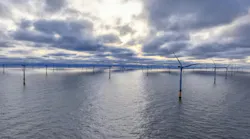 Offshore Wind Farm with Dozens of Turbines at Sunset
Path toward large-scale deployment
Looking beyond 2030, Campbell-Smith sees floating wind following a trajectory similar to that of fixed-bottom offshore wind, though potentially on a compressed timeline.
Over time, larger project volumes, standardized designs, improved infrastructure and technological innovation should drive down costs and improve competitiveness, he said. But unlike the industry's early years, future progress will depend less on proving the technology and more on deploying it at scale.
"The decisive factors will be deployment volume, standardization, port infrastructure and cost of capital," he said.
For Campbell-Smith, the ingredients needed to advance floating wind are becoming increasingly clear. The industry now has operational experience, proven technologies and a growing project pipeline. The next phase will depend on whether policymakers, developers and supply chain participants can create the conditions necessary to turn early successes into large-scale deployment.
About the Author
 Ariana Hurtado
Ariana Hurtado
Editor-in-Chief
With more than a decade of copy editing, project management and journalism experience, Ariana Hurtado is a seasoned managing editor born and raised in the energy capital of the world—Houston, Texas. She currently serves as editor-in-chief of Offshore, overseeing the editorial team, its content and the brand's growth from a digital perspective.
Utilizing her editorial expertise, she manages digital media for the Offshore team. She also helps create and oversee new special industry reports and revolutionizes existing supplements, while also contributing content to Offshore's magazine, newsletters and website as a copy editor and writer.
Prior to her current role, she served as Offshore's editor and director of special reports from April 2022 to December 2024. Before joining Offshore, she served as senior managing editor of publications with Hart Energy. Prior to her nearly nine years with Hart, she worked on the copy desk as a news editor at the Houston Chronicle.
She graduated magna cum laude with a bachelor's degree in journalism from the University of Houston.