France issues tender for 11 offshore wind farms
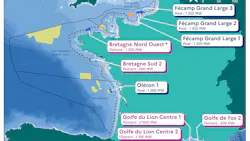
The French government has published a call for tenders notice in the Official Journal of the European Union on June 11, 2026.
The call launches the process to award development rights for 11 offshore wind projects, seven floating and four fixed-bottom, totaling a little over 10 GW.
The offshore wind sites offered through this tender are located off the coasts of Normandy and Brittany, in the South Atlantic and in the Mediterranean Sea. The project areas and their planned installed capacities are:
- Fécamp Grand Large: three fixed-bottom projects, each with a capacity of 1.35 GW
- Bretagne Nord Ouest: a 1.2 GW floating wind farm
- Bretagne Sud 2: a 500 MW floating wind farm
- Oléron 1: a 1.2 GW fixed-bottom offshore wind farm
- Narbonnaise Sud Hérault 2: a 500 MW floating wind farm
- Golfe du Lion Centre: one 1.1 GW and two 550 MW floating wind farms
- Golfe de Fos 2: one 500 MW floating wind farm
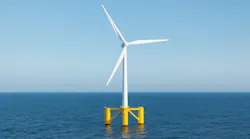 floating offshore wind
The French government announced earlier this year that it planned to award around 10 GW of offshore wind capacity by combining AO9 and AO10 tenders, with results expected by the end of 2026 or early 2027.
The tender documents and official pages do not specify an exact number of turbines per farm at this stage. They define installed capacity targets in MW/GW per zone/project (e.g., 1.35 GW each for the three Fécamp Grand Large fixed-bottom sites, 1.2 GW for Bretagne Nord Ouest floating, etc.).
Bidders (developers/consortia) will propose the exact layout, number of turbines, and models during the tender process. The final count will depend on:
- Chosen turbine power rating (modern offshore turbines are typically 8–18+ MW each; larger ones mean fewer turbines per GW)
- Site-specific constraints (bathymetry, wind resource, environmental buffers, etc.)
- Technology (fixed-bottom vs. floating affects spacing and design)
Rough estimates (based on current industry norms and similar French projects):
- A 500 MW farm might use ~30–60 turbines.
- A 1.2 GW farm could use ~70–150+ turbines, depending on unit size.
- Total across AO10: potentially several hundred turbines, but this will be refined post-award.
Related content:
 offshore wind operations in the Netherlands
 Wind turbines farm in Baltic Sea, Denmark
 dolphins and a rig offshore Iran
 East Anglia 2 OSS
About the Author
 Bruce Beaubouef
Bruce Beaubouef
Senior Lead Reporter / Managing Editor
Bruce Beaubouef is Managing Editor for Offshore magazine. In that capacity, he plans and oversees content for the magazine; writes features on technologies and trends for the magazine; writes news updates for the website; creates and moderates topical webinars; and creates videos that focus on offshore oil and gas and renewable energies. Beaubouef has been in the oil and gas trade media for 25 years, starting out as Editor of Hart’s Pipeline Digest in 1998. From there, he went on to serve as Associate Editor for Pipe Line and Gas Industry for Gulf Publishing for four years before rejoining Hart Publications as Editor of PipeLine and Gas Technology in 2003. He joined Offshore magazine as Managing Editor in 2010, at that time owned by PennWell Corp. Beaubouef earned his Ph.D. at the University of Houston in 1997, and his dissertation was published in book form by Texas A&M University Press in September 2007 as The Strategic Petroleum Reserve: U.S. Energy Security and Oil Politics, 1975-2005.