What will it take to build floating offshore wind at scale off the US West Coast?
Key takeaways:
-
California has set a planning goal of up to 25 GW of offshore wind capacity by 2045, but most projects will require floating foundations because of deepwater conditions.
-
Developing utility-scale floating wind farms will depend on new port infrastructure, transmission systems, supply chain investment and permitting progress.
-
Offshore oil and gas experience in floating structures, project execution and mooring systems offers valuable lessons for commercial-scale floating wind development.
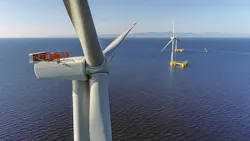
Floating wind by the numbers
-
Global wind capacity: ~1,300 GW
-
Fixed-bottom offshore wind: ~93 GW
-
Operational floating wind: <0.3 GW
-
California offshore wind goal: up to 25 GW by 2045
-
California leases awarded: 5 (2022)
Global wind power capacity reached approximately 1,300 GW in 2025, including about 93 GW of fixed-bottom offshore wind.
Floating offshore wind remains at an early commercial stage, with less than 0.3 GW installed worldwide, largely in pilot and pre-commercial projects. While fixed-bottom offshore wind has reached commercial scale, floating wind remains significantly more expensive. Several larger floating projects, totaling roughly 1.5 GW, are approaching investment decisions, but none are in the US.
Why the US West Coast is different
The US West Coast nevertheless offers exceptional long-term potential. Strong, persistent winds provide high expected capacity factors and access to an enormous renewable energy resource. California has established a planning goal of up to 25 GW of offshore wind by 2045, and BOEM awarded five commercial leases off California in 2022.
The challenge is water depth. The continental shelf drops rapidly to depths ranging from roughly 100 m to well over 1,000 m, making floating foundations essential for most development areas. These foundations can support the latest generation of 15-25 MW turbines. Combined with strong wind resources and large lease areas, they could support a significant new renewable energy industry.
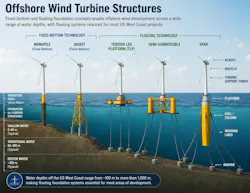
The infrastructure challenge
Realizing that opportunity, however, will require overcoming several significant challenges:
- Developing multiple foundation assembly and turbine-integration sites with adequate quayside capacity, water depth and unrestricted access to the development areas;
- Constructing substantial new transmission infrastructure to move several gigawatts of power to existing load centers and securing bankable power-purchase arrangements;
- Navigating environmental, tribal, military and other permitting requirements while managing federal policy uncertainty; and
- Establishing a supply chain capable of fabricating, integrating, installing and operating floating wind farms comprising hundreds of large floating structures.
These challenges are surmountable, but they must be addressed early and will require substantial investment before projects become financeable.
Lessons from deepwater oil and gas
Developing a 1-GW-plus floating wind farm has important similarities to developing a large deepwater oil and gas field. Both are capital-intensive, have long cycle times from lease acquisition to first production, and demand sophisticated project and risk management, supply-chain coordination and technical expertise. Both also rely on floating structures (e.g., semisubmersibles, spars and tension-leg platforms [TLPs]), and both must operate reliably for decades in challenging offshore environments.
Over several decades, the offshore oil and gas industry has developed a disciplined stage-gate process covering the complete project life cycle, from lease acquisition through abandonment. Each phase progressively defines and de-risks the project before the next major investment decision.
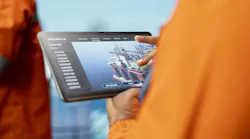 platform specialist uses a tablet to monitor real-time production data and performance metrics
The industry has also developed contracting strategies, execution models and operating philosophies that make multibillion-dollar investments in remote offshore environments possible. Floating wind should adapt many of these lessons rather than recreate them.
Critical decisions during project selection
The Select phase is particularly important because it is where many of the most consequential decisions are made. For a floating wind development, one is selection of the foundation concept. Semisubmersible, spar and TLP configurations are among the principal candidates for West Coast conditions, but each must be evaluated against the site-specific metocean environment, fabrication and assembly infrastructure, turbine-integration strategy and available installation vessels. A sub-optimal selection can propagate through later project phases, ultimately appearing as additional capital cost, schedule delay or operational constraints, adversely impacting sanctioned performance metrics.
Station keeping provides another example of transferable offshore experience. Spread-moored systems for semisubmersibles and spars and vertically tensioned systems for TLPs are well-established offshore technologies over a wide range of water depths. The underlying technology is not the principal obstacle. The challenge is industrialization: scaling from perhaps 12-16 mooring lines on a conventional offshore platform to 300 or more lines for a 100-turbine floating wind farm while achieving repetitive, low-cost installation and integrity management.
While floating wind projects have yet to reach commercial scale in US waters, decisions made during the next decade on infrastructure, supply chains and project execution will largely determine how quickly the industry can develop along the West Coast.
Floating offshore wind has progressed substantially in the past decade. However, to successfully execute and fully realize the enormous resource potential of industrial scale wind farm projects off the US West Coast in 10 to 15 years, it must lean heavily into the lessons, learnings and capabilities of the floating oil and gas industry on the Gulf Coast.
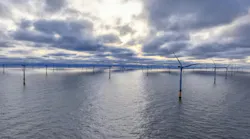 Offshore Wind Farm with Dozens of Turbines at Sunset
About the Author
 Richard D'Souza
Richard D'Souza
Richard D'Souza is president of Richard B Offshore LLC and a floating production and wind energy consultant. In his 50 years of experience (1974-present), he has executed major offshore field developments in every producing region across the globe. As a deepwater pioneer, he has progressed developments from 300-m to 3,000-m water depths.
He was responsible for creating and sustaining premier multi-discipline upstream and downstream engineering and consulting companies: Omega Marine, Aker Engineering, Halliburton Deepwater and KBR/Granherne as well as recruiting and mentoring three generations of offshore engineers.
He has also authored 90 technical papers documenting deepwater technology and history for major conferences (OTC, DOT, SNAME), many of which have been excerpted in Offshore magazine.
He has a bachelor's degree in naval architecture from the Indian Institute of Technology, Kharagpur. He also has a master's degree in ship structures from the University of Michigan as well as a master's degree in civil engineering from Tulane University.
D'Souza is also a member of Offshore's 2026 Editorial Advisory Board.