BW Ideol CFO: Floating wind's biggest hurdle is industrialization, not technology
Key highlights:
-
Supply chain capacity remains the largest barrier to floating wind commercialization.
-
Lenders want proven technology, execution certainty and predictable delivery schedules.
-
BW Ideol argues industrial-scale manufacturing is now more important than technology validation.
-
Dedicated production facilities could help reduce costs and improve project bankability.
By Ariana Hurtado, Editor-in-Chief
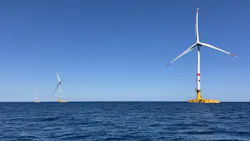
Floating offshore wind has advanced well beyond the demonstration stage, with pilot projects now operating in Europe and Asia and governments planning gigawatts of future capacity. Yet despite growing momentum, industry leaders continue to debate what will ultimately determine whether floating wind can achieve commercial scale.
BW Ideol CFO Guillaume Faure believes the industry's biggest challenge is no longer proving that floating wind technology works offshore. Instead, he argues that manufacturing capacity, bankability and industrial-scale execution will determine how quickly the sector moves from pilot projects to large commercial developments.
In an exclusive interview with Offshore, Faure discusses the lessons learned from projects, including Floatgen and Eolmed; the requirements for attracting investment; and the milestones the industry must achieve over the next decade.
Offshore: The offshore wind industry often speaks about floating wind's long-term potential. From BW Ideol's perspective, what specific conditions must be met before floating wind can be deployed commercially at scale?
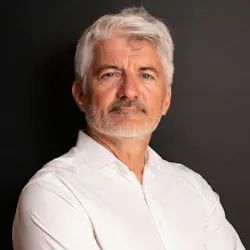
Faure: Three conditions need to converge:
- Technology track record proven over years of offshore operation rather than months;
- Dedicated serial manufacturing capacity replacing one-off custom design and fabrication; and
- Commercial terms (order books, EPC-type delivery) that give lenders confidence on cost and schedule.
BW Ideol's own history illustrates that maturation. Fifteen years of R&D; eight years of continuous operation at Floatgen and Hibiki; and the Eolmed pilot farm, awarded in 2017 and commissioned in 2026, have shaped both a floater design proven and ready for serial construction.
Offshore: Which barriers pose the greatest risk to commercial deployment today: project economics, supply chain capacity, financing, regulatory frameworks, grid infrastructure or something else?
Faure: Supply chain capacity is the most structural barrier.
European shipyard capacity for steel floaters is scarce and oriented toward high-value, low-volume work. Sourcing from Asian yards exposes projects to price volatility, shipping-lane risk and dependence on a limited pool of carrier vessels for long-haul transport of finished structures.
This bottleneck was visible in France's three pioneering pre-commercial farms (Provence Grand Large, EFGL, Eolmed), all built in steel, where procurement and fabrication capacity, rather than turbine or floater technology, drove schedule and costs pressure.
Financing follows directly from this; lenders want confidence that foundations will be delivered on cost and on time, which needs dedicated production capacity with a credible execution partner rather than project-by-project fabrication.
This is why from the Damping Pool project inception, BW Ideol's response has been to consider concrete, which draws on the existing civil-engineering supply chain rather than shipbuilding, paired with an established construction partner (NGE) for its Fos3F line.
Offshore: What are the most critical requirements for creating a bankable floating wind market, and what are investors and lenders looking for before they commit capital to larger floating wind projects?
Faure: First, standardized and certified products rather than bespoke per-project designs, which shortens engineering lead times. Second, dedicated serial production capacity backed by a credible industrial execution partner. Third, firm orderbook mechanisms that reserve production capacity ahead of final investment decision [FID], giving developers price and schedule certainty, and giving factories the volume needed to run efficiently. This mostly applies to the construction phase of the projects.
For the construction phase of any project, lenders want three things:
- A technology with a genuine offshore track record;
- A recognized execution partner; and
- Visibility on delivery cost and schedule.
The industry as a whole isn't fully there yet. Few floating foundation providers have reached technology validation (TRL 7) and even less dedicated industrial capacity reached manufacturing readiness, which is the piece lenders still find missing on most projects.
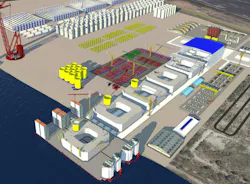
Fos3F, BW Ideol and NGE's planned factory in Fos-sur-Mer dedicated to serial production of concrete floating foundations, is designed precisely to answer these expectations. The Damping Pool technology behind it carries eight years of continuous offshore operation at Floatgen and Hibiki, plus the Eolmed 30-MW pilot farm commissioned in 2026.
The 50:50 partnership with NGE, one of France's leading construction groups, puts established civil-engineering delivery capability behind the factory's manufacturing commitments. And preferred supplier agreements, converted into EPC contracts at FID, lock in price and delivery schedule for developers ahead of construction.
Offshore: Several floating wind demonstration projects have now been deployed worldwide. What key lessons from these projects must the industry apply to the first large-scale commercial developments?
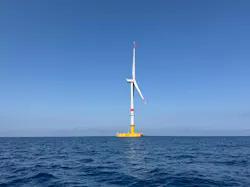
Faure: Floatgen is BW Ideol's 2-MW demonstrator off Le Croisic, in operation since 2018, and it provides the clearest lesson: after nearly eight years in the Atlantic, including winter storms with waves up to 10 m, the concrete hull has shown no degradation beyond normal design margins, and maintenance access has proven straightforward in moderate sea states, with the WTG operating at top nominal values and showing no specific wear. That confirms a simple, stable platform stays serviceable over time, not just at commissioning.
Offshore: Looking ahead to 2035, what will define success for floating offshore wind, and what milestones should the industry achieve over the next decade?
Faure: Volumes are set to scale sharply by 2035. On the order, 200 turbines are expected to be commissioned along France's Mediterranean coast alone over the coming decade (France has tendered or announced roughly 3.7 GW of Mediterranean floating capacity through the AO6 and AO10 rounds), with an even larger buildout expected in Scotland, where ScotWind has awarded on the order of 15 GW of floating wind capacity to date.
Success will mean having delivered that volume while creating long-term jobs, at a competitive cost and on schedule.
Milestones to follow this decade:
- Production lines reaching their expected cadence;
- Order books converting from reservation agreements into EPC contracts as projects reach FID; and
- Continued build-out of the pipeline across the Mediterranean and North Sea.
Our Fos3F facility targets roughly 30 foundations per year, close to one every 12 days at full capacity.
Exclusive content:
 Underwater cables on the ocean floor in the Mediterranean Sea
 HVDC use on DolWin1 offshore wind farm near Germany
 Bibby Marine eCSOV
About the Author
 Ariana Hurtado
Ariana Hurtado
Editor-in-Chief
With more than a decade of copy editing, project management and journalism experience, Ariana Hurtado is a seasoned managing editor born and raised in the energy capital of the world—Houston, Texas. She currently serves as editor-in-chief of Offshore, overseeing the editorial team, its content and the brand's growth from a digital perspective.
Utilizing her editorial expertise, she manages digital media for the Offshore team. She also helps create and oversee new special industry reports and revolutionizes existing supplements, while also contributing content to Offshore's magazine, newsletters and website as a copy editor and writer.
Prior to her current role, she served as Offshore's editor and director of special reports from April 2022 to December 2024. Before joining Offshore, she served as senior managing editor of publications with Hart Energy. Prior to her nearly nine years with Hart, she worked on the copy desk as a news editor at the Houston Chronicle.
She graduated magna cum laude with a bachelor's degree in journalism from the University of Houston.
Related
