Global FPSO activity advances across development, execution and operations

Recent FPSO developments highlight how operators are advancing projects across multiple stages of the asset lifecycle, from FEED and contract definition to brownfield reactivation and new deepwater startups.
Updates from Canada, West Africa and Brazil underscore continued global investment in floating production, alongside growing emphasis on operational certainty, digital connectivity and lower‑carbon design.
 AI-generated FPSO image
Canada: Bay du Nord FPSO advances into FEED phase
BW Offshore has signed a front-end engineering and design (FEED) agreement with Equinor for the Bay du Nord project offshore Newfoundland and Labrador, eastern Canada.
It formalizes the next phase of the project following Equinor’s earlier selection of BW Offshore as the preferred FPSO bidder. A potential final investment decision (FID) could follow in 2027.
 Top 5 projects to watch -- operators advance field development plans
During the FEED phase, which will likely continue through year-end 2026, BW Offshore will mature the FPSO design, complete work on the project execution plan and delivery schedule, and progress commercial/contractual issues (including a selection of major subcontractors and vendors) to submit a firm offer to Equinor.
The company will also develop a local content plan, in line with the frame agreement and the Atlantic Accord.
BW Offshore has established an office in St. John’s and appointed a local benefits manager to support collaboration with Equinor, local authorities and the regional supply chain during FEED and into execution.
 offshore FPSO operations
West Africa: Baobab FPSO reconnection work progresses
Reconnection activities have started for the Baobab FPSO, which arrived back at the Baobab Field location offshore Côte d'Ivoire recently following a drydock refurbishment in Dubai.
In its latest quarterly report, partner Vaalco Energy said four out of seven risers and umbilicals are now connected and production should resume later in the current quarter.
Operator CNR has secured a rig for a new development drilling campaign scheduled to begin in late September.
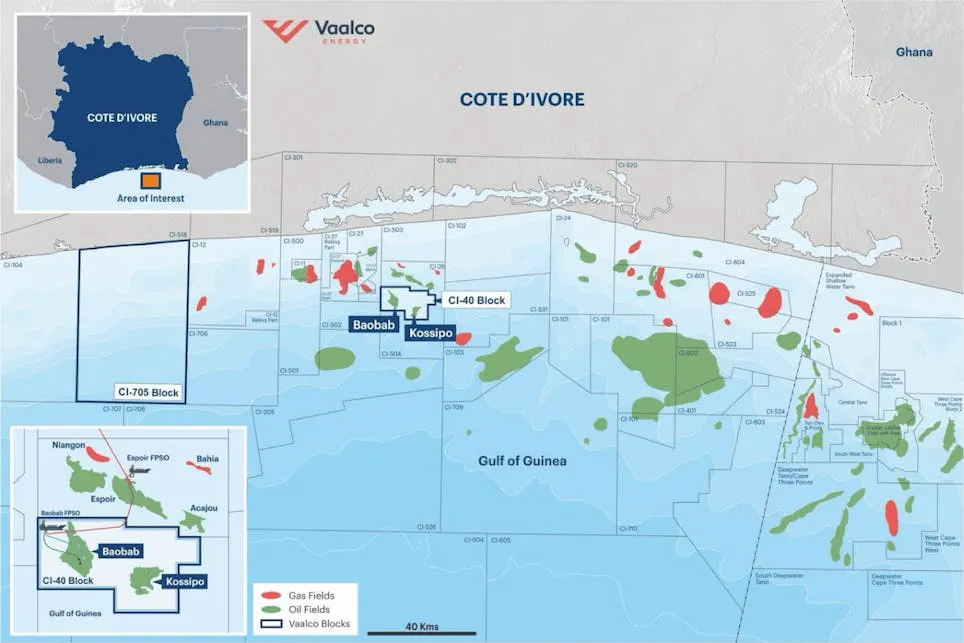
The Baobab Field is in Block CI-40.
In February, Vaalco was confirmed as the operator with a 60% interest in the Kossipo Field, also on the CI-40 Block offshore Côte d'Ivoire, and aims to complete its field development plan in the second half of this year.
The Kossipo‑1X discovery was followed by the Kossipo‑2A appraisal well in 2019, which tested oil at more than 7,000 bbl/d. Vaalco is now analyzing newly acquired ocean‑bottom node seismic data to support development planning.
Brazil: New FPSO begins production at Búzios
Petrobras has started up the eight production platform on the Búzios Field offshore Brazil ahead of schedule.
The P-79 FPSO has the capacity to handle 180,000 bbl/d of oil and to compress 7.2 MMcm/d of gas.
It should increase overall installed oil production capacity at the giant field in the presalt Santos Basin to about 1.33 MMb/d.
In addition, the produced gas will be exported to the mainland via a connection to the Rota 3 pipeline, potentially expanding gas supplies in Brazil by up to 3 MMcm/d.
P-79 arrived in Brazil in February following a voyage from South Korea, with commissioning and operations teams on board. This eliminated the need for a stopover in sheltered waters in Brazil, bringing gains in operational readiness.
The FPSO has a new design hull and features technologies said to lower emissions and improve operational efficiency. It is part of the Búzios 8 Production Development project, and it will be connected to eight subsea producer wells and six injectors, equipped with intelligent completion systems for enhanced production management.
 Petrobras' P-79 platform offshore Brazil
Búzios, discovered in 2010, is 180 km offshore Rio de Janeiro state, in water depths of more than 2,000 m.
Operator Petrobras’ partners are CNOOC and CNODC as well as PPSA, which is responsible for managing the production sharing contracts.
North Sea: BW Catcher contract revised through 2030
BW Offshore has agreed to amend the contract for the FPSO BW Catcher, converting it into a fixed-term agreement running through year-end 2030 (± six months) and removing the prior one‑year extension options.
Effective Feb. 1, 2026, the revised terms are expected to add about $490 million to BW Offshore’s firm operating cash-flow backlog.
The new structure provides greater certainty on contract end timing, enabling BW Offshore to actively market the harsh‑environment FPSO for potential redeployment. Contract changes include a revised tariff framework from 2028 that introduces an oil‑price‑linked cap, while maintaining the existing structure, and a discount equivalent to 10% of the bareboat charter dayrate, offset against O&M rates.
Offshore's 2025 FPSO Series:
- Review of global FPSO inventory reveals deployment trends
- FPSOs have evolved to handle more volatile crudes, gassier fields
- Dimensions, deadweight key factors in determining FPSO hull size and shape
- FPSO fleet correlations: examining storage vs deadweight
- FPSO fleet correlations: calculating topsides weight vs. processing capacity
Brazil: Satellite connectivity planned for seven new Petrobras FPSOs
SES will provide connectivity services via its O3b mPOWER medium‑Earth‑orbit satellite network to support seven new Petrobras FPSOs scheduled to enter operation offshore Brazil between 2026 and 2030. The agreement will supply high‑capacity, low‑latency communications to enable data‑intensive offshore operations as Petrobras expands deepwater production capacity.
The FPSOs will use O3b mPOWER’s carrier‑grade connectivity to support real‑time data transfer, operational monitoring and digital workflows, reflecting the growing role of satellite communications in FPSO automation and remote operations.
Design & decarbonization: ABS approves SBM Offshore NearZero FPSO concept
ABS it has granted approval in principle (AiP) to SBM Offshore for its NearZero FPSO concept, which integrates low‑carbon technologies aimed at achieving up to an 80% reduction in greenhouse-gas emissions.
The design combines all‑electric topsides, closed‑flare systems, carbon capture and alternative seawater intake solutions, and it has been reviewed against applicable class and statutory requirements.
SBM Offshore said the NearZero concept is fully integrated with its Fast4Ward standardized FPSO design, indicating technical readiness for near‑term project application as operators increasingly focus on emissions reduction and energy efficiency in floating production assets.
The AiP was announced at the Offshore Technology Conference (OTC) in Houston earlier this week.
 OTC 2026 Opening Ceremony
About the Author
 Jeremy Beckman
Jeremy Beckman
Staff Writer / Editor, Europe
Jeremy Beckman has been Editor Europe, Offshore since 1992. Prior to joining Offshore he was a freelance journalist for eight years, working for a variety of electronics, computing and scientific journals in the UK. He regularly writes news columns on trends and events both in the NW Europe offshore region and globally. He also writes features on developments and technology in exploration and production.
 Ariana Hurtado
Ariana Hurtado
Editor-in-Chief
With more than a decade of copy editing, project management and journalism experience, Ariana Hurtado is a seasoned managing editor born and raised in the energy capital of the world—Houston, Texas. She currently serves as editor-in-chief of Offshore, overseeing the editorial team, its content and the brand's growth from a digital perspective.
Utilizing her editorial expertise, she manages digital media for the Offshore team. She also helps create and oversee new special industry reports and revolutionizes existing supplements, while also contributing content to Offshore's magazine, newsletters and website as a copy editor and writer.
Prior to her current role, she served as Offshore's editor and director of special reports from April 2022 to December 2024. Before joining Offshore, she served as senior managing editor of publications with Hart Energy. Prior to her nearly nine years with Hart, she worked on the copy desk as a news editor at the Houston Chronicle.
She graduated magna cum laude with a bachelor's degree in journalism from the University of Houston.