Westwood: Offshore project sanctions surge 90% in first half of 2026
Why this news matters:
-
Offshore operators sanctioned 38 projects in just six months, indicating sustained confidence in large-scale deepwater and offshore gas developments.
-
Floating production systems continue to dominate major project spending, creating opportunities for vessel builders, EPC contractors and subsea suppliers.
First-half 2026 offshore development snapshot
- 38 offshore field FIDs
- $66.4 billion committed capex
- 90% increase versus first-half 2025
- $12.9 billion FPS EPC awards
- $5.6 billion subsea EPC awards
- 539,000 boe/d of new FPS processing capacity
- 4.4 MMt/year of FLNG capacity added
Data courtesy of Westwood
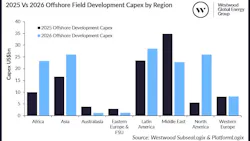
Offshore project investment accelerated sharply during the first half of 2026, with operators sanctioning 38 offshore field developments and committing $66.4 billion in capital spending, according to Westwood Global Energy Group. The total represents a 90% increase over the same period in 2025 and signals continued momentum for deepwater and offshore gas developments worldwide.
The surge in final investment decisions (FIDs) suggests operators remain confident in the economics of deepwater developments despite market uncertainty. Many recent sanctions are tied to long-life oil and gas projects that support energy security objectives while creating opportunities across the offshore supply chain, from floating production systems (FPS) and subsea equipment to installation and export infrastructure.
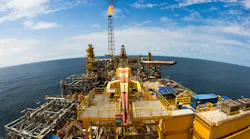 Top 5 projects to watch -- operators advance field development plans
Floating production spending remains a key driver
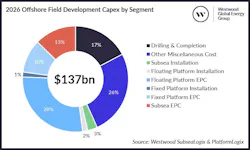
EPC contracts for FPS units accounted for about $12.9 billion of this sum, with subsea engineering, procurement and construction (EPC) awards totaling $5.6 billion, according to Mark Adeosun, director of SubseaLogix and PlatformLogix and author of the Westwood report.
Westwood has identified a further $70.5 billion in offshore oil and gas field development capex that could be sanctioned during the second half of 2026, along with more than $30 billion in additional FPS and subsea EPC awards.
Among the standout factors are the imperative for energy security and competitive deepwater project economics as well as a broader geographic spread of awards than before.
 FPS sentiments survey market to stay active through 2028
Major FPS awards span multiple regions
The six big FPS EPC awards issued in the second quarter will add more than 539,000 boe/d of processing capacity and 4.4 MMt/year of FLNG capacity.
They include Petrobras’ P-81 and P-87 FPSOs, both assigned to SBM Offshore under a build, operate and transfer model, a departure from the Brazilian major’s lease-and-operate arrangement.
Together, the six major FPS awards announced during the second quarter highlight continued investment across Brazil, Angola, Malaysia, Cyprus and North America, demonstrating the increasingly global nature of offshore development activity.
Other notable awards highlighted by Westwood are Delfin FLNG in the US Gulf, Azule Energy’s Greater PAJ floater offshore Angola, PTTEP’s deepwater Kikeh replacement FPSO unit offshore Malaysia, and Eni’s Cronos floating control unit (FCU) offshore southern Cyprus.
In July 2026, Eni sanctioned the FPS for its Baleine Phase 3 development offshore Côte d’Ivoire (Wison New Energies is managing the EPC program). And in the Kutei North Basin offshore Indonesia, Searah (the new joint venture between Eni and Petronas) handed Saipem the EPC work scope for the Bahtera Haluan Lestari FPSO.
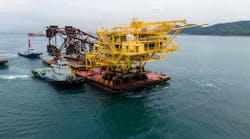 EPC contracts awards in 2026 expected to total some $59 billion
More projects expected in second half of 2026
FPS projects still to launch this year could include ExxonMobil's Longtail gas development offshore Guyana, TotalEnergies’ Venus development offshore Namibia, Bahia Blanca LNG (Argentina), Ksi Lisims FLNG (Canada), and the Yoho FLNG offshore Nigeria.
Subsea award activity remains strong
Westwood forecasts a total of $17 billion of subsea EPC awards for the year as a whole, including 283 subsea trees and 4,000 km of subsea umbilical, risers and flowlines, and 2,600 km of export lines.
The forecast underscores the extent to which recent field sanctions are expected to translate into follow-on demand for subsea infrastructure and installation services.
Operators of various recently sanctioned developments, Adeosun added, including Baleine Phase 3, Cronos and Geng North, have yet to confirm the associated subsea packages.
Exclusive content:
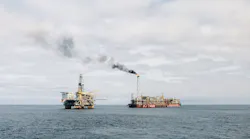 offshore oil and gas operations
 DeepOcean pipeline inspection
About the Author
 Jeremy Beckman
Jeremy Beckman
Staff Writer / Editor, Europe
Jeremy Beckman has been Editor Europe, Offshore since 1992. Prior to joining Offshore he was a freelance journalist for eight years, working for a variety of electronics, computing and scientific journals in the UK. He regularly writes news columns on trends and events both in the NW Europe offshore region and globally. He also writes features on developments and technology in exploration and production.