UK building offshore carbon storage capability close to northern industrial clusters
Key highlights:
-
The UK’s Track 1 East Coast Cluster and HyNet projects are targeting startup in 2028, with offshore storage infrastructure under development.
-
The Endurance aquifer could ultimately support an offshore pipeline network handling up to 23 million metric tons of CO2 annually.
-
Morecambe Net Zero is assessing depleted gas fields that could store up to 1 gigaton of CO2 and serve cement and lime producers.
-
Denmark’s Project Greensand began commercial operations, transporting CO2 by ship for storage in the Nini West Field.
-
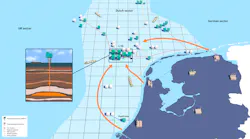
Projects in the Netherlands and Greece are advancing plans to inject captured CO2 into depleted offshore reservoirs.
Britain's first two offshore carbon capture utilization and storage (CCUS) projects are progressing toward planned startup in 2028.
Both the Northern Endurance Partnership's (NEP) East Coast Cluster project, which will store CO2 in a North Sea aquifer, and the HyNet Cluster, which will transport emissions to the decommissioned Liverpool Bay fields, received financial support under the UK government’s Track 1 CCUS program.
Two other planned developments—Acorn in northeast Scotland and Viking in the Humber region in eastern England—are designated Track 2 Clusters, as the government seeks to promote a nationwide carbon capture and storage (CCS) capability of 20-30 MMmt/year by 2030.
Other potential developments that could start operations by the early 2030s include Spirit Energy’s Morecambe Net Zero (MNZ), which would repurpose the Morecambe gas fields in the East Irish Sea to store carbon emitted by cement and lime producers in central and northwest England.
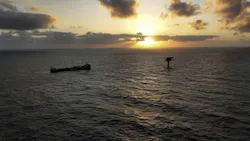
Elsewhere in northwest Europe, Project Greensand began commercial operations in September, transporting CO2 via a newbuild carrier for storage in the Nini reservoir in the Danish North Sea.
Another development nearing operational status is Porthos in the Dutch North Sea/Rotterdam area.
East Coast Cluster/Endurance
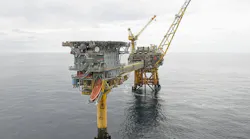
Drilling should by now have started on the first injection well for the Endurance subsurface carbon store in the UK southern North Sea, a saline Triassic Bunter sandstone aquifer about 140 km offshore northeast England.
This landmark operation comes almost two years after the NEP shareholders bp, Equinor and TotalEnergies approved financing of their East Coast Cluster development. This involves constructing onshore transportation infrastructure, including a 12-km pipeline, and compression facilities for CO2 emitted by industrial companies in the Teesside region, for three initial carbon capture projects. A 149-km offshore pipeline transportation will deliver captured CO2 for subsea injection into the Endurance permanent storage site, 1,000 m beneath the seabed.
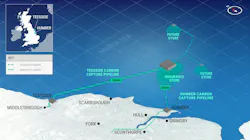
NEP is also progressing development work for the proposed Humber Carbon Capture Pipeline, an expansion of the East Coast Cluster to the industrial Humber region to the south. Another new pipeline system here would transport CO2 from future carbon capture projects in this area for ultimate delivery to the Endurance aquifer. Eventually, the offshore pipeline network could handle throughput of up to 23 MMmt of CO2 annually.
In January this year, the NEP co-venturers and The Crown Estate signed a lease of the seabed covering the offshore infrastructure and permanent CO2 storage. The lease will run until injection at the site has reached the anticipated storage capacity, currently expected in the mid-2050s.
According to the latest update on the North Sea Transition Authority’s (NSTA) Energy Pathfinder information service, the Phase 1 offshore scheme will feature five injection wells and a single monitoring well, all controlled and powered from onshore. Endurance is a large pressurized aquifer with verified injection volumes for Phase 1 of more than 5 MTPa and a total storage volume of more than 100 MTPa.
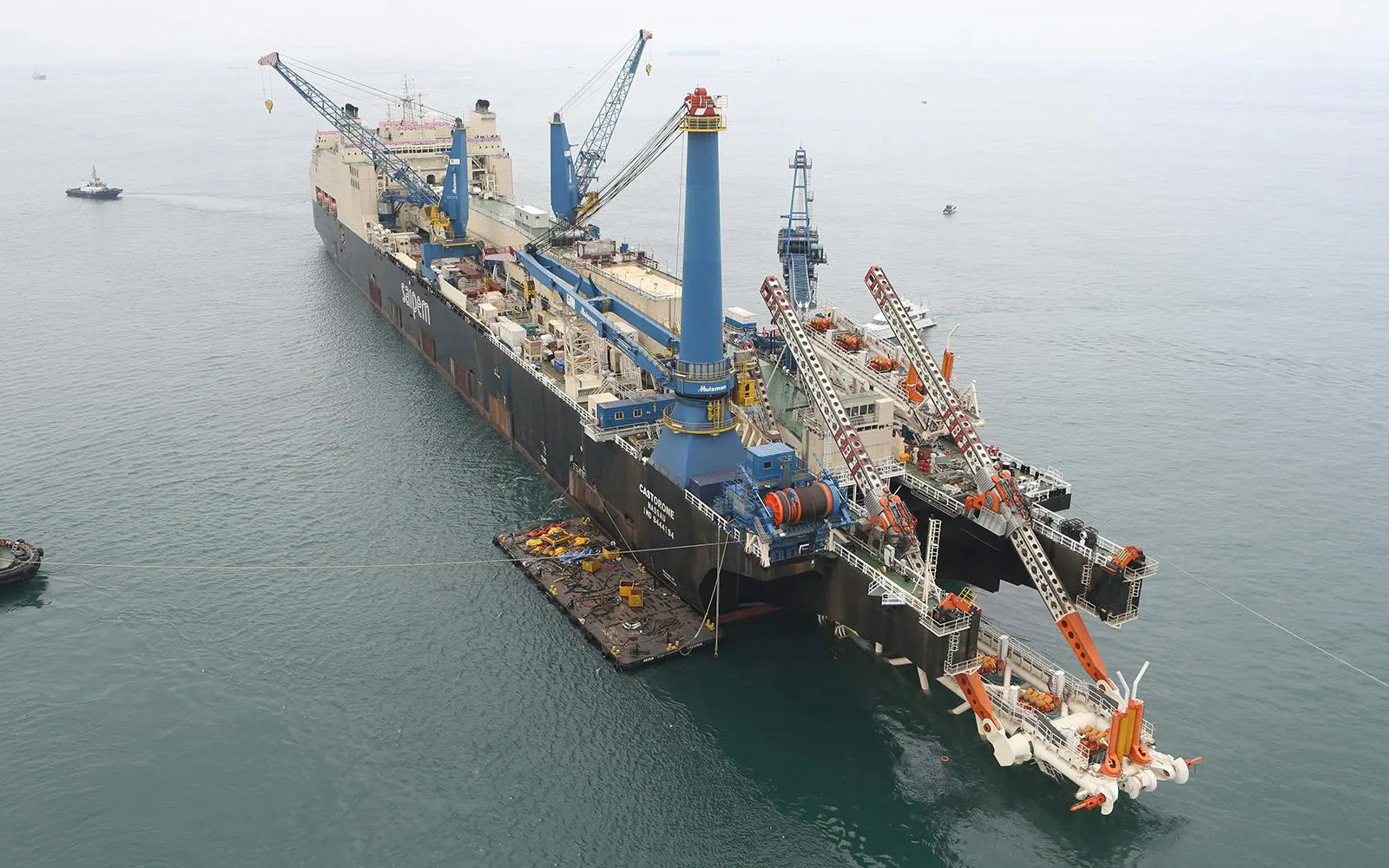
Saipem’s Castorone construction vessel began laying the 136-km, 28-inch CO2 export pipeline in September. Corinth Pipeworks UK nearby at Hartlepool, in partnership with Marubeni-Itochu Tubulars Europe and Eisenbau Kramer GmbH, has supplied 105 km of linepipe for NEP’s offshore infrastructure, with a further 65 km delivered for the overall project from Corinth Pipeworks’ plant near Athens, Greece. PD Ports, as a subcontractor to Saipem, invested in additional pipehandling equipment at Hartlepool.
Helix Robotics Solutions has performed engineering and design for unexploded ordnance technical support.
TechnipFMC is responsible for the supply and installation of the all-electric subsea system, including trees, manifolds, umbilicals and infield flowlines, to be delivered using the company’s integrated engineering, procurement, construction and installation (EPCI) execution model. The all-electric technology is designed to help reduce the required infrastructure and the installation time through the removal of hydraulic components and simplified umbilicals, and enable the extended distances needed for the project.
Alcatel Submarine Networks is providing the project’s subsea power and communications cable.
NEP described the recently completed appraisal drilling program for the Phase 1 project as “one of the most comprehensive carbon storage appraisal programs undertaken in UK waters."
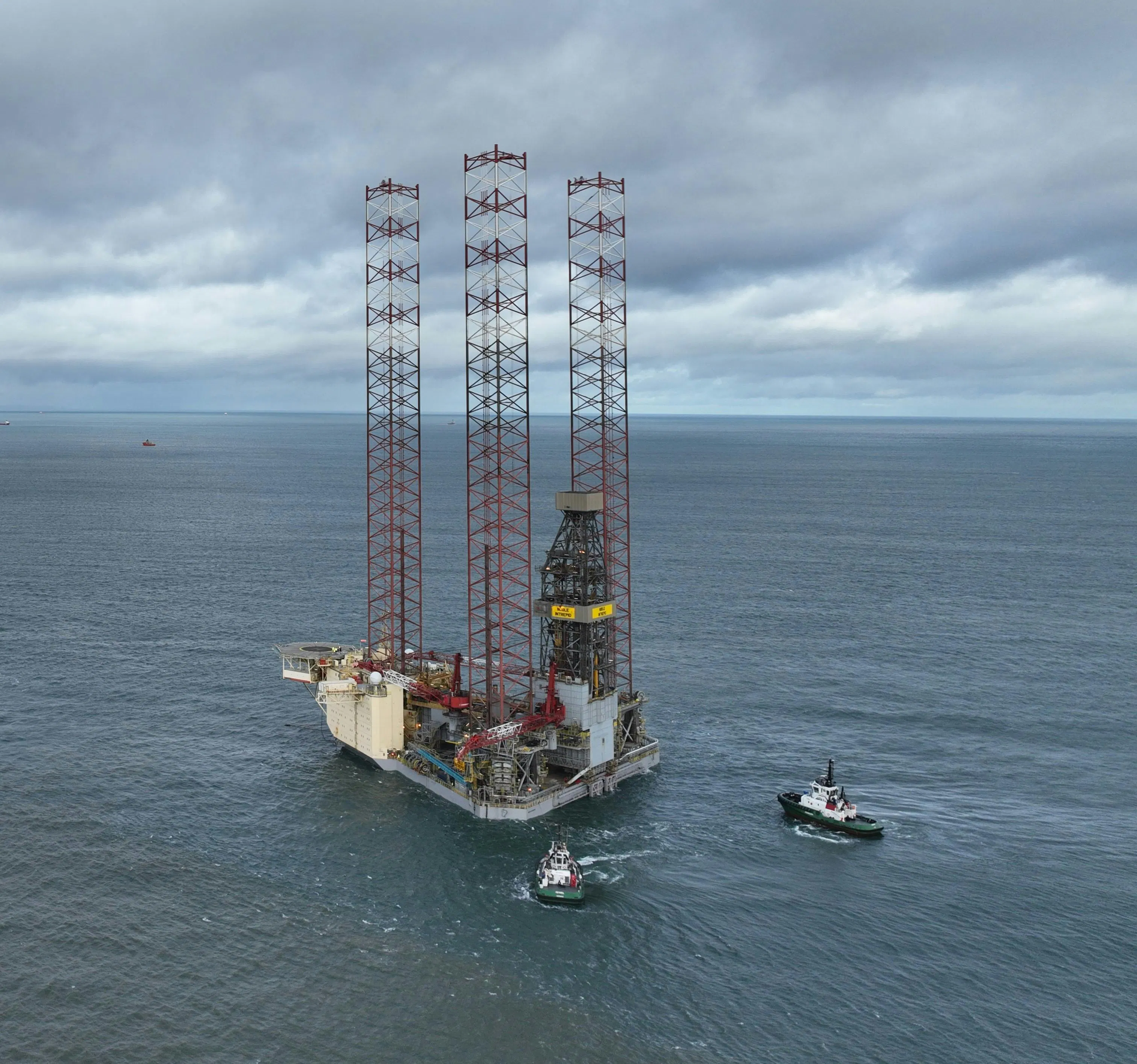
Noble Corp.’s Noble Innovator jackup rig drilled the C44/27-3 (BC37-1) appraisal well, following the earlier C43/30-2 (BC39-1) well (on the CS006 and CS007 storage licenses). Rich Denny, Managing Director of NEP, said the results had delivered “a much richer picture of the potential storage sites and the conditions beneath the Southern North Sea.” Noble Corp.’s Noble Intrepid jackup will drill the six Phase 1 wells.
Sonardyne has started baseline environmental and passive seismic monitoring for the project, after completing a successful deployment of six seabed lander systems at the Endurance CO2 store. The monitoring landers will support NEP’s long-term measurement, monitoring and verification program for offshore CO2 storage by delivering the repeatable data needed to monitor the reservoir integrity effectively over time.
The equipment comprises three autonomous environmental monitoring landers, designed and built by Sonardyne to remain on the seabed for long periods, and three co-located TIAMAT passive seismic monitoring systems provided by K.U.M. in Germany. The six systems are collecting baseline data on seawater chemistry, currents, seabed conditions and passive seismic activity prior to the start of future CO2 injection operations, and it will support continued monitoring throughout the storage lifecycle.
Sonardyne’s environmental monitoring landers employ onboard power management, Edge data processing and wireless underwater communications to operate remotely and relay data back from the seabed to the sea surface. This allows the data to be collected and recovered over time without the need to regularly retrieve the landers.
Morecambe Net Zero
Spirit Energy’s proposed Morecambe Net Zero (MNZ) project would convert the South and North Morecambe gas fields in the East Irish Sea—both approaching depletion—to provide permanent subsurface storage of CO2. Operations could start early in the 2030s, with most of the initial CO2 deliveries (close to 3 MM metric tons/year) generated by the Peak Cluster, comprising four leading cement and lime producers in central and northern England.
Technical studies have confirmed that the converted offshore storage facility, located close to the port of Barrow-in-Furness, northwest England, could accommodate up to 1 gigaton of CO2 over time, making it potentially one of Britain’s largest carbon stores. The CO2 from the cement producers will be transported to the offshore site via an underground pipeline.
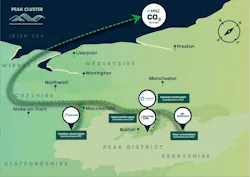
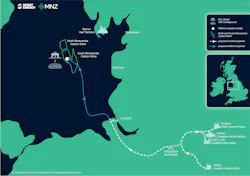
Aside from potentially decarbonizing 40% of the UK’s cement and lime sectors, the repurposed gas fields could attract £5 billion ($6.61 billion) in private investment in associated construction and operations, Spirit Energy claims. It could also form the basis for a future low-carbon hub in the same time safeguarding the positions of thousands of staff employed by the Peak Cluster companies.
These positives helped secure a £28.6-millon ($37.83-million) investment last year from the UK’s National Wealth Fund to support onshore transportation part of the project. The investment, in addition to industry funding, will help cover the cost of ongoing FEED studies and other work streams.
In June this year, the UK’s NSTA confirmed that Spirit Energy had received clearance to enter the "Assess Phase" of its carbon storage license (CSO10). It followed three years of studies completed by the company’s subsurface, wells, projects, engineering, commercial and HSE teams. The program had included acquisition and subsequent imaging of 500 sq km of new 3D seismic over the Morecambe fields to determine their suitability for storing CO2 in large volumes.
“Shearwater Geoservices acquired and processed the high resolution, high-density seismic survey to create a detailed 3D depth image of the prospective Morecambe North and Morecambe South carbon storage sites,” Matt Browell-Hook, managing director MNZ CCS for Spirit Energy, told Offshore. “The results confirm the large potential storage capacity at both carbon storage sites.
“The seismic data has also provided significantly improved detail and resolution of the overlying geological horizons that form the caprock and sealing layers for containing CO2. While it is not possible to directly delineate the remaining gas in the pressure-depleted Morecambe fields, based on this data, studies on alternative technologies like seabed gravity confirm their potential to map the storage of CO2 over the project lifetime.”
Entry into the Assess Phase, he continued, “recognizes the maturity of the technical studies and risk assessments of the Morecambe gas fields and wells for use as carbon storage sites."
This resulted in MNZ becoming one of only a few stores to meet this milestone, including those in the UK’s Track 1 process, which are now in construction, he added. The MNZ project team will now decide on a preferred development concept and progress the engineering and commercial activities needed to reach a final investment decision (FID) and permit application.
“There are currently 24 production wells on South Morecambe and 10 on North Morecambe," he continued. "All 34 wells will be plugged and abandoned, and none will be repurposed. The reuse of the offshore pipelines, however, remains an option that is linked to the final engineering design decisions.
“At the point of FID, Spirit will have the required regulatory approvals and finance in place to begin the offshore construction works. The work scope in advance of FID is focused around planning for the offshore construction phases, which includes the preparation of the required regulatory applications.”
Spirit’s engineering teams are monitoring the progress and lessons learned from other, more advanced CCUS projects across northwest Europe.
“The experience gained by the industry is being incorporated into the MNZ development,” Browell-Hook explained, “via engagement with the owner/operators of the projects already onstream and with the regulators and supply chain supporting the other CCS projects. For example, industry learning from injection trials at Poseidon [in the Dutch North Sea] and asset reuse at HyNet [Liverpool Bay] are being factored into design through the industrywide technical forums.”
Among the engineering consultancies participating in the MNZ studies, Quintessa assisted Spirit’s application for its CSO10 license and is currently supporting assessment of containment assurance, Browell-Hook confirmed, “along with workflows to screen technologies and define criteria to develop a monitoring plan for the carbon storage sites.
The first planned subsurface monitoring will take place prior to CO2 injection to acquire baseline data ahead of CO2 injection. Following that, regular subsurface monitoring surveys will be undertaken to confirm the CO2 is being contained and all aspects of the CO2 storage conform to the modeled predictions. Alongside the surveys, the Spirit will have continuous monitoring on the seabed and within the injection wells. The company is currently engaging with drilling and subsea contractors, and contracts for specific scopes will be developed as the project progresses, he added.
“Arup supported Spirit with the development of a concept for ship import of liquid carbon dioxide (LCO2) to our existing gas terminal at Barrow," he said. "That scope extended to all onshore facilities and equipment, but did not include the offshore facilities. As part of a wider feasibility into pathways for CCS storage, the overland Peak Cluster pipeline remains the primary and fundamental route forward. For the MNZ/Peak Cluster project, Arup is leading the environmental workstream in support of the development consent order, with specific responsibility for writing the environmental impact assessment.”
As for management of offshore and onshore operations post-startup, no decision has been taken on a central operations center.
“We expect that each of the cement and lime partners’ capture facilities will tie into the existing operations centers at their manufacturing sites," he said. "Spirit also expects to have a dedicated operations center for the offshore injection facility for monitoring and control of the offshore transportation and injection of CO2. The pipeline operations lend themselves to an integrated approach for monitoring, control and maintenance; however no decision has been made on that either at this time.
“While we are wholly focused on the partnership with the Peak Cluster, there will be available storage capacity that can be considered with other partners further down the line. We are working closely with the UK’s Department for Energy Security and Net Zero and industry to establish the pathways for access into the future.”
The Morecambe fields span four blocks in the East Irish Sea, 25 km southwest of Walney Island and in water depths of 17-35 m. Production started in 1985.
Project Greensand
In September, the INEOS-led Project Greensand began commercial operation in the Danish North Sea, following a ceremony staged at the Port of Esbjerg in western Denmark.
This is the first cross-border CCS development onstream in the European Union (EU). The facilities for the Northern Lights project, which started operations last year and receives CO2 from EU countries, are in Norway, which is not an EU member.
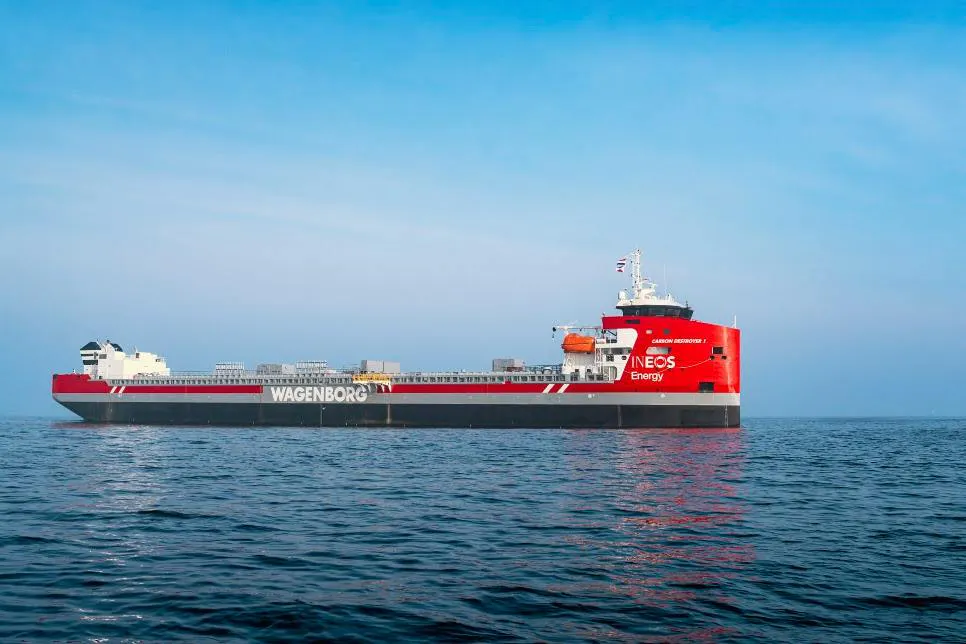
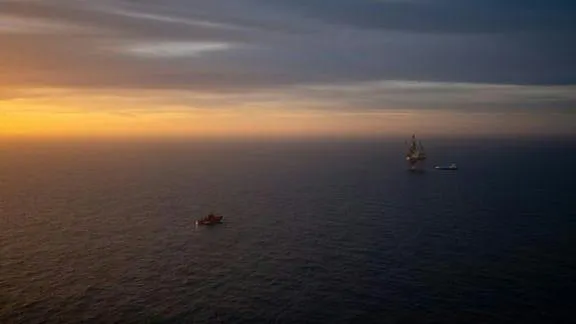
The vessel transports its cargoes to the depleted Nini West oil field, 250 km offshore, for permanent storage in the reservoir, at a depth of 1,800 m beneath the seafloor, with round trips to the offshore location and back lasting three days.
During the transfer operation at the injection site, the CO2 is heated to temperatures between 0 and 7 C, and then injected into the reservoir at a pressure close to 200 bar. GEUS, the Geological Survey of Denmark and Greenland, confirmed the integrity of the reservoir during prior testing. The development also obtained safety approval from DNV.
Wells used previously for oil production at Nini West are being adapted to safely accommodate injection of CO2. New equipment and barriers are run by wire from the platform deep into the wells. Eight seismometers, developed by seabed data compilation specialist KUM Kiel, have been deployed on the seabed, continuously recording any associated movements in the area surrounding the Nini Field. They are also designed to detect pressure waves from the engines of nearby ships and also seismic waves from distant earthquakes.
In this initial commercial phase, the Greensand partners expect to receive and store up to 400,000 mt/year of CO2, rising eventually to 4 MM to 8 MM mt annually at full capacity. First cross-border deliveries could come from Sweden, where Oresund Kraft & Vare has an agreement with INEOS, on behalf of the partners, to investigate exporting potential CO2 volumes of up to 210,000 mt/year to Nini West.
Porthos
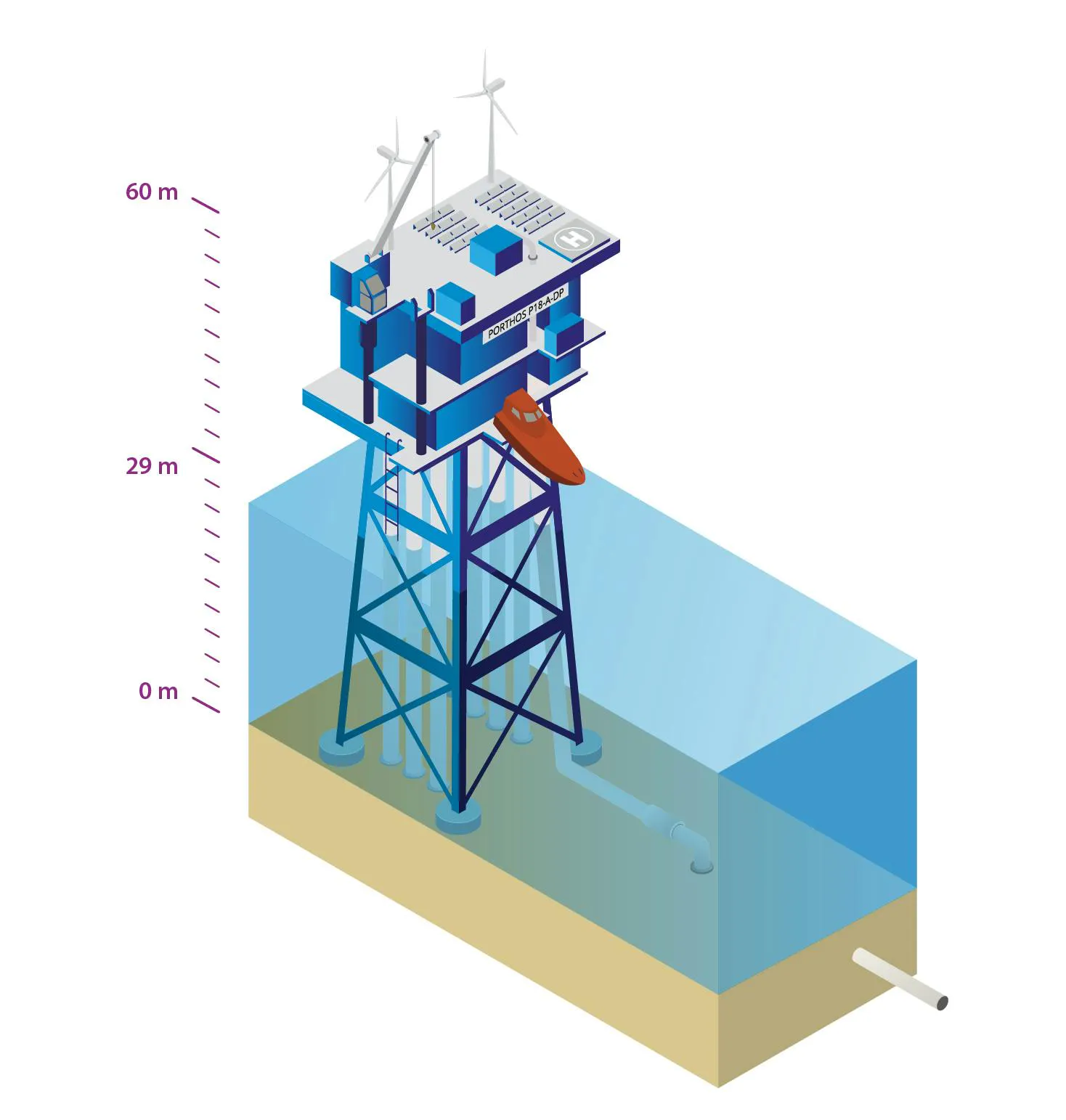
Among other CCUS projects within the EU, the Porthos project in the southern Netherlands will transport CO2 captured from industrial emitters through a pipeline crossing the Rotterdam port area. After being pressurized at a compressor station, the CO2 will be delivered in gaseous form through a subsea pipeline to the P18 platform, which is 20 km offshore in the North Sea, converted to inject the CO2 into depleted gas fields. These fields are located in a sealed reservoir of porous sandy rock, 3-4 km subsurface.
Porthos will inject/store about 37 MM mt of CO2 over a 15-year period, in a three-phase process. The initial free-flow phase will be enabled by the low pressure (at this point) of the depleted reservoir. The next step will be gas-phase injection using compressors, up to 75 barg, and then the dense-phase injection with colder CO2 and pressures rising to 135 barg.
In March, Tampnet was awarded a contract with Porthos CO2 Transportation and Storage C.V. to deliver communication services for the first CO2 injection platform. And last year, Allseas’ Lorelay performed pipelay operations for the Porthos CCS project in the Dutch North Sea.
Prinos
Energean subsidiary EnEarth manages the Prinos Carbon Storage project onshore/offshore northeastern Greece. Studies suggest the depleted Prinos Field in the northern Aegean Sea could be used to inject/store 1 MMtons/year of CO2 under a first development phase, with up to 2.8 MMtons/year injected in a second phase. According to Energean, the Prinos reservoirs and underlying aquifers are ideally suited to carbon storage.
The first phase of the project involves repurposing existing infrastructure and delivering an injection capacity of 1 MtCO2/year (initially in a compressed form). In the second phase, injection capacity would expand to accommodate 2.8 MtCO2/year of liquid CO2 for about 20 years, delivered from industries in Greece and elsewhere in southeast Europe.
In March, EnEarth contracted Kent to perform FEED work for the Prinos CO2 storage project. Kent’s scope related to the planned CO2 handling and storage facility, which will receive, store, transport and inject CO2 into the Prinos aquifer beneath the existing reservoir.
Then in September, EnEarth contracted Vallourec to provide premium tubulars for Phase 1 of the project. Vallourec will supply about 3,000 t of casing pipes and accessories, including seamless carbon steel and corrosion-resistant alloy pipes fitted with VAM premium connections.
About the Author
 Jeremy Beckman
Staff Writer / Editor, Europe
Jeremy Beckman has been Editor Europe, Offshore since 1992. Prior to joining Offshore he was a freelance journalist for eight years, working for a variety of electronics, computing and scientific journals in the UK. He regularly writes news columns on trends and events both in the NW Europe offshore region and globally. He also writes features on developments and technology in exploration and production.
Related