EAGE 2026: Monitoring the UK’s first offshore carbon storage development
Key highlights:
- Monitoring systems will be deployed before CO2 injection to establish baseline environmental data for comparison during operations.
- Sensors on landers track seawater chemistry, currents and detect potential leaks via acoustic sensors and passive sonar arrays.
- Ocean-bottom seismometers will monitor microseismic activity, providing data on natural and induced seismic events over a two-year baseline period.
By Stephen Auld, Sonardyne
Monitoring on the UK’s first offshore carbon capture and storage (CCS) development is to begin this summer, marking a significant milestone for the country’s decarbonization ambitions.
As part of the East Coast Cluster (ECC), one of the UK's flagship CCS clusters, advanced monitoring systems are due to be deployed at the Endurance CO2 store in the Southern North Sea.
Their installation is the first step in a multi-year effort to verify that the CO2 collected from industrial sites in Teesside and the Humber remain safely contained in the Endurance reservoir after injection.
Over 25 years, that could see up to 100 million tonnes of CO2 stored in Endurance, a reservoir in the Triassic Bunter Sandstone Formation, contributing to UK emissions reduction.
But before injection starts, subsea environmental baseline monitoring is being completed.
Getting this far is already an achievement. Drafting the monitoring plan and developing the technologies that underpin it resides with the Northern Endurance Partnership (NEP), who are also responsible for building and maintaining the infrastructure that will transport and store CO2 into the Endurance store.
They’ve developed a detailed monitoring plan, approved by UK authorities, which combines established geological methods with modern techniques that include marine technology, supported by Sonardyne.
Endurance
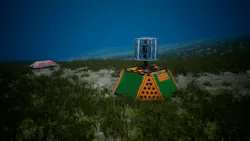
The plan has been developed for monitoring at the Endurance store, a four-way dip-closed anticline, capped by a thick seal with minimal faulting. This makes it a strong candidate for CO2 storage, with a low risk of leakage. There are only three pre-existing (legacy) wells on the structure, and assessments show that these wells have been appropriately abandoned to minimize the risk of leakage. Despite the low risk, the monitoring plan includes landers placed near two of the older legacy wells and at the outcrop where the Bunter Sandstone Formation reaches the seabed, a distance of about 25 km from the nearest injection well.
The monitoring systems will be deployed before CO2 injection begins, so the task will be to collect baseline data for comparison during future operations. This baseline phase is important because it allows project scientists to understand the natural variations in the environment before injection operations commence. By comparing future data to this baseline, the team aims to identify any changes that might indicate a leak or other issue.
Monitoring challenge
Detecting CO2 in the marine environment is challenging because CO2 dissolves quickly in seawater.
The monitoring landers use a combination of sensors to track changes in the environment. Accurate pH sensors measure acidity, which can indicate the presence of dissolved CO2. Other sensors measure conductivity, temperature, depth, nitrate and dissolved oxygen. These readings help build a picture of both chemical and biological activity at the site. A Sonardyne Origin 600 acoustic Doppler current profiler (ADCP) is included in the lander to measure local water currents, which is important for interpreting sensor data and planning future work.
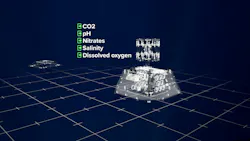
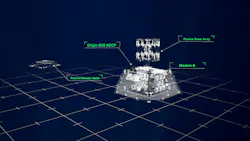
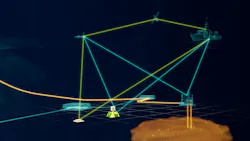
The landers also have a passive sonar array that can detect the sound of CO2 bubbles if a leak occurs. Separate hydrophones are used to record marine mammal vocalizations, supporting broader cetacean migratory path monitoring. Each lander has a subsea electronics module that manages power, stores data and handles communications. Data can be sent acoustically from the lander to a surface vessel or buoy, which then transmits it to shore. The landers are powered by modular battery packs, sized according to the sensors used and the monitoring duration.
Passive seismic
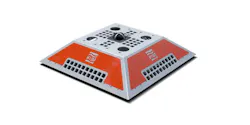
Alongside environmental monitoring, NEP will deploy ocean-bottom seismometers (OBS) to monitor for microseismic activity near the Endurance store. These instruments will work with the UK’s national onshore seismic network to provide detailed data on natural and induced seismic events if any occur. OBS units will be deployed for a two-year baseline period, with annual recovery for data download and battery replacement.
The OBS baseline phase will create a localized reference dataset at Endurance for future comparison during the injection phase.
Moving toward autonomy
Sonardyne is contributing its expertise in subsea instrumentation and acoustic communications to the design and deployment of the lander systems and OBS devices. This technology allows for high-quality data collection with minimal human intervention. As marine autonomous systems develop, uncrewed surface vessels are likely to become more common for data retrieval and equipment checks, improving safety and efficiency. The use of autonomous systems also reduces the need for personnel offshore, lowering operational risks, costs and carbon footprint.
The deployment of monitoring systems at Endurance is an important step in the UK’s CCS strategy. The data collected will help verify that CO2 is stored safely and securely beneath the seabed. This project demonstrates how engineering and technology can support environmental goals and contribute to the transition to net zero. The monitoring plan is also designed to evolve as new technologies and lessons are learned, ensuring that the project remains effective and efficient over time.
Deployment
As the monitoring systems are deployed this summer, NEP will begin collecting high-resolution data on seawater chemistry, microseismicity, seafloor morphology and marine life. This information will be used to assess containment integrity and reservoir response during CO2 injection. Continuous improvement will be a key part of the project, with regular reviews and updates to the monitoring plan based on new findings and technological advances.
The activities at Endurance are not only about storing CO2; they are also about developing evidence base for CCS in industrial decarbonization and building confidence in offshore CCS as a safe and reliable solution for reducing emissions. They are also a practical example of how complex engineering challenges can be addressed through collaboration and innovation.
By focusing on clear goals and using accessible technology, the project aims to deliver reliable results that support both environmental protection and industrial progress. The lessons learned here will help guide future CCS projects in the UK and around the world.
This article is based on a paper presented during the "Environmental and Passive Seismic Monitoring for the Endurance CO2 Store" session on June 10 at EAGE Annual 2026 in Aberdeen. It is co-authored by Jon Tarasewicz and Sarah Buchanan with bp. The full conference paper can be accessed here.
Exclusive content:

 OTC 2026 Day 2 panel session on CCUS
 CCS_offshore energy
About the Author
 Stephen Auld
 Stephen Auld
Stephen Auld is business development manager for Subsea Asset Monitoring and Custom Projects at Sonardyne International. He joined Sonardyne in 2017 after roles including business development manager at Liquid Robotics Oil and Gas and managing director at CodaOctopus.
Related
