Morecambe carbon storage project enters the ‘Assess Phase’
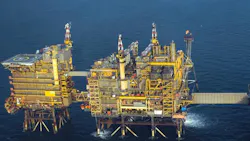
Centrica subsidiary Spirit Energy’s Morecambe Net Zero (MNZ) Peak Cluster development in the East Irish Sea area has moved a step closer to enactment.
The company claims this will be the world’s largest cement decarbonization project, potentially decarbonizing 40% of the UK’s cement and lime industry.
Britain’s North Sea Transition Authority (NSTA) has confirmed that Spirit Energy has successfully entered the "Assess Phase" of its carbon storage license (CS010). This represents a major step toward preparing a permit application to safely inject CO2 emissions in the depleted offshore North and South Morecambe fields, the company said, once gas production ceases toward the end of the decade.
It follows three years of studies by Spirit Energy’s subsurface, wells, projects, HSE, commercial and engineering teams, including new high-resolution 3D seismic acquisition and 3D seismic imaging of the Morecambe fields to demonstrate their fitness for storing about 1 billion metric tons of CO2.
Shearwater Geoservices acquired the seismic data over a 500-sq-km offshore area.
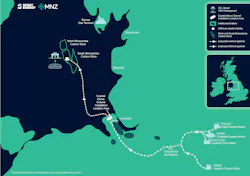
MNZ Peak Cluster and partners would transport 3 MMmt of CO2 per year from four cement and lime plants in Derbyshire and Staffordshire, central England to the depleted offshore gas fields.
Centrica CEO Chris O’Shea said, “By repurposing the Morecambe fields for carbon storage, we can put existing infrastructure to work again, helping secure the future of essential British industry while making real progress towards net zero.”
Spirit Energy’s Director of Energy Transition, Decommissioning and Projects, Matt Browell-Hook, added that this is the UK’s first carbon capture and storage project to secure investment from the National Wealth Fund “and potentially the largest offshore carbon store in the UK.”
Exclusive content:
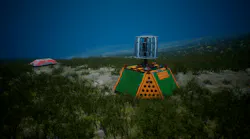 CCS lander on the seabed
 CCS_offshore energy
About the Author
 Jeremy Beckman
Jeremy Beckman
Staff Writer / Editor, Europe
Jeremy Beckman has been Editor Europe, Offshore since 1992. Prior to joining Offshore he was a freelance journalist for eight years, working for a variety of electronics, computing and scientific journals in the UK. He regularly writes news columns on trends and events both in the NW Europe offshore region and globally. He also writes features on developments and technology in exploration and production.