North Sea roundup: Aker BP discovery, Greensand CCS launch and offshore project milestones
Key highlights:
-
Aker BP discovers gas at the Alpehumle prospect in the Norwegian North Sea.
-
Project Greensand launches commercial offshore CO₂ storage operations in Denmark.
-
Heerema begins construction of another 2-GW converter platform jacket for TenneT.
-
Viridien deploys digital monitoring technologies for Ithaca's decommissioned Stella Area assets.
The North Sea continues to see investment across the offshore energy spectrum, from new hydrocarbon discoveries and commercial-scale carbon storage to offshore wind infrastructure construction and post-decommissioning monitoring activities.
Recent developments from Norway, Denmark, the Netherlands and the UK highlight the basin's increasingly diverse mix of energy projects.
Aker BP makes North Sea Alpehumle gas find
Aker BP has discovered gas in the Alpehumle prospect in the Norwegian North Sea, 25 km north of the Duva field.
The Norwegian Offshore Directorate estimates recoverable volumes at 1-15 MMboe.
While relatively modest in size, the discovery could benefit from proximity to existing infrastructure in the area, potentially improving development economics.
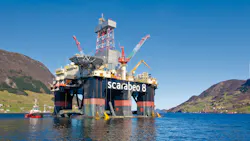
Saipem’s semisub Scarabeo 8 drilled wells 36/4-2 and 36/4-2 A in 255 m of water in production license 1153, encountering a 10-m gas column in the Agat Formation.
Aker BP and co-venturers INPEX Idemitsu, Okea and Harbour Energy will assess the results to determine whether the find is economic for a development, and whether further delineation is warranted.
Official opening for North Sea Project Greensand CCS project
INEOS and its partners have opened the EU’s first full-scale facility for transport and permanent offshore storage of CO2, marking the start of commercial operations at Project Greensand.
The other co-venturers are Harbour Energy and Nordsøfonden.
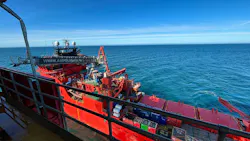
The CO2 will come mainly from Danish biomethane plants. Once captured, the CO2 is liquefied, sent by truck to a dedicated CO2 terminal at Port Esbjerg, shipped aboard the purpose-built CO2 carrier vessel Carbon Destroyer 1, and injected into the Nini West reservoir in the Danish North Sea.
This is a depleted oil field 250 km offshore, and roughly 1,800 m below the seabed.
The initial commercial phase provides storage capacity of up to 400,000 mt/yr of CO2, with plans to expand to 4-8 MMmt/yr as demand develops across Europe.
"Greensand is open for business, and a new European market for permanent CO2 storage can now begin to take shape," said Mads Gade, CEO of INEOS Energy Europe.
Heerema starts work on second TenneT 2-GW converter platform jacket
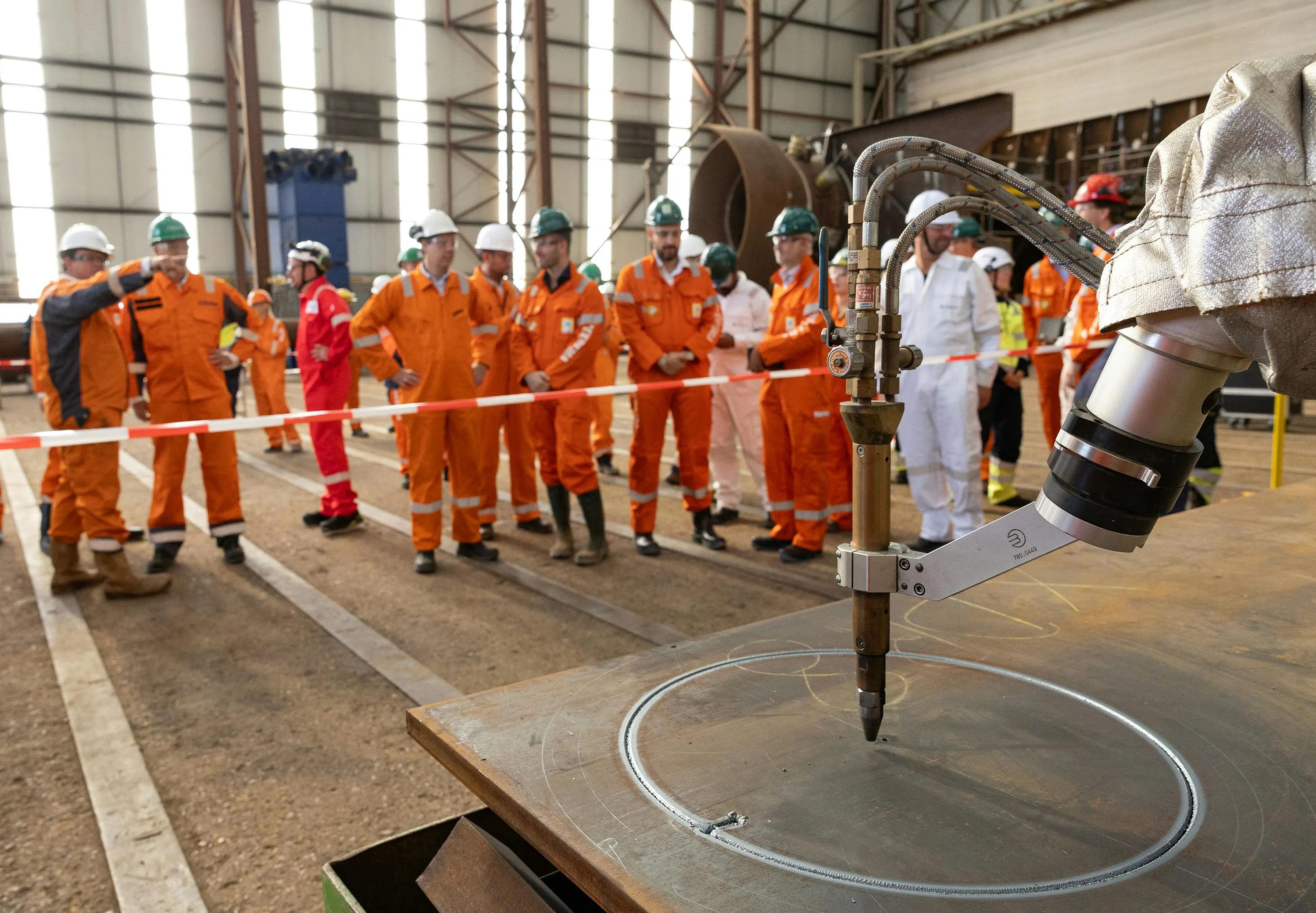
Heerema Fabrication Group (HFG) has staged a steel cutting ceremony to mark the start of construction of the jacket for TenneT’s IJmuiden Ver Gamma converter platform in the Dutch North Sea.
This will be the second jacket built at the Vlissingen site for TenneT's new generation of 2-GW offshore converter platforms.
HFG is constructing the IJmuiden Ver Beta jacket and will also deliver the Nederwiek 2 substructure, working with main contractor GE Vernova–Seatrium. The consortium has commissioned HFG in Vlissingen to build the three jackets.
Two 1,800-mt structural sections for IJmuiden Ver Beta were recently upended. The completed jacket will be around 100 m long, 55 m wide and 46 m tall, with a weight of around 10,000 mt, and will support a near-30,000 mt topside.
All three jackets are being built according to the same standardized 2GW design. TenneT said the standardized design allows lessons learned and fabrication methods to be reused from project to project.
During operation, the converter platform topsides’ power electronics modules will convert the alternating current generated by the wind farms to direct current at 525 kV, enabling transmission over long distances to shore.
The 2-GW platform concept is central to TenneT's strategy of connecting large-scale offshore wind developments more efficiently while reducing costs through standardization and repeatable construction methods.
Viridien supports North Sea Stella area post-decommissioning surveillance
Ithaca Energy has contracted Viridien to perform environmental monitoring and marine situational-awareness services at the Greater Stella Area in the central UK North Sea.
The program, awarded under a five-year contract, involves a post-decommissioning monitoring approach approved by the UK’s Offshore Petroleum Regulator for Environment and Decommissioning (OPRED).
The approach reflects growing use of digital monitoring technologies to support long-term oversight of decommissioned offshore assets while reducing reliance on conventional guard vessels.
It combines’ AIS vessel surveillance using Viridien subsidiary Sercel’s Marlin Vessel Tracking and Alerts (VTA) platform with satellite-based environmental monitoring intelligence from Viridien’s SeaScope service, in place of conventional guard vessel coverage.
The Marlin software delivers an operational picture of real-time vessel movements, offshore infrastructure, geofences and automated proximity alerts. It also displays satellite imagery and interpreted sea surface data from SeaScope.
The integrated monitoring system is designed to help Ithaca identify vessel activity and potential environmental events around decommissioned infrastructure, supporting regulatory compliance and asset stewardship in the Greater Stella Area.
About the Author
 Jeremy Beckman
Jeremy Beckman
Staff Writer / Editor, Europe
Jeremy Beckman has been Editor Europe, Offshore since 1992. Prior to joining Offshore he was a freelance journalist for eight years, working for a variety of electronics, computing and scientific journals in the UK. He regularly writes news columns on trends and events both in the NW Europe offshore region and globally. He also writes features on developments and technology in exploration and production.