Electrification reshapes next-generation CSOV design
By Ariana Hurtado, Editor-in-Chief
Battery-first architecture is driving a shift in offshore wind vessel operations.
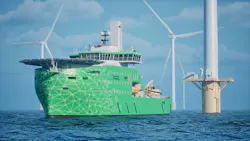
England-based SOV operator Bibby Marine is positioning electrification at the center of its commissioning service operation vessel (CSOV) strategy, advancing a “battery-first” design philosophy that it believes will reshape how offshore wind support vessels are engineered and operated.
The company’s electric CSOV (eCSOV), currently under construction at Armon Shipyard in Spain and scheduled to enter service in 2027, reflects a departure from conventional hybrid approaches in which batteries supplement diesel propulsion systems.

Gavin Forward, vessel newbuild director at Bibby Marine, recently chatted with Offshore about the shift to electrification in offshore wind vessels.
“The most important shift has been moving to a battery-first design philosophy, rather than treating batteries as a support system within a conventional propulsion arrangement," Forward said. "The batteries are the primary power source for operations.”
By placing batteries at the core of the vessel’s architecture, Bibby Marine has reconfigured propulsion, power generation and redundancy systems around energy storage rather than fuel consumption. The vessel features a 24,400-kWh lithium iron phosphate battery system split into three independent sections, supported by rim-drive propulsion and dual-fuel methanol/diesel generators.
Cost and performance gains emerge in hybrid operations
While full zero-emission operations remain dependent on offshore charging infrastructure, hybrid-electric configurations are already delivering measurable operational benefits.
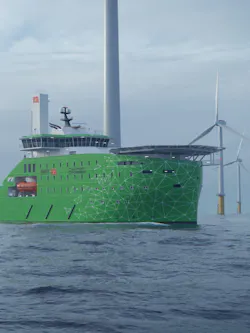
Bibby Marine estimates that operating costs for its eCSOV could be reduced by more than 40% in hybrid mode compared with conventional vessels, driven primarily by lower fuel consumption and more efficient power generation. Additional gains are expected as offshore charging becomes available.
“While fuel savings provide the most immediate benefit, the combined effect of lower maintenance costs, reduced emissions exposure, greater energy price stability and improved operational performance creates a compelling long-term business case for electrification,” Forward said.
Electrification also introduces a more predictable energy cost profile for offshore wind developers, reducing exposure to volatile fuel markets and aligning vessel operations more closely with the renewable energy they support.
Technology readiness no longer the primary barrier
Despite ongoing discussion around alternative fuels and propulsion technologies, Bibby Marine sees electrification as the most practical near-term pathway to zero-emission offshore operations.
“For us, the question is no longer whether electrification is commercially viable. The technology is already here,” Forward added.
Instead, he points to infrastructure, regulatory frameworks and market coordination as the primary challenges to broader adoption. While offshore charging systems are advancing through pilot projects and early deployments, questions remain around power access, permitting, commercial models and integration into wind farm developments.
These constraints are now the focus of industry collaboration, with developers, vessel operators and policymakers working to establish standards and frameworks that can support large-scale electrification.
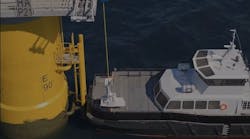 offshore charging
Optimizing the full vessel system, not just the battery
Early design and operational modeling have reinforced that vessel electrification is not simply a matter of increasing battery capacity.
Bibby Marine has conducted extensive analysis of real-world wind farm operations, ranging from transit and dynamic positioning to walk-to-work campaigns, to better align battery sizing with actual energy demand.
“Ultimately, the biggest lesson has been that success comes from optimizing the entire vessel system, not simply installing the largest battery possible,” Forward said.
This systems-level approach incorporates power management, route planning and energy optimization, supported increasingly by digital tools such as advanced energy management systems, digital twins and AI-driven operational planning.
These technologies enable continuous refinement of vessel performance, helping to reduce energy consumption, improve efficiency and support predictive maintenance over the vessel’s life-cycle, Forward added.
Charterers drive new design priorities
Shifting expectations among offshore wind developers are also influencing vessel design and specification.
“Historically, vessel selection was often driven primarily by day rate and basic operational capability," he said. "Today, developers are taking a much broader view, looking at the total operating profile of the vessel over the life of a contract.”
Key considerations include emissions profiles, fuel efficiency, long-term operating costs and readiness for future regulatory requirements.
This shift is driving demand for vessels that can deliver immediate operational savings while maintaining flexibility for future zero-emission operations, he added, reinforcing the case for hybrid-electric and fully electric designs.
 Floating wind turbine off the coast of Karmøy, Norway
Standards and future operating models
One area still evolving is the development of consistent standards for electric vessel performance. Differences in battery capacity, redundancy and operational capability can make direct comparisons difficult for charterers, Forward said.
Bibby Marine is working with classification societies and industry partners to establish frameworks that provide greater transparency and comparability, similar to the role dynamic positioning (DP) notations have played in conventional offshore vessels.
Looking ahead, electrification is expected to extend beyond incremental efficiency gains to influence how offshore wind projects are planned and executed.
As large-scale deployment targets in Europe drive demand for more efficient and predictable operations, electric vessels could play a central role in reducing costs, lowering emissions and enabling new operating models across the sector.
“Electrification is the beginning of a different operating model for offshore wind support vessels, with consequences right across the sector," Forward concluded.
Key takeaways:
- Electrification is already viable. The constraint is infrastructure and policy, not technology. The industry’s focus is shifting from proving the technology to enabling deployment at scale.
- A “battery-first” design approach is reshaping vessel architecture and operations. Electrification is not just a fuel switch; it represents a systems-level redesign of offshore vessels and operating models.
- Charterers are driving the transition through life-cycle cost and emissions priorities. The shift to electrified vessels is being pulled by charter demand, not just pushed by regulation or technology innovation.
About the Author
 Ariana Hurtado
Ariana Hurtado
Editor-in-Chief
With more than a decade of copy editing, project management and journalism experience, Ariana Hurtado is a seasoned managing editor born and raised in the energy capital of the world—Houston, Texas. She currently serves as editor-in-chief of Offshore, overseeing the editorial team, its content and the brand's growth from a digital perspective.
Utilizing her editorial expertise, she manages digital media for the Offshore team. She also helps create and oversee new special industry reports and revolutionizes existing supplements, while also contributing content to Offshore's magazine, newsletters and website as a copy editor and writer.
Prior to her current role, she served as Offshore's editor and director of special reports from April 2022 to December 2024. Before joining Offshore, she served as senior managing editor of publications with Hart Energy. Prior to her nearly nine years with Hart, she worked on the copy desk as a news editor at the Houston Chronicle.
She graduated magna cum laude with a bachelor's degree in journalism from the University of Houston.
Related
