From telecom to power: what subsea cable history reveals about the offshore grid's next decade
Key takeaways:
-
Offshore power cable networks are growing in scale, complexity and strategic importance as offshore wind deployment accelerates.
-
The power cable sector is beginning to follow telecom's path in project scale and ownership models, but maintenance practices remain less mature.
-
New industry partnerships and TSO initiatives could pave the way for more coordinated offshore cable repair and maintenance strategies.
By Hélia Briaud, Spinergie
Subsea power and subsea telecom cables serve different markets, operate at different scales and have almost no overlap in ownership or operations. The telecom sector is well established while the power cable sector enters a new phase of scaling projects, more diverse ownership and a still-to-be-defined maintenance model. Yet, parallels are emerging between the two.
This comparison looks at three aspects of the developing power cable market, with a specific focus on interconnectors, as it scales. In this article, Spinergie examines what can be learned from telecom’s earlier growth spurt through the lens of project size, ownership and repair.
Project scale
The interconnector market has progressed from a national to an international to an intercontinental scale.
Historically, interconnectors were used as a domestic element, connecting remote areas, islands and isolated regions to national grids. However, a gradual international shift saw interconnectors moving toward grid balancing and electricity trading. This is a particularly strong trend in Europe with the 1,000-km Nordlink (2021) between Norway and Germany serving as a key example.
Now the first intercontinental projects are emerging. However, to date, only the 4,000-km AAPowerLink between Australia and Singapore is moving after Xlinks, between Morocco and the UK, was canceled by the latter government in 2025. A Morocco-to-Germany alternative is currently being explored.
Intercontinental projects have been the norm in the telecom sector for years. The pioneering TAT-8 project crossed the Atlantic in 1988, but the current generation goes even further. Notable examples include Meta’s 45,000-km 2Africa that was completed in 2025 and the 50,000-km Project Waterworth that was announced last year. Each project spans multiple continents.
Governance
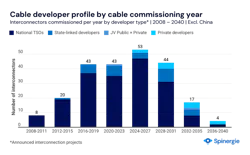
Governance has also seen a significant shift from national transmission system operators (TSOs) to state-linked to private.
TSOs traditionally dominated the interconnector sector, following a domestic logic of national projects for national grids. TSOs were followed by state-linked developers that had more flexibility than TSOs.
Now, private developers are emerging such as Champlain Hudson Power Express, a North American entity developed by Transmission Developers and backed by Blackstone. In Europe, NeuConnect, a £2.4 billion (€2.8 billion) project currently under construction will create the first direct power link between Great Britain and Germany upon completion. These different methods of governance demonstrate that alternative financing and ownership models can emerge.
Interconnectors also saw the shift from public companies to joint ventures to private hyperscalers (GAFAM). It should be noted that the driving forces and nature of private capital in subsea power cables have key differences compared to telecoms.
The regulatory driver has been inverted. Telecom liberalization was demand-led due to 1990s deregulation and the explosion of internet traffic. On the other hand, power is policy-led following EU green targets and offshore wind development.
With private capital, telecom hyperscaler ownership is vertical and strategically purchased for company use in data centers or the cloud. In power, private capital is mainly raised through financial infrastructure investment—as demonstrated with Blackstone on Champlain Hudson, and NeuConnect’s backers—and not based on the end use of the electricity generated.
Spinergie sees that project scale and ownership are diversifying, but the vessels involved in laying and repairing these cables are not yet following the same path.
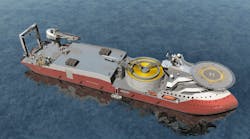 Export cable-laying vessel
The maintenance gap
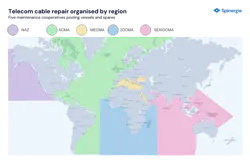
There is a key difference between the telecom market and the power market: telecom has dedicated repair fleets and pools repair equipment by geographic zone while power uses the same cable-laying vessels (CLVs) for both laying and repair.
The power sector faces some barriers to securing this same kind of “task force mutualization."
Technical barrier
The core technical barrier is the universal joint. While it is standardized in fiber telecom cables, this is not yet the case in power cables in terms of voltage, AC/DC, insulation type or manufacturer.
Volume barrier
Telecom operates a network of more than 1.5 million kilometers across more than 600 active systems. This justifies having dedicated fleets designated by zone. While the volume of subsea power cables is increasing, there is not yet the order of magnitude that warrants a dedicated repair fleet.
Nonetheless, the subsea power cables sector is starting to shift, and this can be demonstrated through two examples.
In 2019, Orsted became the first renewable energy member of the Atlantic Cable Maintenance Agreement (ACMA)—one of the telecom regional repair zones.
A framework agreement was signed with Global Marine Group for the repair and replacement of inter-array cables but not the laying of them. This overlap is limited to lower-voltage inter-array cables. The laying and repairing of interconnectors and high-voltage export cables remains the domain of manufacturers with dedicated fleets such as Prysmian, Nexans and NKT, and specialized marine contractors like Boskalis, Van Oord, DEME and N-Sea.
A second example came in April this year when a TSO memorandum of understanding (MoU) was signed at WindEurope in Madrid. The MoU is between Elia (Belgium), Energinet (Denmark), 50Hertz (Germany) and TenneT (Germany and the Netherlands). Over an initial exploratory phase of at least one year, five groups will work toward collaboration methods for repair logistics, spare parts and equipment, fault detection, and legal and financial frameworks.
These two examples show the progression from Orsted’s individual initiative in 2019, to an attempt at a collective power sector structure, seven years later in 2026.
Telecom may not provide a blueprint for the power sector, but it can be thought of as a preview. Ownership and scale are following similar arcs; however, maintenance continues to lag. Recent moves suggest the maintenance gap is beginning to close, but the next decade will show when the move to a dedicated fleet becomes necessary through sheer volume. Whether there will be a wholescale shift will depend on how quickly installed cable volumes rise and how much repair demand grows alongside.
Exclusive content:
 HVDC use on DolWin1 offshore wind farm near Germany
 Offshore wind power cable design graphic
 offshore wind vessel
About the Author
 Hélia Briaud
Hélia Briaud
Hélia Briaud is an offshore analyst at Spinergie, specializing in data analytics and market intelligence for the subsea power cable industry. She brings field expertise from her experience as an officer in the French Navy and ongoing service as a reservist, combining operational insight with data-driven analysis. Her work focuses on supply-demand modeling, predictive forecasting and cable repair analysis to support offshore energy stakeholders in their strategic decisions.