ONS 2026: Offshore wind growth drives interest in multi-terminal HVDC
At a glance:
-
Offshore wind growth is increasing demand for multi-terminal HVDC networks.
-
Integrated offshore grids could connect wind farms, energy hubs and multiple markets through shared transmission infrastructure.
-
Industry collaboration and coordinated planning will be critical to scaling future offshore grid networks.
By Ariana Hurtado, Editor-in-Chief
Offshore wind ambitions continue to expand across Europe, the US East Coast and Asia-Pacific, prompting a shift in how transmission infrastructure is planned and deployed.
In this exclusive Q&A, Andreas Berthou, global head of HVDC (high-voltage direct current) at Hitachi Energy, discusses why multi-terminal HVDC networks are gaining attention, the challenges of building more integrated offshore grids, and what successful offshore implementation could look like over the coming decade.
Offshore: Why are new schemes like multi-terminal HVDC becoming an important integration of more traditional point-to-point systems for future offshore developments?

Berthou: The offshore energy market is entering a period of unprecedented expansion. Across Europe, North America and Asia-Pacific, governments have announced ambitious offshore wind targets as part of their energy security, industrial competitiveness and decarbonization strategies.
The scale of generation being planned over the coming decades is significantly larger than what existing offshore grid architectures were originally designed to accommodate. As a result, the discussion is increasingly shifting from how to connect individual projects to how to develop integrated offshore energy systems.
I believe the role of point-to-point HVDC is not over and a number of future projects will continue to utilize this solution. At the same time, we see that the scale and nature of offshore wind development is changing, starting from how offshore grids are planned. What we see now is a shift from individual project optimization toward system-level thinking, driven by the need to deliver affordable, resilient and sustainable energy at scale.
We are no longer looking at isolated wind farms, isolated national grid reinforcements [or] isolated interconnectors between nations. Our customers and their stakeholders are looking more and more in a holistic manner to the upcoming needs and planning multi-year and multi-purpose. We are looking at an entire offshore ecosystem.
In that environment, it becomes more evident the benefits one could achieve through new grid architectures like multi-terminal HVDC. Each point-to-point project requires its own corridor and infrastructure and is often designed to transport power in one direction (i.e., from generation to load).
However, with the need for grids to become more interconnected and dynamic in their operation, and the need to maximize the utilization and minimize the environmental impact, alternative approaches to traditional point-to-point connections will be needed. We simply cannot build the future energy system by repeating yesterday’s model.
So the issue is not that point-to-point HVDC is obsolete; it remains essential. But on its own, it cannot deliver the level of system efficiency, flexibility and resilience that future offshore grids will require with the best asset optimization and affordability. Multi-terminal HVDC complements this by enabling a more integrated, scalable and future-ready grid architecture.
Offshore: What role could multi-terminal DC (MTDC) networks play in supporting offshore wind clusters, energy islands and hybrid interconnectors?
Berthou: Multi-terminal HVDC represents the transition from point-to-point connections to integrated networks, enabling a holistic approach that supports the grid’s short-, medium- and long-term needs. In many ways, it is the natural evolution of HVDC as we move deeper into the electrification journey.
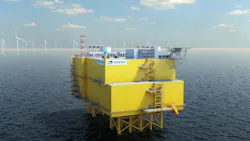
In regions like the North Sea, governments are already planning for offshore wind hubs and energy islands that collect large amounts of green power and dispatch energy to multiple countries. Similarly, hybrid interconnectors—linking wind farms while enabling cross-border exchange—are being deployed as a first step toward more integrated systems. This reflects a broader shift where energy systems are no longer national assets but shared regional infrastructures.
MTDC networks build on that foundation. They allow wind farms, hubs and onshore grids to be interconnected through a shared backbone. That enables the flexibility to harvest power where most abundant at a specific time and also have the possibility to route it where it is needed most, from a grid stability or also from an energy market perspective. This is where technology starts to unlock real system value, balancing markets, improving security of supply and accelerating decarbonization simultaneously.
Offshore: What technical, regulatory and planning challenges still need to be overcome to enable broader offshore deployment?
Berthou: The progress we have seen in recent years is significant, but scaling offshore grids globally requires addressing a few key challenges. If we want to move at the pace required by the energy transition, these challenges must be tackled collectively and proactively.
On the technical side, interoperability is critical. Offshore grids will involve equipment from multiple vendors, across different countries and project phases. Ensuring that converters, control systems and protection schemes can work seamlessly together is essential. This is not only a technical question, but also about building trust in a multi-vendor, multi-stakeholder ecosystem.
On the regulatory side, alignment remains one of the biggest barriers. Offshore grids often cross national boundaries, but regulatory frameworks are still largely national. Questions around cost sharing, especially for anticipatory investments for greater future asset optimization, market access and revenue models need clearer, more harmonized answers. Without this alignment, we risk slowing down projects that are critical for energy security and competitiveness.
From a planning perspective, we need to move earlier and think bigger.
Regions like the North Sea are already shifting toward coordinated offshore planning, but in many parts of the world, development is still project driven. Moving to anticipatory, system-level holistic planning, where the grid is designed ahead of generation is key to unlocking scale.
There is no transition without grids. And ultimately, grids are not a constraint; they are an enabler of growth, resilience and decarbonization.
Offshore: How are developers, regulators, transmission operators and technology providers approaching offshore grid planning and integration?
Berthou: What we see globally is a clear evolution toward stronger coordination. This is one of the most encouraging shifts in the industry today.
In the European region, transmission system operators are increasingly leading offshore grid design, supported by regional initiatives that look at the system as a whole rather than individual projects.
In the US, there is growing momentum toward coordinated transmission planning along the East Coast.
And in Asia-Pacific, governments are beginning to define long-term offshore grid strategies, including grid reinforcement, [and] interconnections for energy trading, alongside renewable targets.
Across all regions, the direction is clear: more integration, more collaboration and more long-term thinking. Developers are adapting to this shift. Grid access is no longer just a connection issue, it is a strategic factor that influences project viability from the outset.
Offshore: What does successful offshore implementation look like over the next decade?
Berthou: Looking ahead, success will be defined at the system level—not by individual projects, but by how well the overall system performs for society.
We will see coordinated offshore grids, particularly in regions like the North Sea, where multiple wind clusters, energy hubs and interconnectors operate as part of an integrated network. Similar models are likely to emerge in other regions with high offshore growth potential, including North America and parts of Asia.
Infrastructure will increasingly be designed for future expansion, not just immediate needs. That means modular solutions, standardized interfaces and a clear pathway from today’s hybrid links to tomorrow’s larger and even more integrated HVDC networks.
Ultimately, success is not just technical. It is about delivering reliable, affordable and sustainable electricity at scale, while making efficient use of both offshore space and onshore infrastructure. It is about enabling economic growth, strengthening energy security and supporting communities through access to clean power.
And perhaps most importantly, it is about enabling cross-border collaboration, because offshore wind, and the grids that connect it, naturally sit beyond national boundaries.
ONS 2026:
Hitachi Energy will be exhibiting at indoor booth 2300 and outdoor booth 370 at the Offshore Northern Seas (ONS) event taking place Aug. 24-27 in Stavanger, Norway. Hitachi executives will be participating in several onsite panel and roundtable discussions; View Hitachi's ONS agenda here.
About the Author
 Ariana Hurtado
Ariana Hurtado
Editor-in-Chief
With more than a decade of copy editing, project management and journalism experience, Ariana Hurtado is a seasoned managing editor born and raised in the energy capital of the world—Houston, Texas. She currently serves as editor-in-chief of Offshore, overseeing the editorial team, its content and the brand's growth from a digital perspective.
Utilizing her editorial expertise, she manages digital media for the Offshore team. She also helps create and oversee new special industry reports and revolutionizes existing supplements, while also contributing content to Offshore's magazine, newsletters and website as a copy editor and writer.
Prior to her current role, she served as Offshore's editor and director of special reports from April 2022 to December 2024. Before joining Offshore, she served as senior managing editor of publications with Hart Energy. Prior to her nearly nine years with Hart, she worked on the copy desk as a news editor at the Houston Chronicle.
She graduated magna cum laude with a bachelor's degree in journalism from the University of Houston.