Potential for steep rise in oil production in South America, if higher prices persist

Sustained oil prices of $100/bbl could lead to increased production across South America of up to 2.1 MMb/d y the mid-2030s, according to recent Rystad Energy analysis.
The impact of the effective closure of the Strait of Hormuz has caused the analysts to revise their original forecast of average oil prices for 2026 from $60 Brent per barrel in January to $89/bbl.
Petrobras stands to gain the most of all countries in the region, with revenues rising by $13.1 billion under the current $89/bbl forecast against January’s $60/bbl baseline.
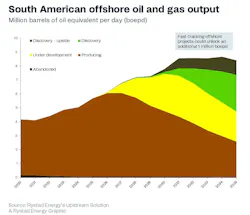
Offshore field developments in Brazil, Guyana and Suriname could provide the most immediate upside. Fast-tracking of projects could add more than 1 MMboe/d over the next decade, said Radhika Bansal, SVP of Oil and Gas Research at Rystad, supported by about $33 billion in incremental greenfield capex through 2035.
In the Stabroek Block offshore Guyana, ExxonMobil is targeting up to 300,000 bbl/d from the Yellowtail project, Bansal said; the field was initially averaging 250,000 bbl/d.
Similar debottlenecking measures could add 80,000 to 90,000 bbl/d across the Errea Wittu, Jaguar and Hammerhead fields elsewhere on the block.
The greatest upside remains in earlier FIDs of new projects, but limited shipyard capacity for new FPSOs could act as a constraint.
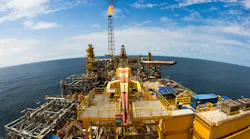
Rystad Energy estimates Venezuela could add 910,000 bbl/d by 2035, 57% coming from existing fields in the East and West provinces with low operating costs.
In March, Shell signed preliminary agreements with PDVSA covering offshore gas and onshore exploration.
The upside could be higher if other E&P companies decide to invest in Venezuela, partly through participation in underdeveloped fields, and through partnerships with PDVSA.

Argentina’s onshore Vaca Muerta could deliver production in a high case of 1.8 MMbbl/d by the mid-2030s, up from 600,000 bbl/d currently.
However, growth across South America will also be governed by execution capacity, supply chain constraints and the broader investment pictures, Bansal said.
Those countries that offer clear fiscal and regulatory frameworks would be best placed to speed up project sanctioning to benefit from the upside of higher prices.