Venezuela reentry: Legal & tax considerations for US offshore operators in 2026
Key highlights:
- US offshore operators should monitor sanctions developments and negotiate contractual clauses that mitigate future regulatory risks and ensure operational flexibility.
- Understanding the implications of US-Venezuela tax treaties and withholding tax regimes is crucial for structuring investments and preserving tax attributes like NOLs.
- Changes in US policy could enable foreign investors to partner with US companies in Venezuelan projects, requiring careful compliance with partnership withholding rules.
To help operators navigate the legal, regulatory and tax considerations at play, and to clarify the risks and requirements ahead, Offshore spoke with the Venezuela Practice Team at Nelson Mullins law firm based in South Carolina.
The following responses represent the collective expertise of three attorneys from Nelson Mullins Riley & Scarborough LLP's:
- John F. Haley (International M&A and Project Finance);
- James D. "Jim" Reardon (International Tax and Oil & Gas); and
- Henry M. Burwell (International Trade & Sanctions).
The attorneys collaborated as a team to address the following questions.
Offshore: What are the most significant legal and tax considerations US energy companies should prepare for if federal sanctions and Executive Orders targeting Venezuela are lifted or modified this year?
Nelson Mullins: Lake Maracaibo and its oil and gas reserves (Lago Cinco and Lagunillas Lago) are within Venezuela. These fields can be operated with drillships or jackup rigs coming from Trinidad & Tobago, Guyana or Curacao. Once anchored and operating, the equipment and personnel are in Venezuelan territory, subject to the same legal regime as onshore drilling operations.
Last year, China Concord Resources Corp., a Hong Kong company (CCRC), entered into a 20-year production sharing agreement with PDVSA to begin drilling activities by sending a jackup rig, the Alula, from Zhoushan port in China across the Pacific, navigating under the Lake Maracaibo bridge. This agreement was negotiated by Nicolas Maduro and called a “productive participation contract,” which provided a more flexible agreement than a traditional joint venture with PDVSA, granting CCRC greater control over oilfield operations and sales. The heavy crude is being shipped to China while any light crude remains with PDVSA.
As sanctions are lifted, US offshore operators and investors should be able to negotiate for more control over operations.
Drilling in the Maracaibo Basin is riskier from a geological point of view than drilling in the Orinoco Belt. Chevron is currently exploring with Venezuelan partners in both the Maracaibo Basin, the Orinoco Belt and a cross-border field along the maritime border between Venezuela and Trinidad & Tobago.
On Jan. 29, 2026, the Office of Foreign Asset Control issued General License 46, which authorizes transactions related to the export and re-export of Venezuelan oil. Any new contracts must be governed by US law, including dispute resolution. Any payments owed to a blocked person must be made to the Foreign Government Deposit Funds pursuant to Executive Order 14373 issued on Jan. 9, 2026, established by the US Treasury Secretary, which will be disbursed in the future according to instructions issued by the Secretary of State.
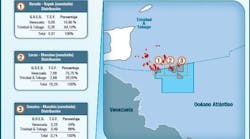 Cross-border projects offshore Venezuela, Trinidad seemingly back on track
Offshore: How might changes to US sanctions affect how companies structure joint ventures, service contracts or investment entities when operating in or alongside Venezuela’s offshore sector?
Nelson Mullins: Any new production sharing agreements, service contracts or joint venture entities involving a US person or entity effectively controlled by a US person will be affected by US sanctions regulations on Venezuela (31 CFR Part 591) and subject to the licensing provisions and directives of the US Department of Treasury Office of Foreign Asset Control (OFAC) and multiple Executive Orders [EOs] including EOs 13692, 13808, 13827, 13835, 13850, 13857, 13884 and 14373. As such, US law will influence the structure and scope of the proposed activities.
A US company that was in existence on Jan. 29, 2025, pursuant to General License 46, known as an “established US entity,” is now authorized for new activities as exceptions to existing sanctions on activities formerly prohibited. Under GL46, any new contracts must provide for dispute resolution in the US, including arbitration.
On Feb. 10, 2026, OFAC issued General License 48, which is entitled “Authorizing the Supply of Certain Items and Services to Venezuela” for the exploration and production of oil and gas, which also provides for contracts to be subject to US law and dispute resolution. However, GL48 provides additional limitations and reporting requirements. This means threading the needle between compliance with new Venezuelan laws and regulations, like the Hydrocarbon Reform Law of Jan. 29, 2026. This may be easier for offshore operators than onshore operators.
There may be more room for negotiating operational control according to international offshore practices and customs rather than from a purely Venezuelan law perspective. For example, equipment coming from Trinidad & Tobago, and oil production directly shipped outside of Venezuela (except for PDVSA’s share of the production) may be allowed to avoid many aspects of standard Venezuelan bureaucracy. The contracts could specifically provide an exemption from requirements that would go along with onshore concessions or production sharing agreements. US companies must track sales of Venezuelan oil and provide reports to the Department of State and Department of Energy.
 Venezuela oil output
Offshore: From a federal tax perspective, what are the primary risks or exposures US companies should reassess when considering reentry into Venezuela’s offshore oil and gas business?
Nelson Mullins: Under the US-Venezuelan Tax Treaty (Jan. 25, 1999), Article 5, paragraph 3, provides that a “permanent establishment” includes a building site or construction or installation project, or an installation or drilling rig or ship used for the exploration of natural resources, but only ... if such project or activities continues for more than 183 days within any 12-month period.”
Likewise, the furnishing of consultancy services through employees within Venezuela for periods aggregating more than 183 days in any 12-month period results in a “permanent establishment” in Venezuela. Once a US company has a ”permanent establishment” in Venezuela, the US company is subject to the income tax jurisdiction of the Venezuelan government, which can be imposed at the federal, state and municipal level.
Offshore: If US companies resume activity in Venezuela, how might debt restructuring, new capital injections or changes of control interact with NOL preservation rules and other federal tax attributes?
Nelson Mullins: From a US income and withholding tax law perspective, it would be best to structure Venezuelan investment through an entity that is disregarded or treated as a tax partnership, so that losses and Venezuelan income tax credits flow through to the US shareholder. Venezuela imposes a corporate income tax at marginal rates of 15%, 22% and 34%, which can go as high as 50% for certain oil and gas businesses. Venezuela imposes withholding tax at a 5% or 15% rate on dividends paid to US shareholders, at a rate of 4.9% or 10% on interest paid to US creditors, and a rate at 5% or 10% for royalties.
Article 11A of the Tax Treaty allows the source state to impose a branch profits tax on the remittance of profits from a branch back to its home office equal to 5% on the “dividend equivalent amount.” Venezuela imposes its branch profits tax on deemed remittances of profits, unless the company can prove the profits were reinvested in Venezuela. The deduction of interest from a Venezuelan entity is subject to thin capitalization rules (a debt-to-equity ratio of 1 to 1).
Offshore: What implications could a shift in US policy have for foreign investors partnering with US operators in Venezuelan offshore projects, particularly with respect to withholding tax regimes and the Foreign Investment in Real Property Tax Act?
Nelson Mullins: General License 46 does not apply to non-US companies, non-US investors or newly formed US joint venture entities. At the moment, non-US companies can provide services to US companies conducting oil and gas operations in Venezuela. A change in US policy could allow foreign investors to partner with US companies in joint ventures to explore for and produce oil and gas in Venezuela. It is anticipated that these joint ventures will be governed by US law. Non-US investors will have to address US partnership withholding tax rules, especially if the joint venture carries on business in the US, including a withholding tax on sales or dispositions of US partnership interests.
Offshore: Do you foresee any intersection between potential Venezuelan policy changes and US companies’ ability to leverage Inflation Reduction Act (IRA) tax incentives, particularly for firms balancing traditional offshore portfolios with emerging renewable investments?
Nelson Mullins: The US allows a foreign tax credit for foreign taxes with respect to non-US source income or profits first before renewable energy tax credits are claimed.
A US company with income from Venezuelan operations is likely to use foreign tax credits arising from paying Venezuelan taxes first. These foreign tax credits may be limited under Internal Revenue Code Sections 904 and 907, and thus, the foreign taxes may not fully offset the US tax liability on “Foreign Oil and Gas Income.”
If that is the case, renewable energy tax credits could be used to offset the residual US tax liability on Venezuelan oil and gas income. Assuming a US company is entitled to the IRA tax credits from investment in US renewable energy projects, and assuming the US company or investor does business in Venezuela through a disregarded entity or tax partnership, the US company or investor may be allowed to offset the US tax liability arising from the Venezuelan income or profits with renewable energy tax credits. These tax credits are not allowed with respect to renewable energy projects or investments constructed outside of the US.
Offshore: What due‑diligence steps should US offshore operators prioritize now to prepare for a scenario where political shifts in Venezuela open new development windows but still carry long-term regulatory uncertainty?
Nelson Mullins: US operators should try to lock in a regulatory regime with PDVSA for the duration of their production sharing contracts or service agreements or have a liquidated damages clause for any changes in law or regulation that occur in the future in Venezuela that adversely affect the underlying operation of the oil and gas production.
In addition, US operators could insert clauses that allow for repricing or additional compensation to address future changes in regulation, capital controls, impaired ability to repatriate capital, higher taxes or other government-initiated policy changes that would adversely affect the ability of a US company to achieve the benefit of its bargain with PDVSA.
About the Author
 Ariana Hurtado
Ariana Hurtado
Editor-in-Chief
With more than a decade of copy editing, project management and journalism experience, Ariana Hurtado is a seasoned managing editor born and raised in the energy capital of the world—Houston, Texas. She currently serves as editor-in-chief of Offshore, overseeing the editorial team, its content and the brand's growth from a digital perspective.
Utilizing her editorial expertise, she manages digital media for the Offshore team. She also helps create and oversee new special industry reports and revolutionizes existing supplements, while also contributing content to Offshore's magazine, newsletters and website as a copy editor and writer.
Prior to her current role, she served as Offshore's editor and director of special reports from April 2022 to December 2024. Before joining Offshore, she served as senior managing editor of publications with Hart Energy. Prior to her nearly nine years with Hart, she worked on the copy desk as a news editor at the Houston Chronicle.
She graduated magna cum laude with a bachelor's degree in journalism from the University of Houston.