Build-to-operate approach leading to faster, more reliable FPSOs
Key highlights:
-
MODEC’s Build-to-Operate philosophy brings reliability, maintainability, safety and energy efficiency into project decisions from the outset.
-
Lessons from Brazil’s presalt developments are informing MODEC’s first FPSO in Guyana, while new challenges there will shape future projects.
-
Early coordination among operators, contractors, suppliers and shipyards can help manage interfaces, secure capacity and reduce schedule risk.
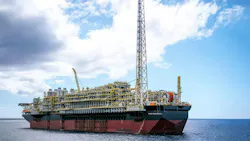
Operational experience, early collaboration and digital tools can help improve FPSO project execution and long-term value, according to Soichi Ide, senior executive managing officer, head of the Floating Production Solutions Business Unit, and Chief Digital Officer at MODEC.
Ide recently spoke with Offshore about how offshore project execution is changing in the age of mega-projects. Drawing on projects in Brazil and Guyana, he discussed execution risks, supply-chain constraints, emissions and lessons for future FPSOs.
Offshore: What distinguishes today’s most successful offshore projects from those delivered a decade ago?
Ide: We should start with a simple point: an FPSO does not create value merely because it has been delivered. It creates value through safe, steady production. The challenge is to bring that production online sooner and sustain it efficiently for decades.
The industry was already delivering highly complex deepwater FPSOs a decade ago. What is evolving is how we bring the realities of operating those facilities into the earliest project decisions. Reliability, maintainability, HSE and energy efficiency cannot be left for the operations team to address after construction. They must influence design and execution from the beginning.
At MODEC, this is the basis of our 'Build-to-Operate' philosophy. Because we both deliver and operate FPSOs, we live with the consequences of design and engineering decisions over the long term. That experience changes the questions we ask before a facility is built:
- How it will be maintained?
- How reliably will it produce?
- How much energy will it consume?
- And how can it be improved throughout its life?
The learning runs in both directions. Experience from operations informs future designs, while lessons from engineering, construction and startup improve subsequent projects. Digital technologies and AI allow us to accelerate that cycle leveraging our close to 400 years of operating data.
For the client, the objective is not simply a well-executed construction project. It is greater value over the life of the field.
Offshore: What are the most important project execution lessons emerging from recent developments in Guyana and Brazil?
Ide: Brazil has taught us hard lessons. We have had difficult projects, but learning from them has made MODEC a stronger company.
Over more than two decades, we have developed alongside Brazil’s presalt industry, and our fleet currently anchors approximately 30% of presalt production, working in deep and ultradeep waters as demand grew for larger, more productive and more energy-efficient FPSOs. That experience has strengthened both our technical capabilities and our understanding of what clients need during field lifecycle including development and production.
One example is the Bacalhau FPSO, which had a production capacity of 220,000 barrels of oil per day. It introduced MODEC’s newbuild hull, providing more space for topsides and greater storage capacity than traditional designs based on converted VLCCs. It also incorporated combined cycle gas turbine (CCGT) power generation, which only produces 9 kg CO2 per barrel of oil, which is more than 20% lower than traditional solutions. Technologies for reducing gas emissions from that development have since been applied to other projects.
That is the practical value of experience, a solution developed for one project becomes part of the starting point for the next.
We are now bringing that experience into our first FPSO in Guyana. The conditions and requirements are different, but we are not starting from zero. Equally, Guyana is presenting new challenges and generating lessons during execution that we will carry into subsequent projects.
The lesson is not to copy one project into another. It is to understand what can be carried forward, what must change and how to apply that judgment early enough to make a difference.
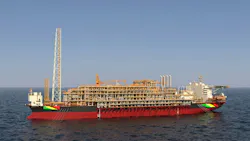
Offshore: As projects grow larger and more complex, where do operators still underestimate execution risks?
Ide: Risk can be underestimated at the points where different parts of a project meet. An FPSO involves engineering, procurement, construction, commissioning and operations across many large networks of teams and suppliers. A decision in one area can have consequences across several others. Managing each activity well is not enough if the connections between them are poorly understood.
This is why the timing of decisions, and who contributes to them, matters so much. Operational requirements need to be understood during engineering. Equipment procurement needs to be aligned with construction. Yard capacity and long-lead items need attention before they become schedule constraints.
We are starting to see the nature of our relationship with operators changing. They are placing greater value on the design and operating expertise we bring to the table, given we have delivered and are operating more facilities than most of the operators in the world. Our contribution is not limited to executing a specification. Experience across successive FPSOs allows us to help clients assess how design and execution choices will affect production, operations and hence field life value.
We are therefore becoming involved earlier to help shape major decisions around the facility and its operating model. That is how our clients gain more of the benefit of our accumulated experience. The best partners reduce risk, not just cost. They help identify consequences before those consequences become expensive to address.
Offshore: Which parts of the offshore supply chain remain the greatest constraints, and what can the industry do to address them?
Ide: In the era of increasing demand of energy supply, supply-chain constraint is everywhere. The pressure points include engineering resources, specialized equipment, fabrication capacity and shipyard availability. Their relative importance varies with the project and the market cycle; there is not one constraint that explains every development.
The industry needs to identify those pressures earlier. Better visibility of future demand allows clients, vendors and suppliers to plan capacity, anticipate long-lead requirements, and align engineering and procurement with the execution schedule. Waiting until a constraint becomes visible on the critical path leaves fewer options.
Over successive projects, we find early engagement and greater use of our proven, standardized designs can make execution more predictable. But we recognize that standardization must remain compatible with the needs of each project. Different projects may require different combinations of yards, suppliers and specialist capabilities.
The right approach depends on the FPSO’s requirements and the capacity available, not simply on repeating the same contracting arrangement. The aim is to carry forward what works while retaining the ability to adapt.
Offshore: How can operators, contractors and suppliers work together more effectively to improve schedule certainty and project outcomes?
Ide: It starts with trust, and trust cannot be created at the beginning of a tender. It is built through decades of working together, understanding each other’s capabilities and resolving problems.
But trust has to translate into how the project is managed. An FPSO schedule is not controlled by MODEC alone. It depends on connected processes across engineering teams, equipment suppliers, fabrication facilities and shipyards.
With MODEC, we are focusing our efforts on two fronts:
-
Internal programs to deliver industry leading efficiency and speed through initiatives such as parallel engineering, digital and AI-enabled workflows across engineering and procurement to design and build right the first time; and
-
Long-standing partnerships that allow deeper coordination and integration across those processes. This can mean changing the traditional process, allowing construction needs to drive engineering. Combined with early client engagement, they help us anticipate critical decisions, secure shipyard capacity and order long-lead equipment earlier.
The objective is not simply a shorter construction schedule. It is to bring production forward with the FPSO ready to operate safely and reliably. Schedule improvement and operational readiness have to be pursued together.
Offshore: How are operator expectations evolving around emissions reduction, digitalization and operational performance, and how is that influencing project execution?
Ide: Clients increasingly need these requirements to be addressed together. Energy consumption, emissions, uptime and operating efficiency are connected, and decisions made during engineering and construction influence all of them.
For us, the case for reducing emissions does not depend only on whether external pressure is stronger or weaker in a particular year. Wasted energy is an operating inefficiency. Improving energy efficiency means making better use of resources as well as reducing emissions.
That is why we think in decades, not just in projects. When we expect to operate a facility for more than 20 years, we must consider the consequences of today’s decisions over that entire period.
Digital technology gives us another way to connect that long-term experience with better decisions. Cumulatively, our 400 years of operational data provides an important foundation for our AI-driven solutions, helping us apply what we learn across assets rather than treating every facility in isolation.
Our first FPSO in Guyana, Uaru, offers an example of the direction we are taking. Its new system architecture enables operation from onshore. Combined with our AI operational-support suite, we see an opportunity to change how expertise and information support offshore operations. This is a capability we want to develop further, not simply a technology feature to add to a project.
The test is whether these tools help people make better decisions and improve the facility’s performance. Those insights should then influence the next design, as well as the FPSOs already in operation.
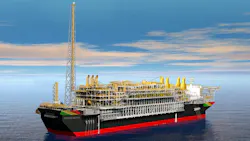
Offshore: Looking toward 2030, what execution trends will have the greatest influence on the success of major offshore developments?
Ide: Speed will matter greatly, it is key to faster development of oil and gas. One way industry can become faster is by carrying more knowledge forward.
That means greater use of proven designs and technologies, more repeatable execution and a systematic approach to lessons learned.
At the same time, every field has its own technical requirements and operating conditions. The challenge is to make execution repeatable without making it rigid.
For a company like MODEC, supply chain integration is also critical. Faster delivery does not only depend on MODEC but also our partners in the value chain. Without engaging these partners, projects can never be fully optimized for faster delivery. Achieving deep integration of management systems, therefore, requires long-term partnerships with the supply chain.
For MODEC, our 'Build-to-Operate' philosophy adds another dimension to this. Because we remain with these assets through decades of operation, what we learn from one FPSO can feed directly into how the next one is designed, engineered and delivered. By using experience, technology and our partnerships with different stakeholders involved in each project, every FPSO we operate improves the next one.
Exclusive content:
About the Author
 Ariana Hurtado
Editor-in-Chief
With more than a decade of copy editing, project management and journalism experience, Ariana Hurtado is a seasoned managing editor born and raised in the energy capital of the world—Houston, Texas. She currently serves as editor-in-chief of Offshore, overseeing the editorial team, its content and the brand's growth from a digital perspective.
Utilizing her editorial expertise, she manages digital media for the Offshore team. She also helps create and oversee new special industry reports and revolutionizes existing supplements, while also contributing content to Offshore's magazine, newsletters and website as a copy editor and writer.
Prior to her current role, she served as Offshore's editor and director of special reports from April 2022 to December 2024. Before joining Offshore, she served as senior managing editor of publications with Hart Energy. Prior to her nearly nine years with Hart, she worked on the copy desk as a news editor at the Houston Chronicle.
She graduated magna cum laude with a bachelor's degree in journalism from the University of Houston.
Related
 offshore FPSO unit
 FPSO ONE GUYANA
