Frontier exploration extending to more basins offshore Africa
Key highlights:
- Up to 19 high-impact wells are expected to be drilled in Africa and the Mediterranean in 2026, focusing on frontier basins and emerging plays.
- Namibia's Orange Basin remains a key exploration area, with recent discoveries like Volans and Mopane shaping future drilling and development plans.
- Greece is preparing for its first deepwater exploration well since 1981, with major companies like ExxonMobil and Chevron involved in new licensing rounds and seismic surveys.
- Libya's offshore acreage is expanding with new licenses, but exploration activity remains slow due to high costs and complex geology.
- East Africa's offshore frontier, including Somalia and Kenya, presents potential for significant discoveries, with TPAO preparing to drill Somalia’s first deepwater well, Curad-1.
By Jeremy Beckman, Editor, Europe
Africa looks set to be the shining light for deepwater exploration this year. Up to 19 high-impact wells could be drilled around the continent, according to Westwood Global Energy Group’s recent Key Wells to Watch in 2026 webinar.
Some of the activity will be in the Orange Basin, building on the stand-out successes of 2025 at Mopane and Volans, both offshore Namibia. But Westwood has also identified potential high-impact drilling in 11 other frontier basins, including in the Mediterranean Sea and offshore East Africa. And in the emerging deepwater play fairway offshore Côte d’Ivoire, the region’s leading operator, Eni, has already swelled its resource base with the recent Calao South gas-condensate discovery. This was the first well drilled on block CI-501, uncovering an estimated 1.4 Bboe resource.
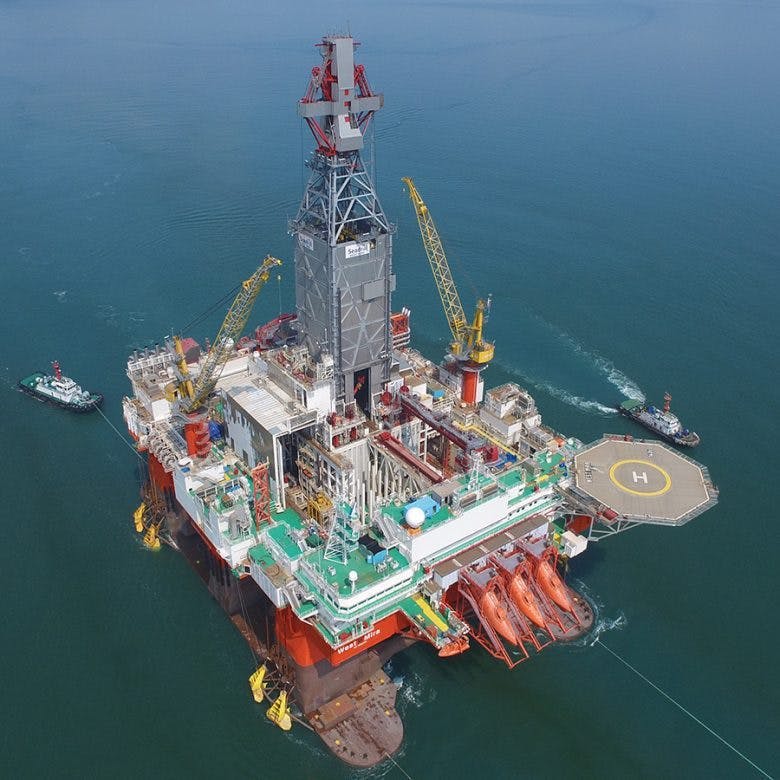
Westwood expects four high-impact wells to spud this year in the Orange Basin offshore Namibia, with Shell and partners QatarEnergy and NAMCOR likely resuming their search in the deepwater PEL0039 license. They had previously drilled nine wells across the license, which yielded two large oil discoveries, Graff in 2022 and Jonker in 2023, about 270 km offshore.
Shell later announced that it would write off all drilling costs to date, with Namibia’s Ministry of Mines and Energy later declaring both finds non-commercial at present due to technical constraints associated with subsurface complexity and reservoir quality (permeability). Other reported issues included a high gas-to-oil ratio.
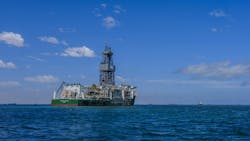
For the new campaign, Shell has hired Northern Ocean’s Deepsea Mira semisubmersible rig, operated by Odfjell Drilling, with the program potentially starting in April.
To the north, Chevron plans to drill the first well since 2018 in the frontier Walvis Basin on the Gemsbock prospect in the offshore PEL 82 permit, shrugging off the disappointment of the dry hole Kapana-1X well that the company drilled in the Orange Basin last year (PEL 90). PEL 82 covers an 11,400-sq-km area, 72 to 300 km offshore.
Chevron operates in partnership with NAMCOR and Custos Energy. Sintana Energy, which has an indirect interest in Custos, said the partnership could drill up to 10 exploration wells and planned large-scale seismic acquisition. Sintana added that the Walvis Basin’s shallower waters and identified geological structures may both represent lower operational risks.
Immediately north of PEL 82 is PEL 37, Sintana is considering a farm-in to PEL 37, currently operated by Namibian company Paragon Oil and Gas, with water depths ranging from 100 m to 1,500 m. Analysis has revealed potential prospects at water depths between 300 m and 600 m, with numerous large fans said to be directly overlying a proven, mature oil-prone Aptian source rock. Sintana has until April 30 to complete a due diligence exercise that could lead to the company becoming a shareholder in Paragon and indirectly a partner in the license.
North of Venus
Earlier this year, TotalEnergies signed agreements to acquire a 42.5% operated position in PEL104 in the 11,000-sq-km southern Lüderitz Basin from Eight Offshore Investments Holdings and Maravilla Oil & Gas. Petrobras too agreed to join by taking 42.5%. Assuming that the Namibian authorities approve the transactions, the other co-venturers will be Eight with 5% and Namcor with 10%.
The license area is just north of TotalEnergies’ existing exploration acreage around its Orange Basin discoveries, including the ultradeepwater giant Venus in PEL 56, where the partners are moving toward FID in 2026 or early 2027 on a phased, FPSO-based development.
Vancouver-based Meren Energy, which has an indirect interest in PEL 56 via its part-ownership of Impact Oil and Gas, said in its latest results statement that the base-case concept for the current FEED work involves up to 40 subsea wells tied back to a single FPSO designed to handle about 160,000 bbl/d, with reinjection offshore of the associated gas.
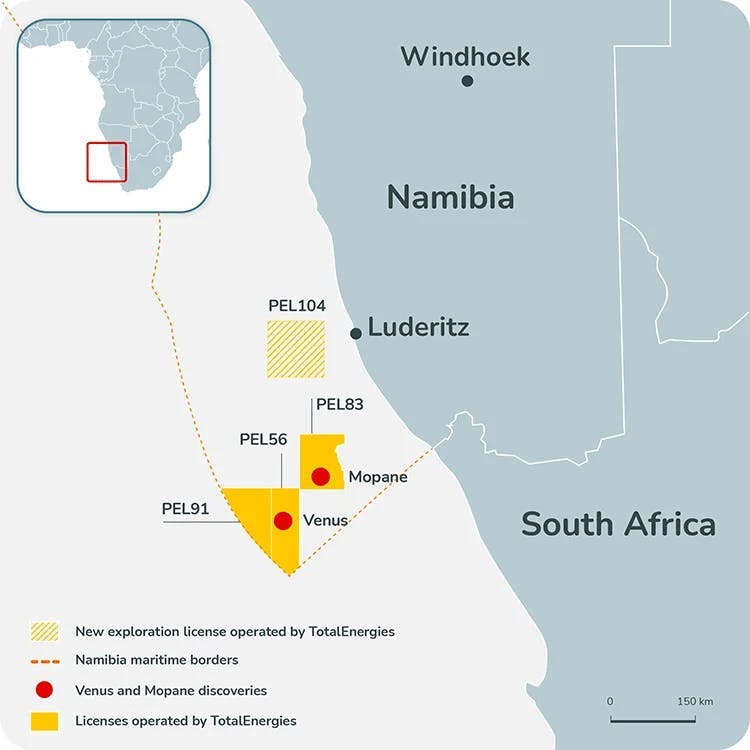
TotalEnergies is also working to complete a transaction with Galp Energia, announced last December, under which TotalEnergies would assume operatorship from Galp of PEL 83 and the potentially larger deepwater Mopane oil discovery to the northeast, with Galp in return admitted as a partner to PEL 56 and PEL 91 to the west.
In addition, the two parties plan a new three-well exploration and appraisal campaign, starting later this year on Mopane.
And in February of this year, the region’s other successful deepwater exploration operator, Rhino Resources, confirmed strong test results from last year’s Volans-1X gas-condensate discovery within the Upper Cretaceous in Orange Basin offshore Block 2914A. Follow-up well testing operations in January delivered 33 MMcf/d of gas and ~5,300 bbl/d of condensate on a 46/64 choke, with a high liquids and low CO2 and H2S content.
CEO Travis Smithard said the flow data indicated that the well had been drilled into a geologically contiguous reservoir system, which is a good sign for a future development. The partners, which include Azule Energy, NAMCOR and Korres, are now assessing next-step appraisal, development and production activity across the acreage, he added.
Others with exploration acreage nearby include the Pancontinental-led joint venture for PEL 87, which is said to be on trend with Venus, Mopane and Graff. Pancontinental Orange’s technical studies to date suggests that good-quality and mature source rocks may be present within the permit, along with large turbidite-related reservoir systems. Based on a review of 3D seismic data over the license, the company has identified eight key prospects and leads, with the stand-outs being Oryx, Hyrax and the Northern Channel. The company has secured a 12-month extension from the Namibian Ministry of Industry, Mines and Energy to the PEL 87 First Exploration Period until Jan. 22, 2027. This is conditional on a work program that includes reprocessing 3D seismic data, seismic interpretation, submitting an environmental impact assessment, and drilling an exploration well at the earliest point possible. Pancontinental said the support should help it to progress efforts to bring in a partner to take these activities forward.
Finally, another of the forthcoming high-impact wells identified by Westwood Global Energy Group, is Azule Energy’s Piambo in the previously undrilled Namibe Basin offshore northern Namibia. This extends from the Walvis Basin toward the maritime border with Angolan border, and it is thought to form part of the same rift system in which Angola’s Lower Congo and Kwanza basins are situated.
Trade-outs to continue
Ian Thom, research director of Upstream Research at Wood Mackenzie, says the recent transaction activity offshore southern and central Namibia will probably continue.
“Farm-ins are common in developing resource plays, as companies with the capacity to explore and develop positions gain exposure to the play," Thom said. "Although many promising blocks have already changed hands, further deals are possible, especially if new finds expand the productive zone.”
Vincenza Papaleo, Wood Mackenzie’s principal analyst of Sub-Saharan Africa Upstream Research, added, “The Orange Basin remains in its exploration phase, with each new well adding critical data that refines understanding of the basin. Recent discoveries, including Volans, continue to improve basin knowledge. Mopane (2024), Capricornus (2025) and Volans (2025) all demonstrate high-quality reservoir characteristics in the inner Orange Basin, unlike deeper-water finds in the outer section of the basin that encountered permeability limitations. Volans has delivered particularly encouraging results, encountering a reservoir containing rich gas and condensate at a condensate-to-gas ratio of 160 bbl/MMscf."
Fluid composition varies across the three discoveries: the six reservoir layers drilled in Mopane have differing fluid properties, Capricornus contains light oil and Volans holds rich gas-condensate, she continued. This variability indicates a complex petroleum system where continued exploration adds data and refines understanding.
“Exploration in the Walvis and Lüderitz basins builds on Orange Basin success but is supported by underlying geological similarities," Papaleo said. "The geological plays remain consistent across all three basins, and this geological continuity provides the rational basis for exploration.”
As for the transition toward the first phase of field developments, Thom expects both Venus and Mopane to proceed soon.
“Venus is ready for investment this year, while Mopane requires more appraisal drilling and engineering work before development; it is several years behind Venus," Thom said. "TotalEnergies will be looking closely at sequencing of activities and capacity to deliver the projects. While running two projects in parallel may put strains on capacity in certain areas, including yards or ports, there may be scope for synergies and efficiencies with upgraded capacity being utilized for both projects.”
Is there the potential for a spanner in the works? Although Namibia’s investment terms have supported the intensifying exploration activity, the mood might change if the government opted for a much less favorable royalty arrangement for future field developments.
Thom thinks this is unlikely. “Governments assess a variety of factors when establishing tax policies related to oil and gas licenses or contracts," he explained. "Additionally, they consider broader factors affecting the sector, such as employment, training, development of the local supply chain, domestic gas supply, energy security and the growth of local industry.
“A key theme in taxation is that fiscal terms should reflect the prospectivity and risk. In Namibia's case, one view is that following several significant discoveries since 2022, exploration risk has decreased, potentially justifying higher tax rates for new licenses. Alternatively, it should be recognized that many recent finds are sub-commercial or challenging. Shell, for example, drilled nine wells but wrote off the associated expenses. The Venus discovery by TotalEnergies presents substantial technical challenges due to low permeability reservoirs, high gas content and far offshore in ultradeepwater locations. Many prospective blocks remain in ultradeepwater areas, and numerous Namibian basins are still under-explored. Namibia must balance the risk profile perception and wider policy factors to ensure it has competitive tax rates to stimulate ongoing investment and activity.”
Positioning offshore South Africa
TotalEnergies and others have also taken exploration blocks over a potential southerly extension of the Orange Basin plays offshore the west coast of South Africa. In September 2024, the country’s Department of Mineral Resources and Energy for the Republic of South Africa granted an environmental authorization for exploration activities (up to five exploration wells) on Block 3B/4B.
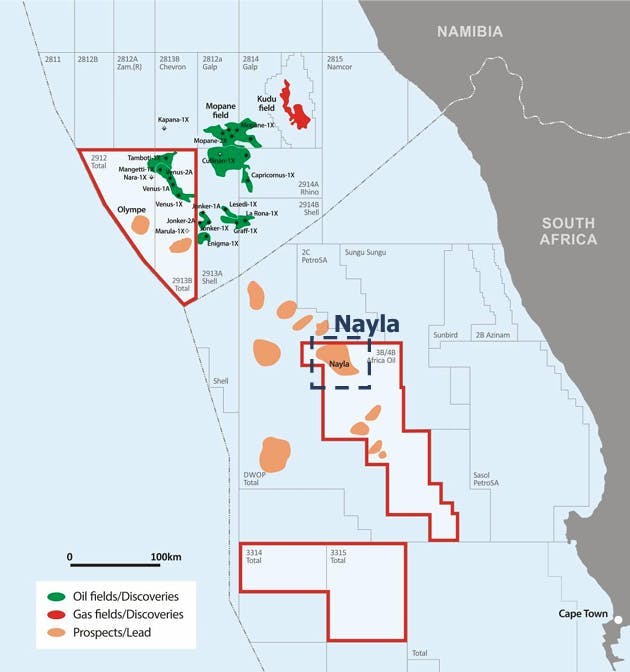
According to one of the co-venturers, Meren Energy, operator TotalEnergies has since stated that the current plan is to drill the first exploration well on the block as soon as the environmental authorization is confirmed. (This is currently held up by third-party legal proceedings concerning environmental authorization for Block 5/7). Nayla, a 678-MMboe fan prospect that lies in the northwest of the Block 3B/4B license area, is the potential drilling target. Another identified prospective structure is the 422-MMboe Aardwolf.
Toronto-based Eco Atlantic, which also holds a minority interest in Block 3B/4B via its subsidiary Azinam, has been developing a relationship with Navitas Petroleum over the past year. Eco confirmed in a recent results statement that Navitas has an option to farm in as operator to exploration Block 1 CBK offshore South Africa, on the maritime border with Namibia, with an interest of up to 47.5%. If approved by the authorities, Eco would retain a similar stake and would be carried by Navitas for the forward work program.
Does TotalEnergies’ exploration position suggest the company is confident that South Africa’s government would support development of any future finds, despite the negative outcome to the company’s proposals for its deepwater Brulpadda/Liuperd discoveries to the east in the Outeniqua Basin?
Papaleo takes a positive view: “The Cretaceous deepwater turbidite play proven in Namibian waters extends across the border into South Africa's Orange Basin blocks, providing the geological basis for operator interest. The earlier Brulpadda and Luiperd discoveries encountered gas and condensate. Development progress has been limited by gas price negotiations. Current Orange Basin exploration targets oil, which has more favorable commercial characteristics than gas for the South African market.”
Heading north again, there has been a resurgence in exploration in recent months offshore Angola, spearheaded by the bp/Eni joint venture Azule Energy. This led to the country’s first purposely gas-led offshore discovery, Gajajeira (in shallow water), and the 500-MMbl in-place Algaita oil find earlier this year on the prolific Block 15/06 in the Lower Congo Basin.
“While the Namibian discoveries have increased regional interest in the Atlantic margins,” Papaleo said, “Angola's recent exploration activity stems from domestic fiscal reforms, revised licensing strategy, and untapped prospectivity in both frontier and mature areas. Operators continue to pursue Tertiary plays in the Lower Congo basin, including ultradeepwater extensions, as demonstrated by TotalEnergies' Ondjaba well (2021) and Azule Energy's Quitexe-1X well (2025). Additionally, older and deeper Cretaceous plays are being tested across both frontier and established areas.”
Libya back in spotlight
Offshore North Africa, Westwood highlighted key frontier basin tests ahead, such as Shell’s Velox well in the Herodotus Basin in the Egyptian sector of the Mediterranean Sea, and bp/Eni’s Matsola well, which was spudded in January in 1,900 m of water in the Sirte Basin offshore Libya.
In February, Eni expanded its Libyan offshore acreage after being offered License 01, in partnership with QatarEnergy, under National Oil Corp.’s (NOC) 2025 open licensing round. The 29,000-sq-km block is in the offshore extension of the Sirte oil and gas province and contains various stranded oil and gas discoveries. The partnership plans 2D and 3D seismic acquisition and drilling during the initial five-year exploration period. Another consortium comprising Repsol, TPAO and MOL was offered offshore Block 07.
Despite the recent awards and the current well, Martijn Murphy, principal analyst of Upstream North Africa and Eastern Mediterranean at Wood Mackenzie, expects deepwater activity in Libya in the near future to be slow.
“Deepwater offshore Sirte Basin is frontier with a limited historical well count," Murphy said. "It will take some time to acquire and process seismic over the 40,000 sq km, awarded by NOC to the consortia led by Eni and Repsol. Well costs exceeding $100 million will limit campaigns to a single well in awarded blocks and the threshold for commerciality in the event of any discovery will be high, especially if gas is discovered. A discovery at Matsola would likely sharpen interest in a follow-on bid round planned by NOC for later in 2026.”
Offshore East Africa, Turkish state oil and gas company TPAO is preparing to spud Somalia’s first deepwater exploration well, Curad-1, with the drillship Cagri Bey. In his presentation for the Westwood High Impact Wells webinar, Senior Analyst Bryan Gill said TPAO had acquired three offshore exploration licenses in 2024 as part of a broader deal with the Somalian government, and it had since acquired 2D and 3D seismic over two of the blocks.
“This is a proper frontier basin test,” Gill continued, “with only one prior well drilled offshore eastern Somalia in the early 1980s—Esso’s Merech-1, just inboard from TPAO’s licenses. That well penetrated mixed clastics of Miocene Kimmeridgian age followed by Jurassic shale carbonates, with no indication of hydrocarbons and minima porosity.”
The next closest well, he added, was Woodside’s Pomboo-1 in 2007, on the disputed border with Kenya to the south, which encountered a thick Upper Cretaceous clastic sequence and some reservoir-quality sands, but no significant oil shows.
“Reportedly, Curad-1 will be drilled in 3,000 m water depth, suggesting it could be in Block 152, the block farthest to the southwest," Gill said.
TPAO’s initial priority, he continued, will likely be to prove up a source rock (a Cenomanian-Turonian source rock has been proposed for the basin).
“There is also the potential for a lower Jurassic source rock, more analogous to Kenya and Tanzania, or a Synrift Karoo Lacustrian source rock…,” he added.
One potential target, he suggested, could be mid-Jurassic Upper Carbonate build-ups, a play which Phoenix Liberty Petroleum Corp. has identified over one of its blocks to the northwest, which were awarded in 2024.
If Curad-1 does result in a significant oil find, it would be a first for East Africa, Gill said. Other major E&P players will be monitoring the outcome with keen interest, he concluded, with significant exploration acreage still open offshore Somalia.
Deepwater drilling revival in Greece
Despite the uncertainty facing explorers and producers in the eastern Mediterranean Sea, due to the Middle East conflict, Chevron and its partners are pressing ahead with development planning for the Aphrodite gas field in Block 12 offshore southern Cyprus. Worley has just started work on front end engineering and design for the project, which will feature subsea wells in up to 1,700 m of water connected to a floating production unit, with production exported through a pipeline to new shore-based facilities.
Chevron, which has been looking to expand its footprint in the East Med region, signed lease agreements in February with Greece’s Ministry of Environment & Energy for four blocks offshore southern Crete and the southern Peloponnese peninsular. Subject to approval by the Hellenic Parliament, the company will operate South Crete 1 and 2, South of Peloponnese, and Block A2, all with a 70% interest and in partnership with HELLENiQ ENERGY (30%).
This is the Athens-based upstream company’s third joint venture with a supermajor in Greek waters. Last November, the company and Energean agreed to farm out a 60% stake to ExxonMobil in Block 2, west of Corfu in the northwestern Ionian Sea, again pending government approvals. HELLENiQ ENERGY and ExxonMobil had previously formed a joint venture for the West Crete and Southwest Crete offshore blocks, over which they commissioned 2D and 3D seismic acquisition during 2022-24.
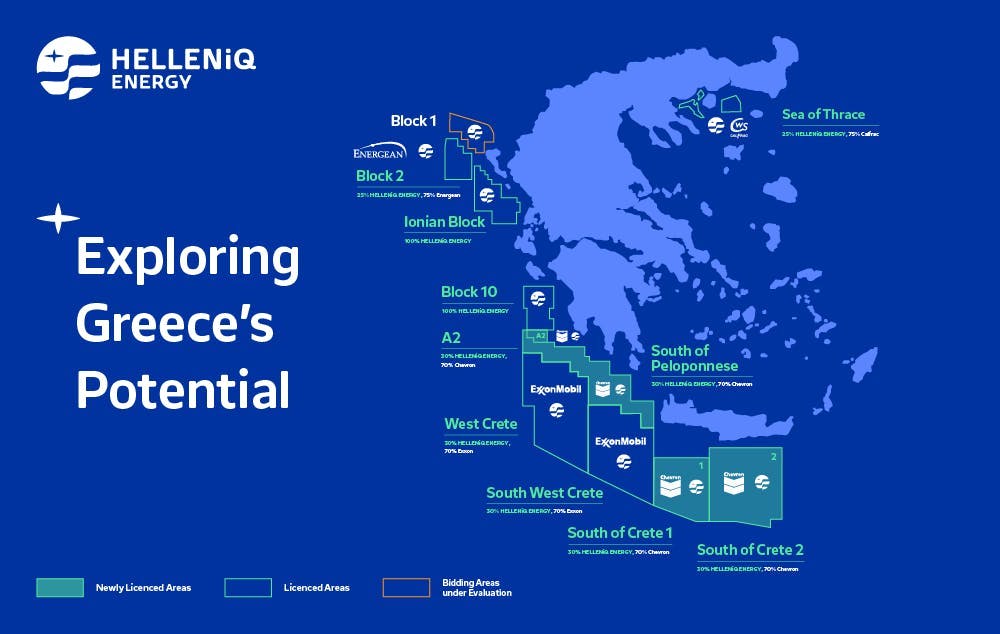
Elsewhere around Greece’s shores, HELLENiQ ENERGY’s Upstream Business division operates offshore Block 10 in the Kyparissiakos Gulf; the Ionian Block off western Greece; and has applied for operatorship of Block 1, north of Corfu. It is also a partner to Calfrac Well Services in a concession in the North Aegean Sea.
In terms of setting the stage for exploratory drilling, Block 2 is the most advanced. Interpretation of a 2,244-sq-km 3D seismic survey shot in 2022 confirmed that the Asopos structure is Greece’s largest unexplored target, with an estimated unrisked resource of 9.5 Tcf. The partners are currently planning to drill in late 2026 or early 2027, assuming all required approvals and permits come through. If there is a substantial, commercial discovery, ExxonMobil would become operator for the development phase.
This would be the country’s first deepwater exploratory well since 1981, when the Greek state oil company drilled the West Katakolo oil find offshore the Peloponnese in the Ionian Sea, followed later that year by two further successful wells on the structure.
Since then, however, as HELLENiQ Upstream CEO Tassos Vlassopoulos told Offshore, “Greece has remained largely underexplored offshore, with limited subsurface data available compared to other parts of the East Mediterranean.
“The limited offshore drilling activity since the early 1980s reflects a combination of factors, including a historically lower prioritization of Greece within global exploration portfolios, limited subsurface data coverage, and regulatory and licensing complexity. This should not be interpreted as a lack of geological potential, nor was it driven by tourism‑related concerns. Greece was largely overlooked while international exploration capital was directed to more mature or better‑understood basins.”
“The current Greek administration has taken a more structured and proactive approach to offshore exploration, including clearer licensing frameworks and competitive international tenders. This has taken place in a regional context where major deepwater gas discoveries over the past 15 years offshore Cyprus, Israel and Egypt have demonstrated the hydrocarbon potential of the East Mediterranean, including geological systems that may extend into offshore Greece.”
Large international companies such as ExxonMobil are looking to identify new resources to replace annual production, Vlassopoulos explained.
“And the East Mediterranean is one of the key areas of focus for them," he added. "To date, activities have focused on seismic acquisition, interpretation and geological evaluation, consistent with early‑stage exploration.”
ExxonMobil’s decision to join the Block 2 partnership has heightened anticipation of a new wave of exploration.
“The geological setting for the Asopos structure is deepwater and geologically complex, which is why a phased exploration approach is required and why careful evaluation is essential before any drilling decisions are taken,” Vlassopoulos cautioned.
As for the next steps, if a discovery does occur, “it is far too early to discuss development concepts," Vlassopoulos continued. "Moving from an early exploration stage through to first production is a multi‑year process. Any potential development approach would depend on the outcome of exploration, including the size and quality of any discovery, and would only be assessed following confirmation of commerciality.”
The recent signing of the four license agreements with Chevron and the Hellenic Republic followed a competitive tender. “At this stage,” Vlassopoulos said, “subsurface data is limited, and it is premature to discuss potential resources or recoverable reserves. The perceived prospectivity lies in frontier offshore areas south of Crete and Western Greece.”
Across the other offshore blocks in HELLENiQ ENERGY’s portfolio, interpretation continues over the areas where 2D/3D seismic data was acquired in 2022/23.
“Interpretation is ongoing, which is typical for complex offshore environments and frontier basins. International companies regularly evaluate such opportunities, and the recent farm-in by ExxonMobil into Block 2 demonstrates continued industry interest,” Vlassopoulos said.
Could any future gas finds, particularly in the southern offshore areas, be connected to the national East Mediterranean gas transportation system concept that Energean and others are working on? Or could future production be converted to LNG to meet Greece’s domestic needs?
“It is premature to discuss export volumes or specific capacity expansions before it is known whether commercial discoveries exist. That said, Greece has a good starting point. While the gas system was historically designed for imports, many of the foundations needed for exports are either in place or actively evolving, including bi-directional flows, regional interconnections, and LNG infrastructure such as Revithoussa and new FSRUs.
“If exploration is successful, export options would be assessed, building on this existing platform," Vlassopoulos said. "Depending on volumes and markets, this could involve upgrades such as additional compression, selective pipeline reinforcement, further strengthening of interconnections and LNG pathways where appropriate. While it is early to quantify capacity expansions, Greece is well positioned to develop an export‑capable system should commercial discoveries support it.”
About the Author
 Jeremy Beckman
Jeremy Beckman
Staff Writer / Editor, Europe
Jeremy Beckman has been Editor Europe, Offshore since 1992. Prior to joining Offshore he was a freelance journalist for eight years, working for a variety of electronics, computing and scientific journals in the UK. He regularly writes news columns on trends and events both in the NW Europe offshore region and globally. He also writes features on developments and technology in exploration and production.