Deltamarin, Offshoretronic advance installation vessel concept for larger monopiles
Why this news matters:
-
Offshore wind developers are planning ever-larger turbines that require bigger monopile foundations, creating demand for installation vessels with greater lifting and transport capabilities.
-
If turbine sizes reach the 20-30 MW range as anticipated, existing installation fleets may face capacity constraints, making next-generation vessels critical to future project execution.
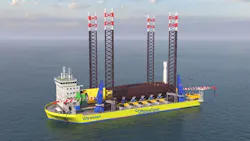
Deltamarin Ltd. and Offshoretronic have agreed to jointly develop what they claim will be the world’s largest jackup monopile and wind turbine installation vessel to shipyard-ready status.
The VITRUVIAN Class vessel, announced at SMM Hamburg, is said to anticipate the requirements for the next-generation 20-30 MW turbines that are expected to start commercial service by 2030.
It is designed to operate in 30 to 60 m of water, accommodating monopile foundations measuring 100–130 m long, 12–16 m OD, and weighing up to 5,000 metric tons.
The partners said current operational limits for most installation vessels are typically in the 3,000-3,500 mt range.
The announcement reflects a broader trend across the offshore wind supply chain, where vessel designers, contractors and developers are preparing for larger turbine ratings and foundation sizes. As turbine capacities have increased over the past decade, installation vessels have been forced to evolve alongside them to accommodate heavier components and higher lift requirements.
Developers are also moving into deeper-water projects and seeking larger turbines to improve project economics, further increasing demand for higher-capacity installation assets.
VITRUVIAN Class' future-proof architecture, the partners claim, will balance CAPEX and OPEX through system integration and streamlined operational workflows.
These should ensure the vessel remains competitive throughout its lifespan in global operations.
The monopile installation vessel is 179 m long with a beam of 75 m, providing substantial deck space and operational stability, the partners add.
They also plan to introduce a Wind Turbine Installation Vessel (WTIV) variant of the concept for handling 20–30 MW wind turbine generator components, including towers, nacelles, and blades. All will be stored in a safe longitudinal axis of the vessel.
Larger installation vessels could help reduce the number of installation campaigns and vessel mobilizations required for major offshore wind projects. By carrying more components per voyage and handling heavier foundations, these vessels could help improve installation efficiency as offshore wind projects move into deeper waters and pursue greater power-generation capacity.