Saltenna tests alternative to cables for subsea communications
Key highlights:
- Saltenna's Plasmonix technology uses radio-frequency surface waves to transmit data along seawater and submerged structures, offering a potential new approach to subsea communications.
-
Laboratory testing demonstrated wireless data transmission through steel pressure boundaries, with offshore pilot trials targeted within the next six to 12 months.
-
The company sees applications in well intervention, asset monitoring and autonomous subsea operations, where wireless communications could complement existing acoustic, optical and wired systems.
When deploying subsea sensors, ROVs or AUVs, offshore operators typically rely on cables because acoustic communications can be slow, optical systems require clear water and line of sight, and conventional radio signals attenuate rapidly underwater.
In the paper Experimental Observations of Plasmonic RF Propagation in Shallow Water, Ice and Submerged Infrastructure, recently published by wireless communications and sensing specialist Saltenna, researchers detailed field tests suggesting an alternative approach. The Virginia-based company said its Plasmonix technology uses radio-frequency surface waves that travel along interfaces such as seawater, the seabed and submerged structures rather than propagating directly through the water column.
In three underwater test scenarios, the system achieved communication ranges well beyond those predicted for conventional underwater radio transmission.
The paper also outlines follow-on experiments aimed at further defining where the technology may offer advantages over acoustic and optical communications.

John Mulholland, who leads Saltenna's Energy Systems Division and served as lead author of the paper, spoke with Offshore about the technology, the testing program and its potential applications in offshore energy.
“Plasmonix will change the way we look at wireless connectivity in the subsea environment, opening the door to the benefits and savings that IoT/IIoT has brought in other areas,” he said. “We believe Plasmonix has the potential to transform subsea communications and is a true enabler for unlocking the autonomous systems.”
Transmitting data through steel pressure boundaries without penetrators could help operators maintain the integrity of critical safety barriers while reducing leak paths, engineering complexity and qualification requirements. Mulholland said the approach could also enable communications with sealed equipment that was not originally designed for data transmission.
“A pressure boundary is a safety barrier, and every additional hole made in it has to be engineered, qualified and maintained for the life of the asset,” he said.
Laboratory testing
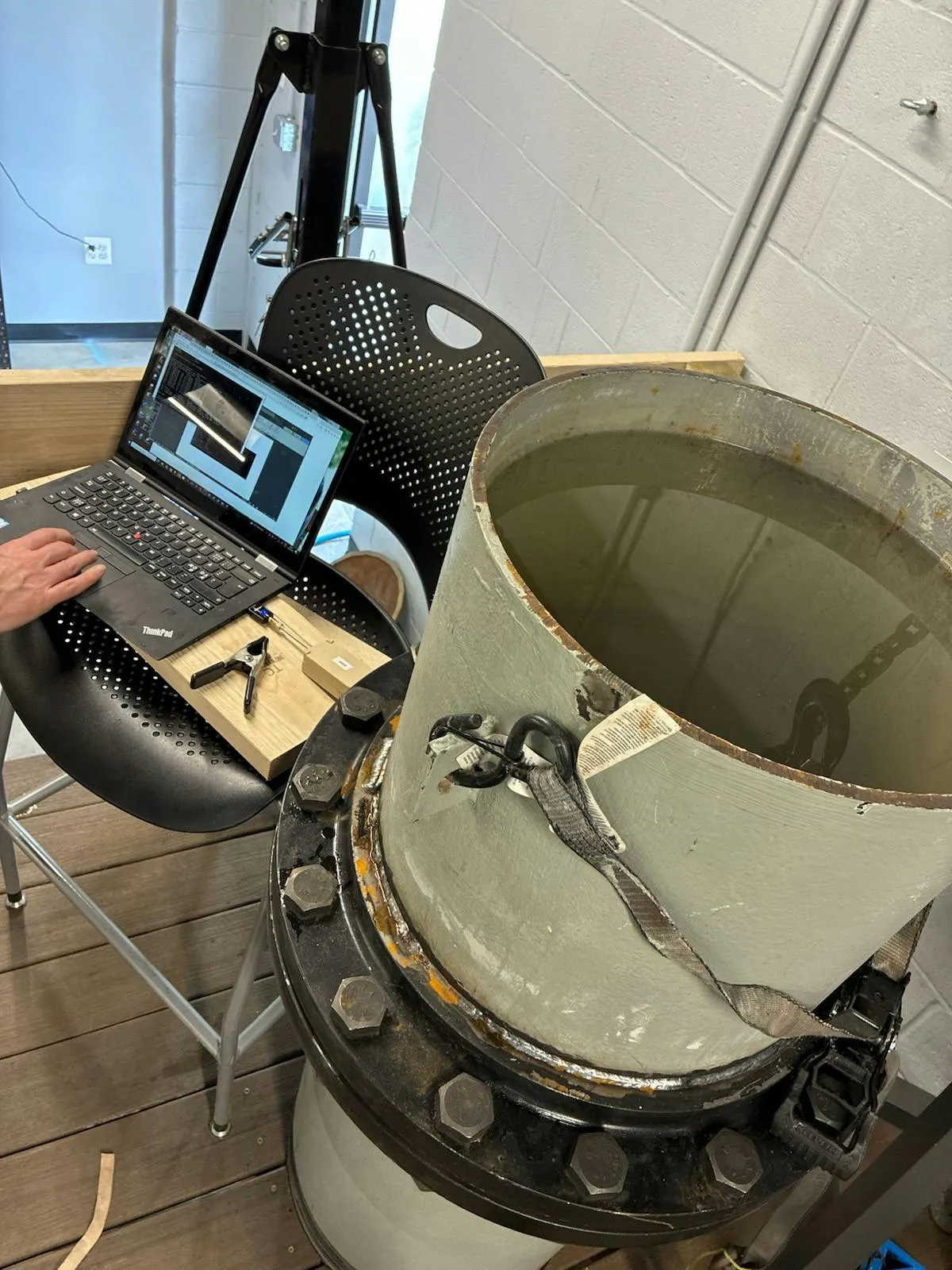
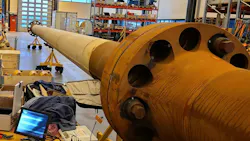
Saltenna has demonstrated data transmission through a sealed, brine-filled steel vessel and marine-riser sections in laboratory testing, with further validation on production subsea hardware planned.
So far, Saltenna's testing has been limited to controlled conditions. The team built a marine-riser replica in its laboratory featuring 18 inches of steel and an ANSI flange, a configuration where wireless communication would typically fail. In underwater testing, the company achieved communication ranges of up to 5 km along the ocean surface and data rates of 1 Mbps through a brine-filled 18-inch marine-riser replica, enabling wireless communications with devices inside the structure.
Having demonstrated the core capability in the lab, the team is now scoping trials with several subsea contractors and service companies. Customer-site trials on production subsea hardware are expected in three to six months. A first offshore pilot, likely ROV- or intervention-deployed, should follow within six to 12 months, subject to partner agreement.
The company said future qualification efforts are being aligned with DNV-RP-A203 and API technology-readiness frameworks.
Near-term offshore applications
Based on the testing completed to date, the company sees several potential offshore applications emerging first.
Mulholland said well intervention and completions represent the strongest near-term opportunity because the applications align closely with Saltenna's demonstrated ability to communicate through pressure barriers and can be deployed on temporary operations before moving to long-term subsea installations.
He also highlighted potential uses for temporary high-bandwidth links between ROVs and subsea sensors, integrity monitoring along risers, flowlines and mooring systems, and data exchange between AUVs and subsea assets.
Looking ahead
If the technology proves successful offshore, Mulholland said it could make it easier to add monitoring and communications capabilities to existing subsea assets without installing new connectors, penetrators or cable runs.
Mulholland said the technology could help make wireless connectivity a practical option across a broader range of subsea assets and operations.
The technology could support retrofitted monitoring, temporary instrumentation during interventions, high-bandwidth communications between subsea assets and ROVs/AUVs, and redundant data paths alongside existing infrastructure.
Mulholland also noted that he sees Plasmonix as part of a layered subsea communications network, complementing acoustic, optical and wired systems rather than replacing them.
Looking ahead, Mulholland believes wireless communications will become a standard component of increasingly autonomous and umbilical-less subsea operations, supporting all-electric systems, resident vehicles and simplified field architectures.
“Wireless will become a standard layer of future subsea architecture rather than a special case,” he said.
While power delivery will still require separate solutions, he sees wireless data transmission playing a key role in enabling low-latency, high-bandwidth communications around subsea assets, particularly where pressure barriers, steel structures and seawater make other methods challenging.
Related reading:
 Jansz-Io Compression project field control station and subsea
 AI-generated image of remote operations center with offshore asset monitoring screens and cybersecurity visualization
About the Author
 Ariana Hurtado
Editor-in-Chief
With more than a decade of copy editing, project management and journalism experience, Ariana Hurtado is a seasoned managing editor born and raised in the energy capital of the world—Houston, Texas. She currently serves as editor-in-chief of Offshore, overseeing the editorial team, its content and the brand's growth from a digital perspective.
Utilizing her editorial expertise, she manages digital media for the Offshore team. She also helps create and oversee new special industry reports and revolutionizes existing supplements, while also contributing content to Offshore's magazine, newsletters and website as a copy editor and writer.
Prior to her current role, she served as Offshore's editor and director of special reports from April 2022 to December 2024. Before joining Offshore, she served as senior managing editor of publications with Hart Energy. Prior to her nearly nine years with Hart, she worked on the copy desk as a news editor at the Houston Chronicle.
She graduated magna cum laude with a bachelor's degree in journalism from the University of Houston.
Related
 NEP's East Coast Cluster map
