Chevron validates battery-free subsea sensor for wax monitoring in deepwater field trial
Key highlights:
-
Chevron's SHIELD technology completed a successful deepwater field trial, demonstrating that wax buildup can be detected from outside a subsea pipeline using a battery-free, thermoelectric sensor.
-
The clamp-on device harvests thermal energy directly from the pipeline, eliminating the need for batteries, cables or pipeline penetrations while providing continuous flow assurance monitoring.
-
Field-test results showed strong correlation with independent CT scan measurements, supporting SHIELD's potential to help operators reduce inspection costs and move toward more proactive integrity management.
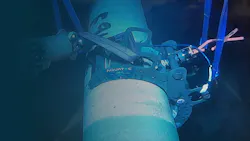
Chevron's patent-pending SHIELD* (Subsea Heat-Induced Energy Loop Detector) is a self-powered, externally mounted subsea sensor that harvests heat from deepwater pipelines to continuously detect wax buildup and other flow assurance risks without batteries, cables or pipeline penetrations.
Recently presented at OTC 2026, the technology has completed offshore deployment and about 10 months of testing on a producing subsea asset, with data collected through standard ROV cameras and analyzed using AI-based tools.
Offshore recently chatted with Chevron inventors Baha Tanju, Simona Duplat and Joseph Patterson from the Facilities Engineering Chevron Center of Excellence.
"Operators often do not know where wax is building up inside a pipeline until it begins affecting flow or requires an expensive inspection campaign," Tanju explained. "SHIELD's greatest value is as a practical, low-cost, repeatable monitoring layer between indirect indicators and high-cost inspection campaigns."
How the technology works
SHIELD at a glance
-
Full name: Subsea Heat-Induced Energy Loop Detector
-
Developer: Chevron
-
Application: Flow assurance monitoring
-
Detects: Wax deposition and thermal behavior changes
-
Power source: Thermoelectric energy harvesting (Seebeck effect)
-
Installation: External clamp, ROV deployable
-
Communications: Optical readout via ROV camera
-
Field testing: ~10 months on a producing deepwater asset
-
Validation: Compared against independent CT scan measurements
The subsea sensor is a self-powered, externally mounted smart clamp that harvests thermal energy directly from the pipeline and eliminates the need for batteries, cables or pressure penetrations. The technology continuously monitors pipeline thermal behavior and detects the formation of wax and other flow assurance deposits from outside the pipe.
Data is then communicated optically and can be read using standard ROV cameras, with AI-based analytics converting the measurements into actionable insights for operators.
"The device 'reads' how heat is escaping from the pipeline. When internal deposits reduce or redistribute that heat flow, SHIELD converts the change into a measurable signal," Duplat said. "SHIELD turns the natural heat loss from a producing pipeline into both the power source and the measurement signal."
Conventional tools (e.g., pressure monitoring, production surveillance,
flow assurance modeling, offshore sampling, ROV inspection, pigging, and CT scanning) will continue to have roles in subsea operations, he explained. The technology is designed to complement those programs by adding localized, repeatable, non-intrusive thermal deposition data at the subsea edge.
"SHIELD provides a non-intrusive, externally mounted method for detecting deposition-related changes in heat transfer through the pipe wall," she added.
For operators, the technology could provide a way to monitor wax deposition between costly inspection campaigns and potentially identify developing problems before production is affected.
Field trial results
The technology has successfully completed offshore deployment and 10 months testing on a producing subsea asset.
Chevron conducted the field trial on a gas-dominated deepwater production system where wax deposition posed a significant flow assurance challenge. The battery-free sensor was installed externally on a subsea pipeline using a clamp-and-magnet attachment system designed for ROV deployment without modifying existing infrastructure.
Prior to installation, the sensor's temperature measurements were validated against a calibrated reference instrument, and its performance was later benchmarked against independent CT scan measurements collected along the pipeline.
The trial demonstrated good agreement between SHIELD's wax-thickness estimates and CT scan data, confirming the viability of the technology under real-world offshore conditions.
According to Chevron, the technology's wax-thickness estimates achieved an R² correlation of 0.907 when compared with independent CT scan measurements collected during the trial.
After about nine to 10 months subsea, Chevron reported that the sensor assemblies remained in good condition, providing additional confidence in the system's durability and suitability for long-term deployment.
"The main finding was that SHIELD successfully demonstrated the core technical premise: deposition-induced changes in heat transfer can be detected from outside a subsea pipeline using a battery-free, thermoelectric, ROV-readable device," Patterson said.
Next steps
Following successful field validation, Chevron is working to scale the technology beyond pilot testing and expand deployment across additional subsea assets.
Development of the next-generation SHIELD Mark II clamp incorporates lessons learned from the initial offshore trial, while new SHIELD Spot sensors are being designed for deployment at multiple locations along a flowline to provide wider monitoring coverage.
Chevron plans to deploy more than 42 sensors across a deepwater asset by the third quarter of 2026.
Longer term, the company views the sensor as more than a wax-monitoring tool, positioning it as a platform for subsea edge sensing that could support continuous infrastructure monitoring through low-power, externally mounted sensors powered by harvested energy.
"SHIELD is being treated as a platform for subsea edge sensing rather than a single-purpose clamp," Tanju said.
The concept could help operators transition from periodic inspection campaigns to more proactive, data-driven approaches to flow assurance and integrity management.
"It demonstrates how existing energy in the production system can be converted into useful sensing and communication at the subsea edge, enabling operators to move from infrequent diagnostic snapshots toward more proactive, digitally enabled flow assurance and integrity management," Tanju concluded.
*SHIELDTM is a registered trademark of Chevron.
Exclusive content:
 Deepwater subsea production infrastructure on the seafloor
 Underwater cables on the ocean floor in the Mediterranean Sea
About the Author
 Ariana Hurtado
Ariana Hurtado
Editor-in-Chief
With more than a decade of copy editing, project management and journalism experience, Ariana Hurtado is a seasoned managing editor born and raised in the energy capital of the world—Houston, Texas. She currently serves as editor-in-chief of Offshore, overseeing the editorial team, its content and the brand's growth from a digital perspective.
Utilizing her editorial expertise, she manages digital media for the Offshore team. She also helps create and oversee new special industry reports and revolutionizes existing supplements, while also contributing content to Offshore's magazine, newsletters and website as a copy editor and writer.
Prior to her current role, she served as Offshore's editor and director of special reports from April 2022 to December 2024. Before joining Offshore, she served as senior managing editor of publications with Hart Energy. Prior to her nearly nine years with Hart, she worked on the copy desk as a news editor at the Houston Chronicle.
She graduated magna cum laude with a bachelor's degree in journalism from the University of Houston.
Related
