ONS 2026: SolarDuck advances offshore floating power hub concept for subsea tiebacks and CCS projects
Key highlights:
- The OFPH system is designed to keep electrical components above splash zones, ensuring durability in harsh offshore environments.
- SolarDuck’s approach reduces costs associated with long-distance subsea umbilicals, especially as tieback distances increase.
- The floating power hub can support a range of offshore applications, from subsea production to CCS developments and remote assets.
- Operational data from pilot projects confirm the system’s robustness and potential for reusability and future deployment.
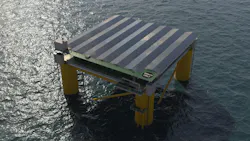
As operators pursue longer subsea tiebacks and carbon capture and storage (CCS) developments, SolarDuck is advancing a floating offshore power concept designed to provide power, communications and other utilities closer to the asset rather than relying solely on traditional long-distance umbilicals.
The concept and its economics were recently detailed in an OTC 2026 paper, examining offshore floating photovoltaic and battery energy storage systems as an alternative to long subsea tieback umbilicals.

Speaking with Offshore ahead of the Offshore Northern Seas conference (ONS 2026), SolarDuck CEO Koen Burgers said the company's Offshore Floating Power Hub (OFPH) was specifically designed for harsh offshore conditions.
"From the onset, SolarDuck has anchored its concepts on having elevated structures that keep the electrical systems (solar PV, energy storage, communications, etc.) above the splash zone," Burgers said.
He added that the system also incorporates offshore-proven equipment and marine-certified components.
The OFPH combines floating solar generation, battery energy storage and auxiliary generation to provide continuous power for subsea infrastructure. According to Burgers, reliability is central to the concept.
"We typically assess the renewable energy available in the 'worst in 50 years' scenario for varying periods and make sure our system is sized such that it can guarantee continuous delivery," he said.
The company is also evaluating hybrid renewable solutions for northern offshore regions.
"We have recently concluded a study to incorporate offshore-proven micro wind turbine generators ... For instance, the hybrid PV + WTG solution evens out the seasonal variability and allows for very high renewable fraction," Burgers said.
SolarDuck sees applications extending beyond offshore renewable energy projects. Burgers said the OFPH can support subsea production systems, CCS developments and other remote offshore assets, while also accommodating hydraulic power units, communications systems and select utility functions.
The company is currently assessing projects ranging from single-digit kilowatt requirements to continuous loads of about 20 kW. These loads are representative of power requirements associated with certain subsea production systems, monitoring applications and CCS infrastructure.
Alternative to long-distance umbilicals
A key selling point is the potential to reduce infrastructure costs for distant developments. The company's recent OTC paper found that offshore floating solar and battery systems can become economically competitive with conventional umbilicals at tieback distances of roughly 10-30 km, depending on application and location.
"The fundamental drivers hinge around the fact that the cost for subsea umbilicals supply and installation typically increases as a function of length, whilst our concept does not," Burgers explained.

Beyond direct cost savings, he said operators have identified additional benefits.
"A few operators have mentioned that the reusability of the asset would be potentially hugely valuable," Burgers said, noting that the floating power hub could potentially be redeployed to support future developments after completing its initial service life.
The company has already collected operational data through its Merganser floating solar pilot in the Dutch North Sea. According to Burgers, the project helped validate assumptions related to platform motions and mooring loads.
"We found, in general, that loads were often lower than we had previously calculated, and work is still ongoing to refine our models accordingly," he said.
SolarDuck recently secured more than €3 million (US$3.4 million) in funding under its Steady Seas program and is working with maritime research institute MARIN on further testing and design validation. Several operators have also expressed interest in participating as reference partners, Burgers said.
Looking ahead, the company plans to complete the basic design of the subsea-optimized OFPH, conduct additional hydrodynamic testing and advance deployment of a first demonstration unit.
"We are excited about that given that the payload might be suited to the demonstrator project, but we see that first unit as being fully capable of commercial deployment further down the line," Burgers said.
Separately, Burgers highlighted the results of a feasibility study performed with Subsea7, which indicated the SolarDuck concept could reduce total cost of ownership by more than 50% compared with a static subsea power cable in the evaluated case, providing early third-party validation of the concept's economic potential.
ONS 2026 takes place Aug. 24-27, 2026, in Stavanger, Norway. SolarDuck CEO Koen Burgers' presentation, "When solar meets the sea: Taking floating PV offshore," will be held at the Net Zero Markets stage on Wednesday, Aug. 26.
About the Author
 Ariana Hurtado
Ariana Hurtado
Editor-in-Chief
With more than a decade of copy editing, project management and journalism experience, Ariana Hurtado is a seasoned managing editor born and raised in the energy capital of the world—Houston, Texas. She currently serves as editor-in-chief of Offshore, overseeing the editorial team, its content and the brand's growth from a digital perspective.
Utilizing her editorial expertise, she manages digital media for the Offshore team. She also helps create and oversee new special industry reports and revolutionizes existing supplements, while also contributing content to Offshore's magazine, newsletters and website as a copy editor and writer.
Prior to her current role, she served as Offshore's editor and director of special reports from April 2022 to December 2024. Before joining Offshore, she served as senior managing editor of publications with Hart Energy. Prior to her nearly nine years with Hart, she worked on the copy desk as a news editor at the Houston Chronicle.
She graduated magna cum laude with a bachelor's degree in journalism from the University of Houston.