ONS 2026: How advanced subsea data is transforming offshore asset integrity
Key takeaways:
-
Offshore operators are shifting from traditional inspection reports to repeatable, high-resolution datasets and digital twins that enable change detection, better asset integrity management and more informed maintenance decisions.
-
Autonomous systems, remote operations and advanced inspection technologies are helping reduce vessel days, offshore personnel requirements and overall campaign costs while improving operational efficiency.
-
As offshore infrastructure ages, AI, subsea robotics and continuous monitoring technologies are expected to play a growing role in extending asset life, improving safety and supporting faster decision-making.
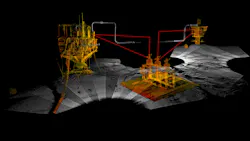
The offshore industry is collecting more subsea data than ever before, but the focus is shifting from simply documenting asset conditions to understanding how those assets change over time.
According to Jeovah Lima, Kraken Robotics' vice president Brazil and business development manager, advances in subsea LiDAR, digital twins, autonomous vehicles and AI-driven analytics are helping operators improve maintenance planning, reduce campaign costs and extend the life of aging offshore infrastructure.
Speaking with Offshore at ONS this week, Lima told Offshore that autonomous systems, digital twins and high-resolution subsea data are becoming essential tools for making faster, more informed operational decisions.
Why this matters:
As operators seek to reduce vessel days, extend asset life and improve maintenance planning, access to high-quality, repeatable subsea data is becoming increasingly important.
Offshore: Over the past few years, how have offshore operators' expectations for subsea inspection and survey data changed, and what are they now asking for that they weren't five years ago?

Lima: Five years ago, the primary deliverable was often imagery, video, sonar data and an inspection report documenting the condition of an asset.
Today, operators increasingly want high-quality, spatially referenced, repeatable datasets that can be compared against previous campaigns. The objective is not simply to prove that an inspection happened, but to establish what changed: corrosion growth, seabed movement, coating degradation or component displacement.
Technologies such as Kraken’s Subsea LiDAR generate precise 3D point clouds with millimetric resolution, creating an accurate digital representation of subsea infrastructure. Operators can take measurements directly from these datasets and compare successive inspections to support change detection and asset integrity decisions.
Digital twins are also becoming more widely used across the offshore industry.
Petrobras, for example, combines their digital twins with AI to support simulations and operational decisions.
Related content:
Petrobras will use a digital twin to optimize oil production and flow
Petrobras continues 70 years of innovation with Azure OpenAI Service
Offshore: As offshore infrastructure ages in regions such as the North Sea, Gulf of Mexico and Brazil, what asset integrity challenges concern you most, and how can new inspection technologies help address them?
Lima: Offshore oil and gas operators are increasingly being asked to make life-extension decisions about infrastructure that has accumulated decades of degradation. The financial, operational and environmental consequences of missing a developing defect can be significant.
Across the North Sea, Gulf of Mexico, and Brazil, the main areas of concern are corrosion and material loss; fatigue and structural degradation; the ability to detect subtle change; and difficulty of inspection for inaccessible assets.
Kraken’s Subsea LiDAR is used to address many of these challenges. It can be deployed from work-class ROVs to produce highly accurate digital twins and precise measurements of subsea infrastructure. By comparing datasets collected at different points in time, operators can quantify change rather than relying solely on visual interpretation, helping them identify developing issues earlier and make better-informed repair and life-extension decisions.
Offshore: With continued pressure to improve project economics, how can advanced subsea survey and inspection technologies help operators reduce vessel time, personnel requirements and overall campaign costs?
Lima: Advanced subsea survey and inspection technologies produce higher-quality data that enables operators to plan maintenance more effectively, execute repairs more quickly and accurately, and reduce vessel time and personnel hours. The value comes not only from conducting the inspection faster, but from improving the planning and decisions before and after an offshore campaign.
During installation at Petrobras’s Buzios Field, Kraken’s Subsea LiDAR was used for inferred subsea metrologies. The data supported more effective project planning before vessel mobilization and helped enable interconnection of the production well 29 days sooner than conventional methods would have allowed.
Petrobras' 2025 reporting explicitly connects diverless technology with cost reduction and logistical efficiency, while the company's ROV-based and remote operation programs are being integrated into ongoing inspection and maintenance activities.
Advanced subsea technologies can address several cost drivers simultaneously: vessel time, offshore personnel, mobilization, inspection productivity, data processing, and unnecessary follow-up work. The result is reduced reliance on large crewed vessels, fewer personnel offshore, faster data processing, fewer repeat campaigns and more targeted interventions.
Over time, resident and persistent inspection systems could further reduce the need for costly campaign-based mobilizations.
Offshore: Autonomous and uncrewed systems are becoming a bigger part of offshore operations. Where do you see the greatest opportunities for autonomy in subsea inspection, mapping and asset monitoring over the next decade?
Lima: Over the next decade, the biggest opportunity is not in making subsea vehicles fully autonomous in every task, but in making inspection and monitoring more persistent, increasingly automated, and less dependent on offshore vessels and personnel. Vessel time and offshore personnel are among the largest campaign cost drivers, so autonomy has the potential to reduce overall costs significantly while compressing project timelines.
There are already strong signals of that direction in Brazil. Operators have been expanding diverless and remotely controlled operations, while a recent Petrobras campaign demonstrated a fully remote USV-ROV inspection with zero offshore personnel.
Petrobras is also moving toward autonomous underwater inspection; they partnered with Saipem and completed functional acceptance testing of the FlatFish autonomous vehicle ahead of planned deployment in Brazil’s ultradeepwater environment.
Worldwide, we are also seeing increased interest in EIVA’s NaviSuite ROV Autonomy software, providing supervised autonomy that supports inspection, maintenance and repair operations for offshore oil and gas installations. This type of technology allows operators to automate repeatable tasks while retaining human oversight for complex decisions.
Offshore: Are you seeing technology or operational lessons flow between offshore wind and offshore oil and gas, particularly in subsea surveying, inspection and asset management?
Lima: The technology exchange is becoming increasingly two-way, although the two industries tend to bring different strengths to the relationship.
Oil and gas has a much longer history of operating complex subsea systems in deep water, so technologies involving ROVs, AUVs, nondestructive testing, subsea intervention and integrity management have naturally transferred to offshore wind.
At the same time, offshore wind is accelerating innovation around large-scale, repeatable inspection, remote operations, autonomous systems and data operations and maintenance, and those lessons are increasingly relevant to oil and gas.
For example, Kraken’s sub-bottom imaging services are often used to confirm the depth of burial of cables at offshore wind installations. The same technology can also be applied to buried pipelines in shallow water.
Offshore: Looking ahead five to 10 years, what technological advances do you believe will have the greatest impact on how offshore operators collect, analyze and act on subsea data?
Lima: Looking five to 10 years ahead, the biggest change will be that subsea data will no longer be something operators collect only during periodic campaigns. Instead, it will be continuously generated, interpreted and incorporated into day-to-day asset management.
These five technologies will have the greatest impact:
- Autonomous and resident subsea robotics;
- AI that moves from detecting defects to interpreting condition;
- Digital twins that become operational rather than visual;
- Edge computing and onboard intelligence; and
- Interoperable data and the 'digital thread' throughout the lifecycle of an asset.
As data quality continues to increase, the operational value of collecting consistent, repeatable data will increasingly outweigh the cost.
Subsea inspections will involve the fusion of several sensor technologies, like subsea LiDAR, photogrammetry and synthetic aperture sonar, to create a much more complete representation of asset condition. This will support more comprehensive project planning, faster and more targeted maintenance, and ultimately safer, longer and more efficient operation of aging offshore assets.
Kraken Robotics' Jeovah Lima and Jeremy Steward are present at the Offshore Northern Seas (ONS) event this week in Stavanger, Norway.
Missed ONS this year? We've got you covered!
 ONS 2026 audience and stage discussion
About the Author
 Ariana Hurtado
Ariana Hurtado
Editor-in-Chief
With more than a decade of copy editing, project management and journalism experience, Ariana Hurtado is a seasoned managing editor born and raised in the energy capital of the world—Houston, Texas. She currently serves as editor-in-chief of Offshore, overseeing the editorial team, its content and the brand's growth from a digital perspective.
Utilizing her editorial expertise, she manages digital media for the Offshore team. She also helps create and oversee new special industry reports and revolutionizes existing supplements, while also contributing content to Offshore's magazine, newsletters and website as a copy editor and writer.
Prior to her current role, she served as Offshore's editor and director of special reports from April 2022 to December 2024. Before joining Offshore, she served as senior managing editor of publications with Hart Energy. Prior to her nearly nine years with Hart, she worked on the copy desk as a news editor at the Houston Chronicle.
She graduated magna cum laude with a bachelor's degree in journalism from the University of Houston.