Deloitte identifies offshore trends driving competitiveness in 2026
Key highlights
- US energy policies are opening new offshore leasing opportunities but also increasing project costs due to tariffs on materials and equipment.
- Offshore operators are adopting strategies like re-sourcing, local manufacturing and contractual innovations to mitigate supply chain risks and manage cost volatility.
- US LNG export growth requires significant infrastructure expansion, including pipelines, processing facilities and port capacity, to support tripling exports by 2030.
- Digital technologies, such as AI-driven predictive maintenance and digital twins, are being scaled to improve operational efficiency and reduce downtime.

In late October, Deloitte released its 2026 Oil & Gas Industry Outlook, which identified five trends that could help oil and gas companies improve performance and differentiation:
- Growth priorities: Oil and gas companies are expected to balance navigating policy tailwinds and industry realities while retaining capital discipline.
- Cost pressures: The sector will likely continue developing and implementing strategies that strengthen supply chains to mitigate tariff-driven cost increases.
- Scaling US LNG: Leveraging LNG’s position as a transition fuel, US exports could potentially triple by 2030, and the industry must prepare.
- Digital transformation: Much of the industry is moving from pilot projects to fully deployed and scaled digital platforms to speed processes and scale operations.
- Downstream resilience: Oil and gas companies are rebuilding downstream resilience by strengthening margins through feedstock optimization and renewable fuels.
Offshore spoke with Zillah Austin, Deloitte's vice chair and US energy and chemicals leader, about how evolving US energy and trade policies, LNG export growth and global sustainability standards are driving offshore oil and gas operators to adapt through procurement strategies, infrastructure scaling, digital transformation, cybersecurity measures, feedstock optimization and emissions-reduction technologies to remain competitive.
Offshore: How do recent US energy and trade policy shifts specifically impact offshore oil and gas operations in regions like the Gulf of Mexico?

Austin: I believe that the recent US energy and trade policies present both opportunities and challenges for offshore operations.
The Administration's domestic energy agenda is opening new doors for offshore drilling. The One Big Beautiful Bill, passed in July 2025, mandates over 30 lease sales in the Gulf of America and Alaska's Cook Inlet through 2040. The first sale in December generated $279 million, with two additional Gulf sales scheduled for 2026.[1]
On top of this, emergency National Environmental Policy Act (NEPA) 'alternative arrangements' now allow the Department of Interior to complete environmental assessments in roughly 14 days and full environmental impact statements in about 28 days for qualifying energy projects.[2]
New tariffs could potentially inflate project costs. Current duties of 10-25% on non-USMCA crude feedstocks, combined with 50% tariffs on steel and aluminum and expanded coverage of derivative equipment, could raise offshore material and equipment costs by 4-40%.[3] With the average US tariff rate projected to increase by roughly 12.5 percentage points to about 15%, offshore projects face a structurally higher cost environment.
Elevated costs may challenge some deepwater greenfield projects, requiring either exceptional geology or fiscal incentives to compete. While measures like royalty adjustments and accelerated depreciation may help, offshore assets increasingly compete for capital against shorter-cycle shale plays.
 offshore renewable energy
Offshore: Tariff-driven cost increases have challenged supply chains. How are offshore projects adapting procurement strategies to mitigate these risks?
Austin: I have observed that offshore operators are deploying several strategies to navigate tariff-related cost pressures, each with distinct trade-offs:
- Re-sourcing supply chains: Many companies are increasingly shifting procurement to non-tariffed suppliers to minimize (or manage) costs. While this approach can deliver savings, it can also extend lead times, creating new schedule risks even as cost stability improves.
- Localizing manufacturing: With approximately 40% of oil country tubular goods (OCTG) historically sourced from foreign suppliers, operators are increasingly adopting dual-sourcing strategies or expanding domestic manufacturing capacity.[4] This shift could strengthen supply chain resilience but may require higher inventory levels and greater working capital commitments.
- Contractual innovations: Growing cost uncertainty is likely to drive new procurement approaches. Operators are negotiating index-linked pricing, escalation clauses and strategic pre-buy agreements to manage volatility. However, these mechanisms primarily redistribute risk rather than eliminate it—someone in the value chain must ultimately absorb the cost increases.
- Investment implications: The cumulative impact is tangible. Industry estimates suggest up to $50 billion in offshore greenfield projects could face deferral if price volatility continues. This cautious capital deployment reflects operators' need for greater cost certainty before sanctioning major deepwater developments.
Offshore: With US LNG exports projected to triple by early 2030s, what infrastructure and offshore capabilities need to scale to support this growth?
Austin: I believe growing US LNG exports over the next decade will require a comprehensive infrastructure buildout across the entire value chain.
US LNG exports are expected to grow by 25% in 2025 and 7% in 2026, with volumes potentially doubling by 2030 and nearly tripling by the early 2030s if all approved projects proceed.[5]
This growth necessitates substantial midstream investment. Gas gathering and processing facilities must expand, while pipeline networks need scaling to handle increased throughput. LNG storage tanks are being constructed alongside new facilities, and the global LNG carrier fleet is expanding to meet shipping demand.
Port capacity may emerge as a critical constraint. Accommodating increased LNG vessel traffic could require deeper navigation channels, expanded berthing capacity and upgraded marine infrastructure.
One project in development would utilize a brownfield deepwater port to support up to three floating LNG (FLNG) vessels. That project is targeting a final investment decision later this year. If approved, the project would likely require tugs, supply boats and possibly specialized vessels for maintenance, personnel transfer and logistics.
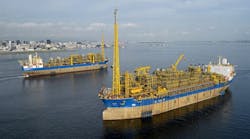
 FLNG designs evolve to meet market needs
Offshore: What are the most impactful digital technologies being deployed at scale in offshore operations—AI-driven predictive maintenance, digital twins or real-time monitoring?
Austin: AI-driven predictive maintenance is gaining traction, supported by results showing 140 hours of avoided downtime, up to 40% fewer failures and around US$10 million per year in savings in early deployments. This may help offset cost inflation, though it potentially increases reliance on data integrity and cyber resilience.
Digital twins may provide material benefits in design optimization and operations, yet their adoption could be slowed by integration complexity when legacy systems or inconsistent data architectures are involved.
Real-time monitoring and edge analytics may enhance system-wide visibility but could also widen the cyber-attack surface, implying the need for more rigorous OT-IT controls.
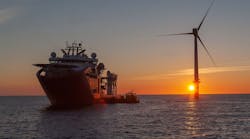 offshore wind vessel
Offshore: Feedstock optimization and renewable fuels are key to downstream resilience. How do these strategies influence offshore production planning?
Austin: Gulf Coast refining margins have fallen more than 50% from 2022 peaks, while D4 RIN prices declined 38% before partial recovery.[6] This may encourage refiners to optimize feedstock slates more aggressively, implying that offshore crude quality and blendability could influence development sequencing.
With ~400 kb/d of refinery closures and ~120 kb/d of renewable conversions expected in the near term, total US refining capacity may decline by roughly 3%, potentially intensifying competition among crude streams.[7] Offsetting this, renewable diesel output is projected to approach 250 kb/d by 2026, which may reward lower-carbon barrels and cleaner production profiles.
These trends suggest that offshore projects with lower emissions intensity may be better positioned in some sector and end markets.
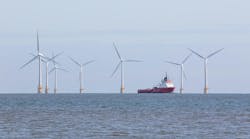 vessel assists with offshore wind operations
Conclusion
Additional references from Deloitte:
-
[1] US BOEM, OBBBA Oil and Gas Leasing Program, August 2025; IRS, One, Big, Beautiful Bill Act: Tax Deductions for Working Americans and Seniors, July 2025; Reuters / EnergyNow, U.S. Unveils Schedule for Over 30 Offshore Oil and Gas Lease Auctions, August 2025; MarineLink, U.S. Unveils Schedule for Over 30 Offshore Oil and Gas Lease Auctions, August 2025; MarineLog, Big Beautiful Gulf 1 Oil and Gas Lease Sale Generates $279.4M in High Bids, December 2025; Axios, Why Trump’s First Offshore Drilling Lease Sale Didn’t Wow the Oil Industry, December 2025; US BOEM, BOEM Proposes Second Gulf of America Lease Sale Under the One Big Beautiful Bill Act (BBG2), November 2025.
-
[2] U.S. Department of the Interior, Department of the Interior Implements Emergency Permitting Procedures to Strengthen Domestic Energy Supply, April 2025; U.S. Department of the Interior, Alternative Arrangements for Compliance with the National Environmental Policy Act amid the National Energy Emergency, April 2025; Council on Environmental Quality, Letter to the Department of the Interior Regarding Alternative Arrangements for Compliance with the National Environmental Policy Act (Executive Order 14156), April 2025; Council on Environmental Quality / Federal Register, Emergencies and the National Environmental Policy Act Guidance, December 2024; Harvard Environmental & Energy Law Program, Interior Released Emergency Permitting Procedures for Fossil Fuel and Critical Minerals Projects, May 2025; Holland & Knight LLP, DOI Implements Unprecedented 14-Day NEPA Review Process Under National Energy Emergency EO, April 2025.
-
[3] Independent Petroleum Association of America, “Comments for the 11th National OCS Oil and Gas Leasing Program,” pp. 13–14.
-
[4] Ed Crooks, “US tariff announcements add to uncertainty,” Wood Mackenzie, Feb. 17, 2025; Vallari Srivastava, “Trump’s tariffs on steel, aluminum to raise costs for US energy firms,” Reuters, March 12, 2025.
-
[5] US Energy Information Administration (EIA), “Short-term energy outlook: Natural gas,” accessed August 2025; EIA, “US liquefaction capacity,” accessed July 2025; Scott Disavino, “Surging US LNG exports to fuel growth in shale gas production,” Reuters, Aug. 22, 2025.
-
[6] Organization of the Petroleum Exporting Countries, “Monthly oil market report,” August 2025; US Environmental Protection Agency, “RIN trades and price information,” accessed August 2025. EIA, “Oil prices and refinery margins fell slightly in first quarter of 2025,” May 1, 2025.
-
[7] International Energy Agency, “Oil 2025: Analysis and forecast to 2030,” June 2025, p. 106; EIA, “Petroleum & other liquids: Refinery utilization and capacity,” accessed August 2025; EIA, “Refinery closures and rising consumption will reduce U.S. petroleum inventories in 2026,” March 3, 2025; Abigail Gerry, “What U.S. refinery closures mean for fuel prices, supply, and exports,” Mansfield Energy, March 10, 2025; EIA, “Refinery closures and rising consumption will reduce U.S. petroleum inventories in 2026”; Goldman Sachs Research, “Americas Energy: Oil – refining: Green shoots: Early signs of a refining recovery,” July 2025.
About the Author
 Ariana Hurtado
Ariana Hurtado
Editor-in-Chief
With more than a decade of copy editing, project management and journalism experience, Ariana Hurtado is a seasoned managing editor born and raised in the energy capital of the world—Houston, Texas. She currently serves as editor-in-chief of Offshore, overseeing the editorial team, its content and the brand's growth from a digital perspective.
Utilizing her editorial expertise, she manages digital media for the Offshore team. She also helps create and oversee new special industry reports and revolutionizes existing supplements, while also contributing content to Offshore's magazine, newsletters and website as a copy editor and writer.
Prior to her current role, she served as Offshore's editor and director of special reports from April 2022 to December 2024. Before joining Offshore, she served as senior managing editor of publications with Hart Energy. Prior to her nearly nine years with Hart, she worked on the copy desk as a news editor at the Houston Chronicle.
She graduated magna cum laude with a bachelor's degree in journalism from the University of Houston.