UK North Sea operating costs fall 9% as production efficiency improves

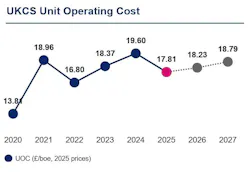
UK offshore operators reduced unit operating costs to £17.81/boe in 2025, supported by higher production efficiency and the addition of newer, lower-cost fields.

Why this news matters:

  • UK Continental Shelf operators reduced average unit operating costs by 9% year over year, improving competitiveness despite a mature basin environment. 

  • Higher production efficiency and the addition of newer fields helped offset costs while overall production remained essentially unchanged. 

  • The NSTA expects costs to rise modestly in 2026-27, highlighting the importance of operational efficiency and technology adoption.
 

Production efficiency (comparing actual production with the maximum potential output), rose last year by one percentage point to 76%. This was another factor behind the improved unit operating cost (UOC).

A field's UOC can also be impacted by infrastructure, water depth and age. As various older fields with high costs ceased production and other new fields came online in 2025, this too had a beneficial influence. Newer developments typically benefit from more efficient infrastructure and lower operating costs than many mature UKCS assets.

“Unit costs improved in all regions of the UK Continental Shelf in 2025, which is encouraging," said Loraine Pace, head of Performance and Planning at the NSTA. “However, with costs projected to rise slightly in 2026 and 2027 [£18-19/boe, or $23.77-$25.09/boe], it is important that operators focus on efficiency, continue to innovate and use new technologies, and share lessons to keep a lid on costs, while continuing to undertake necessary maintenance.”

Exclusive content:

Courtesy Fugro
Fugro Voyager vessel
A large-scale site investigation for Energinet demonstrates how advanced geotechnical tools, offshore laboratory testing and structured reporting can deliver critical seabed data...
Sept. 25, 2026
Courtesy Hydrogen of Dutch Origin
H2DO Demonstrator 30-50 MW
New Dutch and UK R&D programs are advancing offshore hydrogen concepts despite delays to large-scale commercial deployment.
July 16, 2026
Courtesy Sonardyne
CCS lander on the seabed
The UK’s first offshore CCS monitoring initiative at Endurance involves deploying subsea sensors and autonomous systems to establish baseline environmental data.
June 10, 2026
ID 371716721 © Paul Maguire | Dreamstime.com
Oil rig in North Sea at Blakeney Point, Norfolk, UK
The offshore oil and gas industry’s future is linked to the imminent results of UK government review.
Nov. 10, 2025

About the Author

Jeremy Beckman

Jeremy Beckman

Staff Writer / Editor, Europe

Jeremy Beckman has been Editor Europe, Offshore since 1992. Prior to joining Offshore he was a freelance journalist for eight years, working for a variety of electronics, computing and scientific journals in the UK. He regularly writes news columns on trends and events both in the NW Europe offshore region and globally. He also writes features on developments and technology in exploration and production.

Sign up for our eNewsletters
Get the latest news and updates