Seismic data de‑risk Elephant CO2 storage site offshore Norway
Key highlights:
- The Elephant site is located on a stable geological platform with thick Jurassic saline aquifers capable of gigaton-scale CO2 storage.
- High-fidelity seismic imaging reduces uncertainties in reservoir connectivity, capacity and containment, supporting robust modeling and injection planning.
- Ongoing risk management focuses on potential leakage pathways, reservoir heterogeneity and pressure variations, with continuous surveillance to validate containment.
- Time-lapse seismic monitoring, ocean-bottom sensing and well integrity surveillance form the core of the project’s MMV strategy, ensuring real-time plume tracking.
By Kristian B. Brandsegg, Sougata Halder, Allan McKay and Gunhild Myhr, TGS
As industry and governments intensify efforts to meet net-zero targets, carbon capture and storage (CCS) is becoming a cornerstone of long-term emissions management. The maturation of secure, high-capacity carbon storage sites that are demonstrably monitorable has become a defining requirement. Yet, fewer than 50 Mtpa of CO2 are currently captured worldwide, far short of the multi-gigaton scale needed to curb atmospheric emissions. Therefore, developing robust geological storage at an industrial scale is no longer optional; it is an essential enabler of decarbonization.
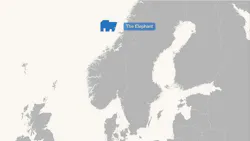
Against this backdrop, TGS’ Elephant CO2 storage project emerges as a strategically significant offshore carbon storage development in the Norwegian Sea off mid-Norway. This project site is developed on modern 3D broadband seismic data and strengthened by a comprehensive, risk-based monitoring measurement and verification (MMV) philosophy. The project demonstrates how integrated geoscience and optimized monitoring planning can accelerate CCS deployment across Northern Scandinavia.
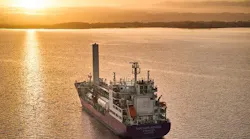 Northern Pioneer LCO2 carrier vessel
A stable geological foundation
The Elephant storage complex lies on the Trøndelag Platform, a region characterized by long-term structural stability with relatively limited faulting compared with adjacent offshore provinces. Thick, laterally extensive Jurassic saline aquifers have potential of gigaton-scale storage, offering capacity sufficient to support multiple industrial CO2 value chains over decades of operation. The primary reservoirs, the Garn and Ile formations, are overlain by laterally extensive seals of the Melke and Spekk formations. This reservoir-seal configuration, validated by oil and gas accumulations in the region, provides several trapping mechanisms, including structural, residual and solubility trapping, supporting permanent containment of CO2 within mapped reservoir zones.
Further, proximity of the Elephant CO2 storage site to emerging ship-based CO2 transport hub, provides a cost-effective CO2 transport model for dispersed northern European emitters or combined with a pipeline solution from an intermediate onshore terminal.
Seismic data driving subsurface certainty
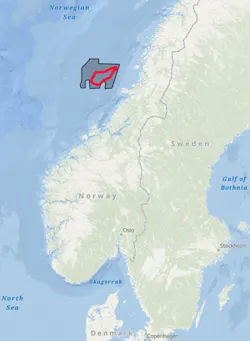
More than 10,000 sq km of modern 3D broadband seismic data underpin characterization of the Elephant CO2 storage site (Figure 1a). High fidelity imaging enables detailed mapping of reservoir connectivity, depositional architecture and seal continuity. These insights reduce uncertainty related to injectivity, storage capacity and containment performance, forming the basis for robust static and dynamic modeling.
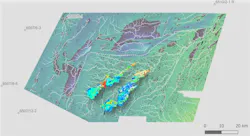
Static and dynamic reservoir models were developed to test industrial-scale injection scenarios involving multiple wells and sustained injection rates. Simulation results showed low-pressure buildup and predictable plume migration, largely confined to the Ile Formation (Figure 1b). Vertical migration into overlying units was limited and transient, with long-term immobilization achieved through multiple trapping processes.
Subsurface risks: Designing for the unexpected
Even with thick regional seals and some of the highest quality seismic imaging available offshore Norway, the subsurface beneath Elephant CO2 storage site does not come with guarantees. A detailed understanding of subsurface risks will play a central role in shaping the site’s monitoring and risk management strategy as the project moves toward Phase 1 development.
Despite the presence of regionally extensive seals and a high-capacity storage system, project assessments indicate that several geological and operational uncertainties must be actively managed to ensure long-term CO2 containment (Table 1).
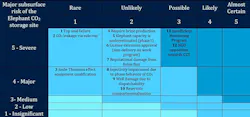
There are three ways of carbon leakage from the storage site influencing the environment:
- CO2 leaves the storage site vertically;
- CO2 leaves the storage site horizontally; and
- Brine discharge via subcrop in the northeast part of the structure.
One of the primary considerations is the potential for unexpected plume migration driven by small-scale reservoir heterogeneity or previously unrecognized connectivity that could alter CO2 flow paths from those predicted by models, underscoring the need for continuous subsurface surveillance once injection begins. Potentially reservoir pressure buildup and/or salinity variations may impact CO2 solubility, plume migration and injectivity, necessitating ongoing calibration within dynamic models.
While the likelihood of leakage is considered low, the project team emphasized that containment must be demonstrated over time, not assumed. After first injection is initiated, the ongoing MMV will be used to validate plume behavior and provide early detection of any deviations from expected performance.
Further monitorability challenges could arise as multiple injection wells are phased in, requiring optimized well placement and seismic acquisition strategies to maintain full field visibility.
MMV: The cornerstone of storage confidence
In offshore CCS, monitorability is inseparable from storage viability. At the Elephant CO2 storage site, MMV planning (and execution) is treated as an engineering control system rather than solely a regulatory requirement.
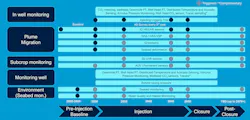
Designing a risk-based MMV program emphasizes requirements of a high-resolution baseline 3D seismic survey for identification and mapping of containment risks to define a scalable, fit-for-purpose monitoring program. Time-lapse (4D) seismic monitoring forms the backbone of the MMV strategy, supported by ocean-bottom sensing, well integrity surveillance and seabed monitoring. Together, these tools provide continuous feedback on plume behavior and pressure response throughout the injection lifecycle (Figure 2).
A blueprint for regional CCS deployment
With offshore CCS moving from pilot projects toward large-scale deployment, the Elephant CO2 storage site is positioned as a regional storage hub linking offshore infrastructure with onshore industrial capture projects across Norway, Sweden and Finland. Its scale, geological robustness and monitoring framework support its role as a foundational asset within a broader Northern European CCS network.
The Elephant CO2 storage site demonstrates how broadband seismic acquisition, advanced seismic imaging and risk-based monitoring can be integrated into a storage system that can transform a subsurface concept into a mature, investment-ready storage solution.
As offshore CCS becomes a material component of the energy transition, projects like the Elephant CO2 storage site provide a practical blueprint for building confidence in the subsurface evaluation and modeling for developing an optimized monitoring strategy for secure, long-term permanent CO2 storage.
Given the multi-decade lifecycle of offshore storage assets, the Elephant CO2 storage site needs to rely on a digital integration platform designed to harmonize real-time operational data across the CO2 injection infrastructure to ensure data continuity, unification, traceability and real-time monitoring of the operational workflows for performance tracking and efficient regulatory reporting. These digital workflows reduce handover risk between project phases and help support long-term stewardship and liability management.
Exclusive content:
 offshore seismic vessel
 OTC 2026 Day 2 panel session on CCUS
About the Author
 Kristian B. Brandsegg
 Kristian B. Brandsegg
Kristian B. Brandsegg is senior business development manager at TGS, working within the marine data acquisition division, where he mainly focuses on advancing carbon capture and storage (CCS) opportunities worldwide. He holds an MSc and PhD in Geoscience and a Master of Technology Management (MTM) from the Norwegian University of Science and Technology (NTNU). With more than 20 years of academic and industry experience, he combines deep subsurface understanding with commercial and strategic insight. His background spans geoscience consultancy, CapeOmega, and TGS, with expertise in subsurface evaluation, 3D geological modeling, seismic interpretation, risk assessment and business development, bridging technical depth with market-driven energy transition solutions.
 Sougata Halder
 Sougata Halder
Sougata Halder is a senior business development manager at TGS where she drives TGS’ commercial activities related to marine data acquisition. She specializes in providing services for carbon capture and storage (CCS), offshore wind and geohazard site surveys for oil and gas operations. She has more than 17 years of experience, with SLB and TGS together, in generating comprehensive client-focused solutions/services and managing and delivering a range of energy projects in a wide variety of geologic settings. She holds a doctorate degree in geoscience from Southern Methodist University, Texas. Her expertise plays a key role in advancing sustainable energy initiatives through developing innovative, data-driven project solutions.
 Allan McKay
 Allan McKay
Allan McKay is a geophysical adviser within TGS’ site characterization team. He has more than two decades of experience in applied geophysics, with a career spanning seismic acquisition, quantitative interpretation, time‑lapse monitoring and subsurface characterization. He has held senior technical and leadership roles at both TGS and PGS, including vice president positions within new energy and 4D technology. He holds a BSc and PhD in geophysics from the University of Edinburgh.
 Gunhild Myhr
Gunhild Myhr
Gunhild Myhr is vice president of business development, New Energy Solutions, heading the Global Business Development team within TGS. She has a MSc in geophysics and completed extensive study in offshore wind at Norwegian University of Science and Technology, NTNU in 2024. She has also completed the "Scale up" program in collaboration with BI and MIT Boston. She is now leading a global team to develop a strategy for growth in offshore wind and CCS-related projects.
Related
