ABS and Samsung Heavy Industries advance floating data center concepts
Why this news matters:
-
Floating data centers could create a new offshore market by applying shipbuilding and marine engineering expertise to rapidly growing AI and digital infrastructure demand.
-
As land-based data centers face power, cooling and site constraints, offshore facilities are gaining attention as a potential alternative.
-
SHI's move from a 50-MW design to a 200-MW concept suggests the industry is evaluating floating data centers at a scale suitable for hyperscale computing.
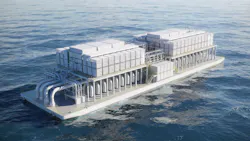
ABS and Samsung Heavy Industries (SHI) have announced two milestones advancing floating data center development, part of a series of innovative agreements following the opening of the Korea-U.S. Shipbuilding Partnership Center in Washington, D.C.
The first milestone is a design approval agreement under which ABS will review SHI’s 50-megawatt (MW) floating data center against applicable class rules and IMO regulations, building on an approval in principle (AIP) of the design granted earlier this year. The second milestone is AIP for SHI’s 200 MW floating data center.
Floating data centers are attracting interest because conventional land-based facilities face growing constraints on available sites, power interconnection, and cooling capacity. By moving computing infrastructure onto purpose-built floating platforms, operators can potentially shorten construction timelines through standardized shipyard processes, reduce pressure on local grids, and take advantage of abundant seawater for efficient cooling—helping meet rising demand driven by artificial intelligence and hyperscale computing.
Patrick Ryan, ABS Senior Vice President and Chief Technology Officer, noted that: “Interest in floating data centers is growing as demand for data infrastructure outpaces what land-based development can deliver. Moving these facilities offshore introduces real complexity, and with it, real opportunity. ABS is proud to support SHI as they advance this technology.”
SHI’s designs incorporate a standardized shipbuilding process, potentially shortening construction timelines. At 200 MW, the AIP represents a fourfold increase in capacity over the earlier concept, targeting the scale requirements of hyperscale data center operators as AI-driven demand for computing infrastructure continues to grow.
Kyung-Hee Kim, Executive Vice President and Head of Future Business Division at Samsung Heavy Industries (SHI), said: “Our collaboration with ABS allows us to pioneer next-generation maritime technology. The 50 MW design agreement and the 200 MW FDC approval in principle (AIP) demonstrate SHI’s differentiated technological competitiveness in the FDC market.”
The Korea-U.S. Shipbuilding Partnership Center is a bilateral government initiative jointly established by South Korea’s Ministry of Trade, Industry and Resources, and the US Department of Commerce. It opened on July 23, 2026, in Washington, D.C.
Related content:
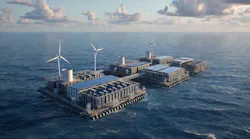
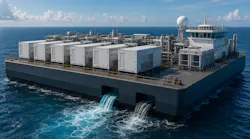 concept rendering of a floating offshore data center
About the Author
 Bruce Beaubouef
Bruce Beaubouef
Senior Lead Reporter / Managing Editor
Bruce Beaubouef is Managing Editor for Offshore magazine. In that capacity, he plans and oversees content for the magazine; writes features on technologies and trends for the magazine; writes news updates for the website; creates and moderates topical webinars; and creates videos that focus on offshore oil and gas and renewable energies. Beaubouef has been in the oil and gas trade media for 25 years, starting out as Editor of Hart’s Pipeline Digest in 1998. From there, he went on to serve as Associate Editor for Pipe Line and Gas Industry for Gulf Publishing for four years before rejoining Hart Publications as Editor of PipeLine and Gas Technology in 2003. He joined Offshore magazine as Managing Editor in 2010, at that time owned by PennWell Corp. Beaubouef earned his Ph.D. at the University of Houston in 1997, and his dissertation was published in book form by Texas A&M University Press in September 2007 as The Strategic Petroleum Reserve: U.S. Energy Security and Oil Politics, 1975-2005.