Seatrium and Mocean push offshore data center concepts to meet rising AI demand
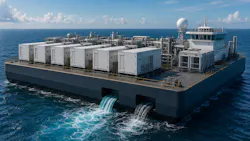
As demand for AI computing infrastructure accelerates worldwide, companies are exploring floating and offshore data centers as a way to overcome land, power and cooling constraints facing traditional onshore facilities.
Rising AI power demand is creating opportunities for offshore engineering firms to apply expertise in marine construction, power systems, mooring and offshore operations to a new class of digital infrastructure.
Two recent developments—from Seatrium in Singapore and Mocean Energy in the UK—highlight growing interest in deploying data center infrastructure at sea.
Seatrium secures AiP for 30-MW floating data center concept
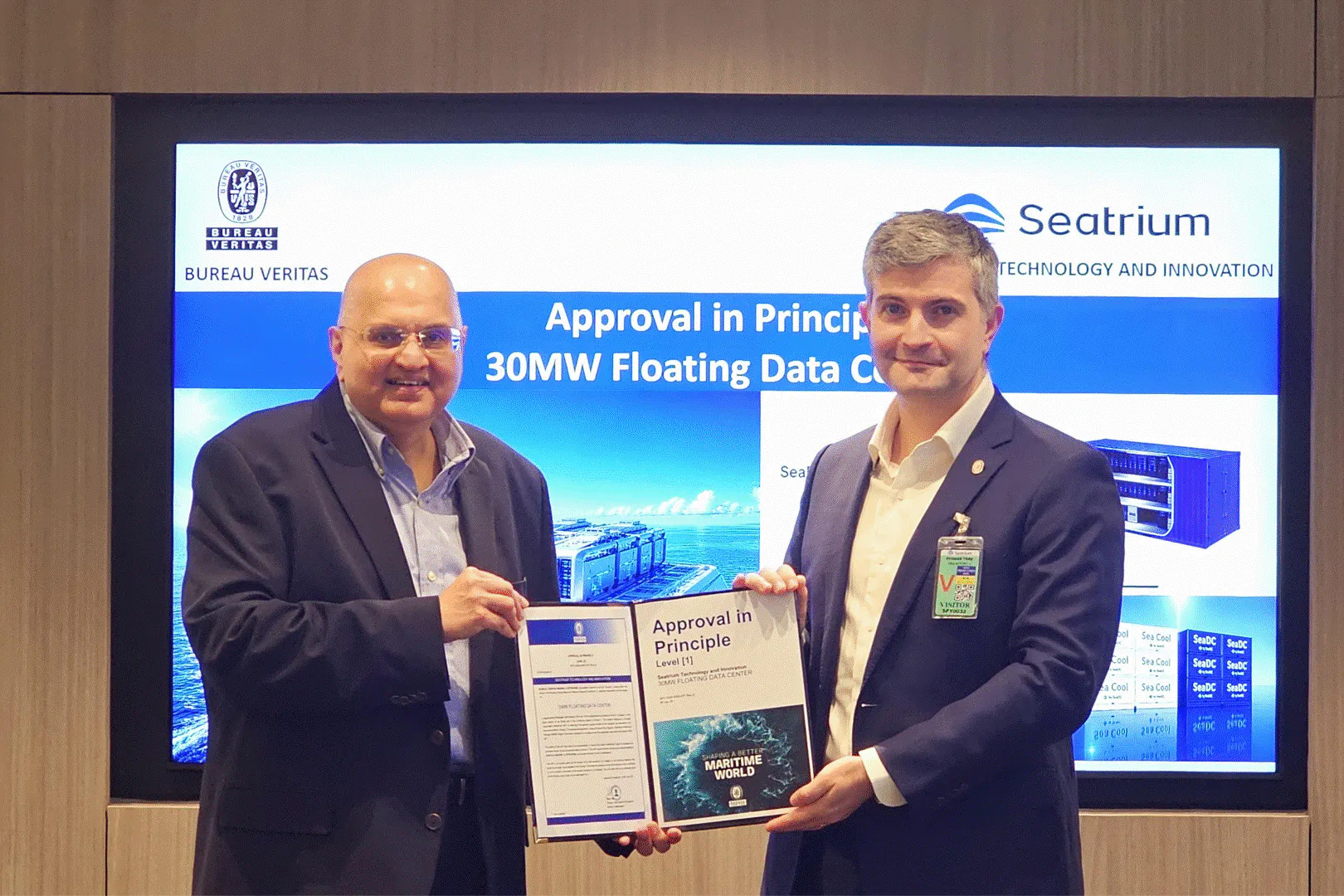
Seatrium has secured Approval in Principle (AiP) from Bureau Veritas Marine & Offshore for its 30-MW, self-powered Floating Data Centre (FDC) concept.
This features six 5-MW Data-In-A-Box modules installed on a jetty-moored, non-propelled barge. Each module integrates IT equipment, cooling systems, power distribution and supporting infrastructure.
The combination of modular construction, natural seawater cooling, embedded power generation and flexible offshore siting provides scalable, relocatable and energy-efficient computing capacity for AI, cloud and other digital services, Seatrium said.
It is also working on floating data center solutions of 100 MW and beyond, helping to address land, energy and cooling constraints in coastal areas.
If deployed at scale, floating data centers could open new opportunities for offshore fabricators, vessel operators, mooring specialists and marine infrastructure contractors.
Earlier this year, Seatrium also entered a memorandum of understanding with Bureau Veritas during Singapore Maritime Week to explore cooperation on advanced engineering, technology and new product design for the marine and offshore sector.
 Person using laptop with holographic data visualizations
Mocean develops self-powered offshore AI data center concept
Seatrium is not alone in pursuing offshore computing infrastructure.
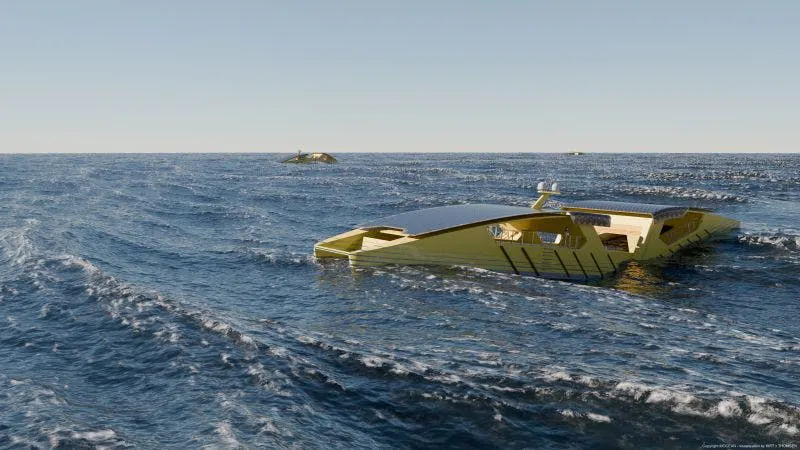
In the UK, Edinburgh-based Mocean Energy has introduced the Blue Core offshore data center concept, which again is designed to generate its own power.
Global demand for AI-optimized computing is set to quadruple by 2030, the company said, citing a forecast by the International Energy Agency. AI data centers are projected to need 1,200 TWhr/year by 2035.
However, many operators face waiting years for a grid connection and end up turning to gas turbines to go online.
Blue Core is designed to remove these constraints by moving the data center out to sea, with each unit combining wave energy, offshore solar and battery storage to power on-board AI server racks.
The technology is designed to connect via low-Earth orbit satellite communications, generating 500 kW to 1 MW without a grid connection, and groups of units can be combined to form larger data centers offshore.
The system is designed mainly for AI inference workloads. Mocean says that cooling, which can eat up to 35% of an onshore data center's energy budget, would account for about 5% at a Blue Core offshore development.
This is due to a closed-loop system that exchanges heat with the ocean rather than drawing on an onshore supply of drinking water.
“Because Blue Core is built like an assembly line rather than a megaproject, units are manufactured and deployed one at a time," said Cameron McNatt, managing director of Mocean Energy. “This means a single unit and a thousand-unit farm come from the same building block and any unit can be pulled out for maintenance or a GPU upgrade without disrupting the rest. When sited in national waters, the farms also provide sovereign infrastructure rather than a lease on another country's cloud.”
Blue Core is a progression of Mocean's existing offshore power system, which has completed 18 months of full-scale testing in harsh sea conditions supported by international offshore energy companies and technology developers.
The two systems both feature the same power conversion, mooring and controls technologies.
Mocean plans to deliver the first Blue Core offshore demonstrator and start early commercial deployments from 2030 onward, and it is targeting 6 GW of offshore power, which it claims is about 2% of projected AI data center demand.
Key takeaway
While both concepts remain at different stages of development, they suggest floating data centers and offshore infrastructure could play a growing role in supporting AI-driven computing demand by helping overcome grid, cooling and land-use constraints.
About the Author
 Jeremy Beckman
Jeremy Beckman
Staff Writer / Editor, Europe
Jeremy Beckman has been Editor Europe, Offshore since 1992. Prior to joining Offshore he was a freelance journalist for eight years, working for a variety of electronics, computing and scientific journals in the UK. He regularly writes news columns on trends and events both in the NW Europe offshore region and globally. He also writes features on developments and technology in exploration and production.