Ongoing wave of M&A reflects market desire for fewer contractors with stronger capabilities
Key highlights:
- Industry consolidation has reduced the number of independent offshore drilling contractors, concentrating market share among top players with modern, high-spec rigs.
- Major mergers, such as Transocean-Valaris and Helix-Hornbeck, are creating larger, diversified companies capable of handling complex, long-cycle projects and improving operational efficiency.
- Tightening supply of premium rigs and strategic fleet high-grading are supporting a positive long-term market outlook, despite cyclical softness in 2025.
- The industry is moving toward integrated offshore services, offering comprehensive solutions across drilling, subsea, and marine support, to meet evolving client demands.
By Bruce Beaubouef, Managing Editor
The offshore drilling rig contractor market (and the broader offshore energy services sector) has undergone significant consolidation over the past 3–5 years.
This is driven by the need for scale, cost efficiencies, fleet high-grading (focusing resources on modern, high-specification rigs while retiring or divesting older units), and capital discipline after the prolonged post-2014 downturn.
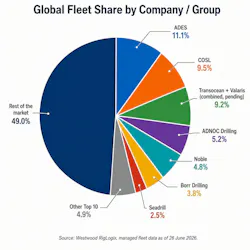
These moves have reduced the number of independent players, concentrated market share among top contractors (now controlling a large share of the global fleet and an even higher proportion of premium/working rigs), and accelerated rig attrition through scrapping or cold-stacking of older units.
As of early-to-mid 2026, the global mobile offshore drilling unit (MODU) fleet stands at roughly 629 rigs (down 10 rigs year-over-year from 639 in the prior year), with active utilization around 80% (502 actively working units). This modest decline reflects ongoing attrition — mainly older, lower-spec rigs being scrapped or retired — while newbuild deliveries have slowed significantly.
This tightening of supply, particularly in premium segments, is one of the structural positives coming out of this consolidation trend.
 Top 10 Offshore Drillers: ADES’ acquisition strategy lands it at top
Key remaining major contractors
Here are the primary players with approximate fleet positions, based on 2025–mid-2026 data. Fleets continue to evolve with sales, reactivations, attrition, and newbuilds:
- Transocean (pre-Valaris acquisition): As a standalone company, Transocean has 27 rigs, with particular strengths in ultra-deepwater and harsh-environment floaters. Combined with Valaris: ~73 rigs (33 ultra-deepwater drillships, 9 semisubmersibles, 31 modern jackups). This would create the world’s largest and highest-specification fleet, diversified across deepwater, harsh environments, and shallow water. Enterprise value ~$17 billion; Transocean shareholders retain ~53% ownership. The deal remains subject to regulatory approvals (including US antitrust review).
- Noble Corp. (post-Diamond Offshore acquisition, closed September 2024): Noble has 24–29 floaters (leading in seventh-generation dual-BOP drillships) and a smaller jackup presence, with some divestitures of non-core assets. The company has a strong backlog and focus on premium deepwater assets.
- Seadrill: The company has a modern, floater-focused fleet of 14 to 15 rigs, primarily drillships and semisubmersibles, with a strong emphasis on young, high-spec assets. Includes some harsh-environment units and joint-venture rigs operated through Sonadrill (Seadrill’s 50/50 JV with Sonangol in Angola). Competitive in key deepwater basins such as Brazil, U.S. Gulf of Mexico, and Angola.
- ADES (post-Shelf Drilling merger, completed late November 2025): ADES is now a dominant jackup player with ~83 offshore units (mostly premium jackups) plus ~40 onshore rigs, operating across 19 countries. Strongest in the Middle East and emerging markets, with boosted backlog and greater flexibility across basins.
- Eldorado Drilling (post-Vantage acquisition, completed June 2026): This recent cash deal combined Vantage’s modern drillships with Eldorado’s operational expertise, management capabilities, and regional strengths. The transaction creates a more scalable and competitive mid-sized player, continuing the industry trend of consolidation among smaller-to-mid-tier contractors.
- Other notables: Borr Drilling (jackup-focused, expanded via acquisitions); ADNOC Drilling (rapidly growing national player); COSL (China Oilfield Services, large state-backed fleet); along with some smaller or regional players fill certain market niches.
Impact of key mega-mergers
Recent deals reflect broader industry dynamics. Some details and analysis follows:
Transocean-Valaris
This $5.8-billion all-stock deal, announced Feb. 9, 2026, combines Transocean’s harsh-environment/ultra-deepwater expertise with Valaris’s diversified modern fleet and ARO Drilling JV (providing Saudi Aramco exposure). Expected synergies are greater than $200 million (on top of Transocean’s ongoing cost program), with approximately $10 billion in combined backlog. The deal positions the entity as the clear market leader in premium rigs with global reach and enhanced pricing power. The deal is still pending regulatory clearances (including intensified US antitrust review via a DOJ Second Request in May 2026), with an original target close in 2H 2026.
Noble’s acquisitions
Noble's acquisitions (Diamond Offshore closed 2024; earlier Maersk Drilling integration) have built what some describe as the leading seventh-generation drillship fleet, added significant backlog, and delivered targeted synergies. These deals have also enabled high-grading (divesting non-core jackups) and focus on high-margin deepwater programs. Noble has returned substantial capital to shareholders while strengthening its position.
ADES-Shelf Drilling
ADES and Shelf Drilling completed a cash merger in late November 2025. This deal created one of the largest jackup-focused platforms globally, with enhanced scale, backlog over Saudi Riyal (SAR) 34 billion at the time (roughly US$9.0 to $9.1 billion) and extended geographic reach.
Helix-Hornbeck
This all-stock merger deal, announced April 2026, is expected to create a premier integrated offshore services company by combining Helix’s subsea/well intervention expertise with Hornbeck’s marine support vessels. The new entity is expected to operate under the Hornbeck name, with significant combined backlog. The deal is expected to close in 2H 2026. The deal broadens the consolidation trend beyond pure drilling rigs into life-of-field services.
Subsea7-Saipem
This proposed merger (binding merger agreement signed July 2025) aims to create a global leader in subsea construction, engineering, and offshore services. The deal is undergoing an in-depth EU antitrust investigation (opened July 2026) as well as Australian review, while receiving clearance in Brazil. Completion is still targeted for 2H 2026, subject to regulatory approvals.
Eldorado-Vantage
The cash acquisition, completed June 2026, enhances scale for the combined entity in the drilling space, demonstrating that consolidation continues even among smaller players.
These deals (plus earlier ones) show that operators are preferring fewer, stronger counterparties with reliable high-spec capacity for complex, long-cycle projects. Consolidation enables fleet rationalization, cost savings, technology investment (automation, emissions reduction), and better contract terms.
Market analysis
The overall offshore drilling and services market is not in a broad contraction; it is experiencing a cyclical correction within a longer-term growth phase. Some key trends are noted below.
For rigs, the supply side is contracting in terms of older assets. Global fleet attrition, recycling, and high-grading continue as contractors retire low-spec units amid high reactivation/upgrade costs. This tightens availability of premium rigs.
The demand side for rigs and related services softened in parts of 2025 (project delays, some Aramco-related pauses, lower oil prices at times), leading to more “whitespace” and regional shifts. However, long-cycle projects in Brazil (pre-salt), Guyana, West Africa, and Asia remain resilient.
The overall market outlook is positive. Reports indicate that there will be expansion and activity into the early 2030s, driven by energy demand, deepwater discoveries, LNG/gas focus, and national oil company programs. Recovery is expected to firm from late 2026–2027 as delayed campaigns restart.
Last year was widely viewed as a “market correction” or “pause in the upcycle” rather than a downturn—demand was largely pushed out, not canceled.
How M&A affects day rates
In the drilling contractor market, these mergers are expected to impact day rates, as follows:
- Short-term (through mid-2026): Some downward pressure from competition for work, whitespace, and softer pockets of demand. Leading-edge rates saw moderation in certain segments, though premium units held up better.
- Medium-to-long-term impact of M&A (positive): Bullish. Fewer aggressive bidders, supply discipline (more cold-stacking/scrapping of marginal rigs), and focus on high-spec assets should stabilize and support modest gains as demand recovers. Consolidated players gain stronger leverage in negotiations, longer contract durations, and capacity to invest in differentiating technology (e.g., high-pressure/high-temperature capabilities commanding premium rates). Backlogs are lengthening for leaders, and utilization is expected to firm.
The common through line
Across drilling rig contractors (Transocean-Valaris, Noble-Diamond, ADES-Shelf, Eldorado-Vantage) and broader offshore services (Helix-Hornbeck, Subsea7-Saipem), a clear theme runs through all these deals: strategic consolidation to create larger, more resilient, and higher-quality platforms capable of thriving in a capital-intensive, cyclical industry.
Key unifying elements include:
- Scale advantages: Handling bigger, more complex, and longer-duration projects that operators (majors and NOCs) increasingly award to fewer, financially robust counterparties.
- Cost synergies and capital discipline: Delivering measurable savings, achieving conservative leverage targets, and freeing up resources for technology and fleet investment.
- Fleet/asset high-grading: Prioritizing modern, high-specification equipment that delivers better uptime, higher day rates, and stronger utilization while shedding lower-spec assets.
- Diversification and integration: Moving toward more comprehensive offerings (drilling plus subsea/well intervention plus marine support) for “life-of-field” solutions.
- Positioning for the upcycle: Building stronger balance sheets, longer backlogs, and pricing power while the market experiences short-term pauses but maintains long-term structural demand growth in deepwater and key basins.
Among the drilling rig contractors, the ongoing wave of mergers is creating a more disciplined, efficient industry with two to three dominant independents in premium segments alongside strong national players. Survivors like the future Transocean-Valaris entity, Noble, the enlarged ADES; and integrated players from Helix-Hornbeck and Subsea7-Saipem are well-positioned for the next phase of growth. Risks remain (oil price volatility, project delays, geopolitical factors, and regulatory hurdles on specific deals), but the structural outlook strongly favors those who have consolidated and high-graded effectively.
About the Author
 Bruce Beaubouef
Bruce Beaubouef
Senior Lead Reporter / Managing Editor
Bruce Beaubouef is Managing Editor for Offshore magazine. In that capacity, he plans and oversees content for the magazine; writes features on technologies and trends for the magazine; writes news updates for the website; creates and moderates topical webinars; and creates videos that focus on offshore oil and gas and renewable energies. Beaubouef has been in the oil and gas trade media for 25 years, starting out as Editor of Hart’s Pipeline Digest in 1998. From there, he went on to serve as Associate Editor for Pipe Line and Gas Industry for Gulf Publishing for four years before rejoining Hart Publications as Editor of PipeLine and Gas Technology in 2003. He joined Offshore magazine as Managing Editor in 2010, at that time owned by PennWell Corp. Beaubouef earned his Ph.D. at the University of Houston in 1997, and his dissertation was published in book form by Texas A&M University Press in September 2007 as The Strategic Petroleum Reserve: U.S. Energy Security and Oil Politics, 1975-2005.
Related
