Big Beautiful Gulf 3 lease sale generates $82.7 million in high bids
Why this news matters:
-
Stronger bidding signals continued operator confidence in US Gulf deepwater opportunities.
-
Selective participation shows companies remain focused on the highest-value, lowest-risk prospects.
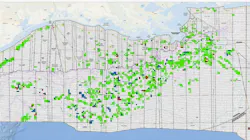
The Marine Minerals Administration has announced the results of Big Beautiful Gulf 3 (BBG3) lease sale, the third offshore oil and gas lease sale in the “Gulf of America” required under the One Big Beautiful Bill Act.
The sale generated $82,689,756 in high bids for 59 blocks covering approximately 330,150 acres in federal waters. Sixteen companies submitted a total of 69 bids amounting to $99,476,285.
BBG3 offered roughly 15,100 unleased blocks spanning about 80.4 million acres across the Western, Central, and portions of the Eastern Gulf Planning Areas. The blocks are located 3 to 231 miles offshore in water depths ranging from 9 feet to more than 11,100 feet. All leases carry a 12.5% royalty rate.
The public bid reading took place this morning at The National WWII Museum in New Orleans and was livestreamed for the public. Results are available on the agency’s website at boem.gov/Sale-BBG3. A final statistical summary will be released within 90 days.
This was the first lease sale conducted by the Marine Minerals Administration, which was established to advance responsible development of America’s offshore energy resources.
BBG3 follows Big Beautiful Gulf 1 (December 2025) and Big Beautiful Gulf 2 (March 2026) and is part of a schedule of 30 Gulf of America sales required by law through 2040.
The BBG3 lease sale sat firmly in the middle of the three sales so far, stronger than the weak March auction but well below the stronger December one.
For comparison:
- BBG3 vs. BBG2 (March): Roughly 76% higher high-bid total, more than double the number of blocks, and stronger participation (16 companies vs. 13).
- BBG3 vs. BBG1 (December): Still only about 27–28% of the high-bid total from the first sale, with far fewer blocks and companies involved.
- Overall trend: Interest rebounded from the very soft March sale but remains well below the initial December auction. Bidding continues to be highly selective — only a tiny fraction of the ~80 million acres offered receives bids in each sale.
The BBG3 lease sale was a clear improvement over March, but still modest compared with the December 2025 lease sale.
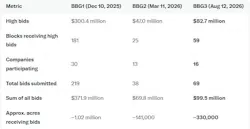
Comparative analysis
The BBG1 lease sale (December 2025) stood out mainly because of timing, policy certainty, and pent-up industry demand. It generated roughly $300 million in high bids — more than three times BBG3 and more than six times BBG2 — even though it was still selective compared with pre-2024 sales.
With BBG1, companies did not bid broadly across large numbers of blocks. Instead, they concentrated their money and attention on a relatively small set of high-potential tracts (mainly deepwater and emerging Paleogene prospects)
The primary drivers of BBG1’s stronger results included:
First sale after a long drought. There had been no Gulf of Mexico/America oil and gas lease sale since December 2023 (Lease Sale 261). Nearly two years of limited opportunity created pent-up demand. Companies had inventories of prospects they wanted to secure once leasing resumed.
New predictable, long-term schedule. BBG1 was the very first sale under the One Big Beautiful Bill Act, which mandated 30 Gulf sales on a regular March/August cadence through 2040. Combined with the new administration’s explicit “energy dominance” messaging and the return of a low 12.5% royalty rate (the lowest deepwater rate in many years), this restored confidence that leasing would no longer face the stops-and-starts of the prior period. Operators treated the first sale as a priority “must-participate” event.
Companies were ready to spend. Exploration budgets and technical evaluations had been building during the hiatus. Majors (especially BP and Chevron) and several independents came in aggressively, focusing on high-potential deepwater and Paleogene prospects. This produced higher per-acre bids even as overall acreage bid remained selective (~1% of the acreage offered).
Strategic front-loading. With a reliable future schedule now guaranteed, companies did not feel forced to bid everything at once in later sales. BOEM officials themselves noted after BBG1 that the predictable cadence meant operators “were not pressed to come in all at once.” Many of the best or most urgent blocks were taken (or contested) in December, leaving thinner inventories and tighter near-term budgets for the March and August sales that followed only a few months later.
Wood Mackenzie described BBG1 as a “targeted” sale in which companies bid firmly on high-confidence blocks rather than broadly. The sharp drop in BBG2 was widely attributed to the compressed three-month gap — companies that spent heavily in December needed time to reload capital and reassess remaining opportunities. Meanwhile, deepwater continued to dominate, with strong interest in emerging Paleogene plays near existing infrastructure.
In short, December’s relative success was driven less by dramatically better geology or oil prices and more by the combination of a long dry spell ending, a newly credible multi-year leasing framework, attractive fiscal terms, and operators’ readiness to commit capital on day one of the new regime. Subsequent sales have been more measured as the industry adjusts to the steady cadence.
Exclusive content:
 A helicopter transports crew to an oil and gas floating production and storage spar in the Gulf of Mexico.
About the Author
 Bruce Beaubouef
Bruce Beaubouef
Senior Lead Reporter / Managing Editor
Bruce Beaubouef is Managing Editor for Offshore magazine. In that capacity, he plans and oversees content for the magazine; writes features on technologies and trends for the magazine; writes news updates for the website; creates and moderates topical webinars; and creates videos that focus on offshore oil and gas and renewable energies. Beaubouef has been in the oil and gas trade media for 25 years, starting out as Editor of Hart’s Pipeline Digest in 1998. From there, he went on to serve as Associate Editor for Pipe Line and Gas Industry for Gulf Publishing for four years before rejoining Hart Publications as Editor of PipeLine and Gas Technology in 2003. He joined Offshore magazine as Managing Editor in 2010, at that time owned by PennWell Corp. Beaubouef earned his Ph.D. at the University of Houston in 1997, and his dissertation was published in book form by Texas A&M University Press in September 2007 as The Strategic Petroleum Reserve: U.S. Energy Security and Oil Politics, 1975-2005.