Rystad Energy analysis on BBG1, deepwater dominance and the future of US Gulf leasing
Key highlights:
- Bidding activity declined by 40% compared to previous sales, but high bids per acre increased.
- Participation from a broader range of companies signals strategic diversification and continued deepwater exploration focus.
- Nearly 17% of blocks received multiple bids, with high competition on key Paleogene and infrastructure-led prospects.
- Financial constraints and macroeconomic uncertainties are leading to reduced shelf bidding, with deepwater projects remaining the primary focus for industry players.
Offshore: BBG1 marked the largest acreage offering in US Gulf history under the new 15-year leasing schedule. How does this sale fit into the broader trajectory of US offshore leasing policy and industry expectations?
Liles: The record amount of acreage offered in BBG1 marks the starting point of a 15-year US Gulf leasing schedule, as specified under the July 2024 reconciliation bill. The bill’s oil and gas provisions mandated a minimum of 30 US Gulf lease sales within 15 years of enactment, with a minimum of 80 million acres offered per sale. This represents by far the most ambitious offshore leasing schedule in US history. For comparison, US Gulf offerings have typically ranged from 40-60 million acres annually between 1983 and 2017.
BBG1 also shows some continuity with US Gulf leasing trends under the first Trump administration. BOEM dramatically increased offerings in the Gulf to more than 120 million acres during the 2017 lease sales—a record at the time—and continued to achieve new records from 2018 to 2020, with Gulf offerings pushing toward 160 million acres annually.
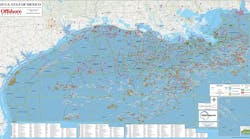 2025 Gulf of Mexico map
Offshore: Rystad Energy's analysis shows a 40% reduction in acreage receiving bids compared to previous lease sales. What are the primary drivers behind this decline—macroeconomic conditions, regulatory uncertainty or strategic operator behavior?
Liles: High-level figures indicate a somewhat declining trend in bid activity compared to Lease Sale 261. Total acreage receiving bids in BBG1 was down by approximately 40%, while the aggregate dollar amount of high bids fell by 21%. However, high bids on a per-acre basis increased to $293—up 33% from Lease Sale 261—supported by strong industry interest in Paleogene prospects.
Another consideration is that US Gulf lease sales are set to occur at a much more frequent interval compared to the 2021-2024 timeframe.
Thus, the imperative for operators to load up on new acreage positions during a single sale may not be as strong, at least under the current schedule mandated by the reconciliation bill.
Offshore: Despite fewer bids, BBG1 saw a rebound in the number of participating companies. What does this tell us about market dynamics and the role of smaller operators amid industry consolidation?
Liles: The increase in bidders was driven by companies of all sizes and underpinned by the role of the US Gulf in the portfolio of these players. In terms of large companies, US-based Chevron and the UK majors Shell and bp have long been dominant in the region, thus their continued participation in BBG1 was of no surprise.
More intriguing was activity by TotalEnergies and Eni, which bid on six and three blocks, respectively. The last time TotalEnergies submitted direct bids for US Gulf acreage was in Lease Sale 254 in March 2020. Still, the company beefed up its US deepwater position through a farm-in transaction in June 2025, which saw the French major take a 25% non-operated stake in 40 Chevron-operated blocks across the Gulf. TotalEnergies’ activity in BBG1 signaled a deepening of its strategic relationship with Chevron, as all associated blocks were either contiguous or in close proximity to Chevron-operated acreage.
For its part, Eni has not directly bid in a US Gulf sale in over 10 years. The Italian major bid on three Mississippi Canyon blocks near the Who Dat hub and clinched a single high bid. In any case, participation in BBG1 is in keeping with TotalEnergies’ and Eni’s respective corporate strategies. Both have continued to emphasize strong organic reserves replacement in the upstream sector while also maintaining ambitious decarbonization goals.
BBG1 also saw first-time bidding by several smaller foreign players. Australian junior Karoon Energy picked up one block near Who Dat, in which it bought a non-operated stake in 2023. Karoon in mid-2025 announced plans to relocate key corporate roles to Houston and Brazil to align with its core growth areas.
Meanwhile, Israel-based Navitas Petroleum successfully participated in four bids in Walker Ridge, Atwater Valley and Viosca Knoll. Navitas already has a non-operated interest in the Shenandoah and Buckskin Paleogene projects in Walker Ridge and is similarly focused on the deepwater Atlantic margin.


Offshore: Nearly 17% of tracts received multiple bids, which is a notable uptick from prior rounds. What does this indicate about competitive positioning and the attractiveness of certain US Gulf blocks?
Liles: Of the 181 blocks receiving bids, 30 were contested by two or more companies. This ‘contested bid’ figure was up from Lease Sale 261 in percentage terms and only down slightly in absolute terms. Despite the headline 40% reduction in total acreage receiving bids, the stable number of absolute contested blocks signals that interest in US Gulf developments is still strong, with more focused bidding on certain areas against the backdrop of advances in subsurface imaging.
Of particular note is continued interest in Paleogene prospects. When measuring the Top 15 contested blocks in terms of total submitted bid amounts, Rystad Energy estimates that 11 of these could be prospective for Paleogene discoveries, with a mix of both infrastructure-led (ILX) and frontier exploration potential.
Block 25 in northern Keathley Canyon garnered both the highest number of total bids—at around $31 million—and BBG1’s record high bid number, with Chevron’s $18.6-million figure beating out offers from bp and Shell.
Blocks 443 and 444 in west-central Walker Ridge likewise drew strong interest, with $15.2-million and $12.2-million joint high bids, respectively, from Woodside and Repsol trouncing offers by Chevron and bp.
In central Walker Ridge, Murphy Oil clinched block 333. The block received bids from Oxy and Shell and could be prospective for ILX activity centered around Murphy’s Pioneer FPSO.
A smattering of other Paleogene-focused blocks received two to three bids.
Contested bidding activity also suggested continued interest in ILX prospects near non-Paleogene hubs. Block 249 in northeast Green Canyon received the second highest total bid amount among contested blocks at $21.2 million, with Chevron beating out bp for a potential tieback opportunity to its operated Stampede platform.
In Mississippi Canyon, blocks 345 and 504 both received three bids. Shell secured Block 345 over Kosmos and LLOG for ILX potential in relation to its Appomattox hub, while Eni’s successful bid on Block 504 is directly adjacent to Who Dat and clocked in above offers from private player LLOG and Murphy Oil.
 Harbour Energy to acquire LLOG Exploration Company
Offshore: A Rystad Energy report mentioned a “tight surety market” and macro conditions affecting smaller players. How are financial constraints shaping bidding strategies and risk appetite in the Gulf of Mexico?
Liles: Deepwater was clearly back in the driver’s seat in BBG1. Bidding at water depths of more than 1,600 meters accounted for over 40% of acreage receiving bids, with nearly 90% of bids going to depths of more than 800 meters.
The reduction in shallow-water bidding—both in absolute and percentage terms—is due in large part to a pullback by ExxonMobil and Repsol, which emerged as key shelf acreage bidders in Lease Sales 257, 259 and 261. In Sale 257, ExxonMobil submitted high bids for over 500,000 acres in the Brazos, Galveston and High Island protraction areas. The US major followed up in Sale 259 with high bids on around 300,000 acres in High Island and Galveston. Meanwhile, Repsol dominated shallow-water bidding in Sale 261, acquiring approximately 170,000 acres in the Mustang Island and Matagorda Island protraction areas.
Although these positions were acquired through federal oil and gas lease sales, market expectations coalesced around their potential for carbon sequestration.
When excluding ExxonMobil and Repsol, shelf acreage receiving bids since Lease Sale 249 in 2017 has ranged between 30,000 and 215,000 acres. Although most of these have featured shelf acreage bids of less than 100,000 acres. In this sense, BBG1 did not mark a significant divergence from the longer-term trend; shelf bids stood at just over 62,000 acres, down from approximately 65,000 acres in Sale 261. BBG1 also saw a wider variety of smaller companies bidding on shelf blocks, with eight individual names compared to four in Sale 261.
The lower amount of shelf acreage bids is due largely to the legacy nature of the US Gulf shelf and a lower potential resource base when compared to deepwater protraction areas. Globally, non-OPEC+ offshore shelf production is in secular decline, a trend reflected in the US Gulf. Additionally, shelf acreage in the US Gulf is largely the domain of smaller companies with less financial firepower compared to the majors and large independents. When viewed in the context of uncertain macro conditions and a tighter surety market, it is not surprising that BBG1 did not exhibit an uptick in shelf bids. Although stable bidding levels between 261 and BBG1 are also worth noting.
Macroeconomic uncertainty and surety bond headwinds have arguably manifested more strongly in the M&A market, as opposed to bidding activity. In mature basins like the US Gulf, smaller players typically acquire lower-margin legacy assets from larger companies. Yet, most indicators suggest a significant pullback in such small-company M&A activity in recent years due to a combination of price uncertainty, BOEM’s 2024 offshore financial assurance rules and an uptick in collateral calls from surety providers in 2025.
About the Author
 Ariana Hurtado
Ariana Hurtado
Editor-in-Chief
With more than a decade of copy editing, project management and journalism experience, Ariana Hurtado is a seasoned managing editor born and raised in the energy capital of the world—Houston, Texas. She currently serves as editor-in-chief of Offshore, overseeing the editorial team, its content and the brand's growth from a digital perspective.
Utilizing her editorial expertise, she manages digital media for the Offshore team. She also helps create and oversee new special industry reports and revolutionizes existing supplements, while also contributing content to Offshore's magazine, newsletters and website as a copy editor and writer.
Prior to her current role, she served as Offshore's editor and director of special reports from April 2022 to December 2024. Before joining Offshore, she served as senior managing editor of publications with Hart Energy. Prior to her nearly nine years with Hart, she worked on the copy desk as a news editor at the Houston Chronicle.
She graduated magna cum laude with a bachelor's degree in journalism from the University of Houston.