FPSO developments advance from Brazil and Guyana to the Falklands
Key highlights:
-
Petrobras expands capacity: Seatrium has delivered the P-80 and P-82 FPSOs for Brazil's Búzios Field, adding a combined 450,000 bbl/d of oil production capacity.
-
Guyana project nears startup: MODEC's FPSO Errea Wittu has arrived offshore Guyana and is preparing for first oil from ExxonMobil's Uaru development.
-
Future growth in the Falklands: Navitas is pursuing a second FPSO for the Sea Lion project, potentially adding 125,000 bbl/d of production capacity in a later development phase.
-
Operational lessons emerge: BW Offshore is addressing equipment issues on the BW Opal FPSO serving the Barossa Field while production continues at about 85% of nameplate capacity.
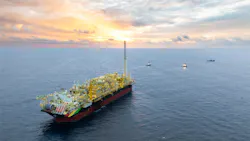
Floating production, storage and offloading (FPSO) vessels continue to play a central role in offshore oil and gas developments worldwide.
Recent updates spanning Brazil, Guyana, the Falkland Islands and Australia illustrate how operators are adding production capacity, advancing new projects and addressing operational challenges.
Below is a look at four notable FPSO developments from the past week. The announcements also reflect the continued role of FPSOs in enabling deepwater developments in regions where fixed platforms are not economically or technically practical.
 AI-generated FPSO image
Seatrium delivers two more FPSOs for Petrobras’ Búzios project
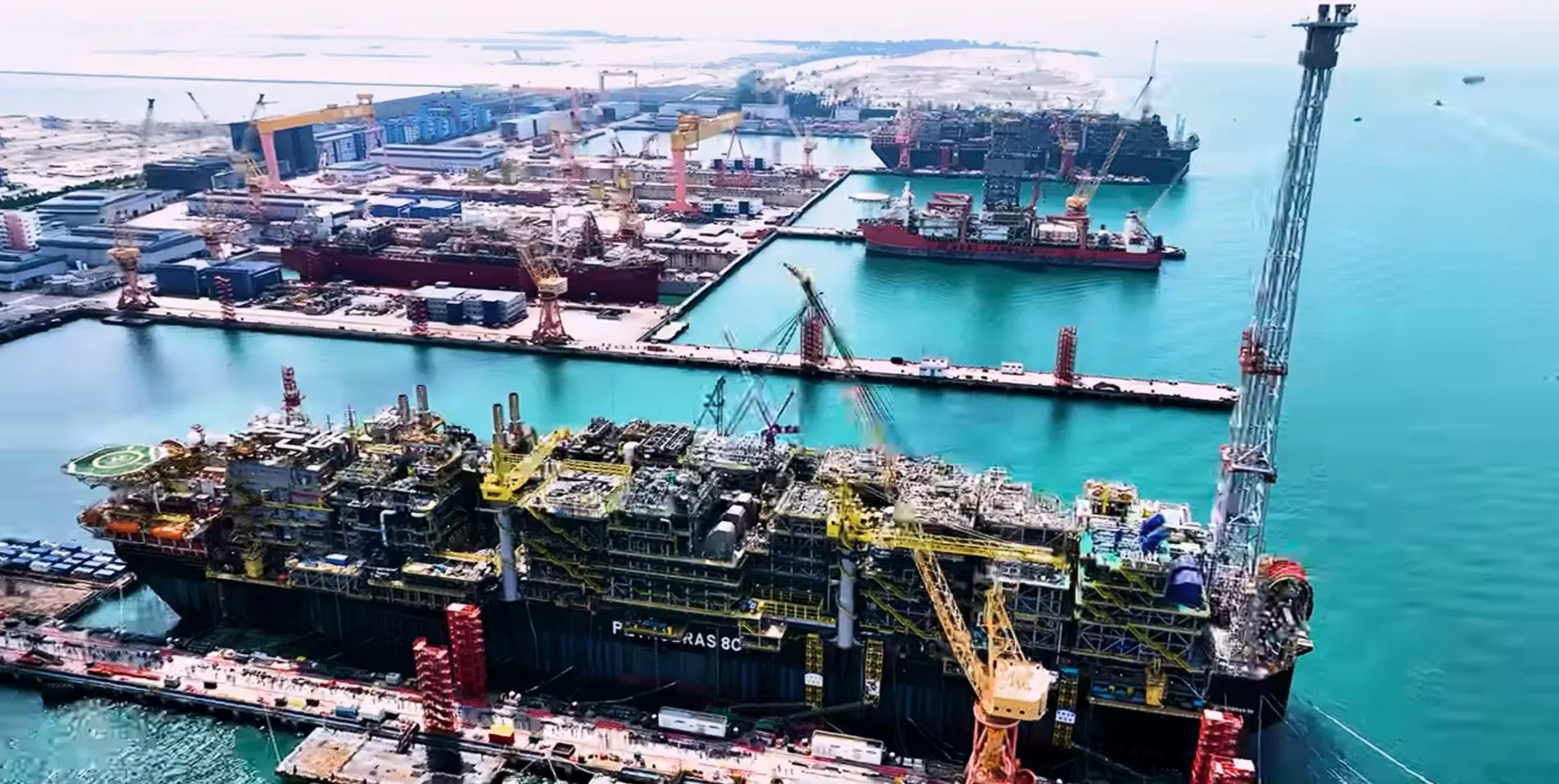
The P-80 and P-82 platforms both underwent naming ceremonies this week at Seatrium's Tuas Boulevard Yard.
Following the sailaway of the P-78 last year, they are also the second and third turnkey FPSOs delivered under the P-Series model commissioned by Petrobras with Seatrium.
P-80 and P-82 will become the ninth and tenth FPSOs at the Búzios Field development in the presalt Santos Basin. Each is designed to produce 225,000 bbl/d of oil and to process 12 MMcm/d of gas. In combination, they should add about 450,000 bbl/d to the installed production capacity at the field.
In addition, each vessel has a water injection capacity of 250,000 bbl/d, and oil storage capacity of about 2.5 MMbbl. Onboard technologies to reduce emissions include carbon capture and reinjection and energy recovery systems.
Seatrium’s yards in Singapore, China and Brazil fabricated more than 110,000 mt of topside modules for the two platforms, with integration and commissioning taking place at Tuas Boulevard Yard.
Some of the topside module lifts were among the heaviest performed at the yard. Seatrium deployed its two 30,000-mt Goliath cranes for the campaign.
Based on lessons learned from the preceding P-78 project, Seatrium said it had reinforced its systems, processes and execution strategy.
The P-80 and P-82 are two of six FPSOs that the company is working on for Petrobras. Collectively, they will provide an oil production capacity of about 1.3 MMbbl/d, equivalent to 30% of Brazil's average daily oil production of 4.5 MMbbl/d as of June 2026.
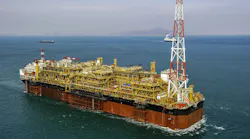 Offshore FPSO
Uaru FPSO arrives in Guyana
MODEC has delivered the FPSO Errea Wittu to Guyana, where it will be used to handle production from the Snoek, Mako and Uaru accumulations in the offshore Stabroek Block, according to an Aug. 24 MODEC news release.
It is MODEC’s first FPSO for a project in Guyana and its 18th FPSO/FSO for operations in South America.
Upon arrival at the field location, 200 m offshore in 1,690 m water depth, the platform will undergo final offshore preparations and commissioning prior to first oil. MODEC said it was working with ExxonMobil to ensure safe integration of the vessel into Guyana’s offshore operations.
The FPSO construction is based on MODEC’s new-built hull design, with a full double hull and a larger topsides deck area to accommodate high-capacity processing systems.
A gas turbine combined cycle system helps bring down CO2 emissions.
The vessel is also designed to support future remote operations from shore, and its AI-enabled systems are engineered to help predict equipment failures and deliver process safety insights.
FPSO Errea Wittu, with its SOFEC spread mooring system, will have about 2 MMbbl crude storage capacity.
In addition, MODEC will provide ExxonMobil Guyana with operations and maintenance services for the vessel.
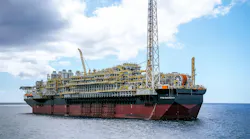 FPSO Bacalhau
Navitas lines up second FPSO for offshore Falklands Sea Lion development
Navitas has signed a memorandum of understanding for a second FPSO for the Sea Lion oil project in the North Falkland Basin, according to partner Rockhopper Exploration's Aug. 24 news release.
Rockhopper expects acquisition of the OSX-1 FPSO, for about $125 million, to complete within the next few weeks.
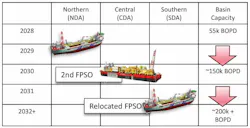
Navitas made its move after assessing the potential for speeding up subsequent phases of the Sea Lion development beyond Phase 1 of the Northern Development Area (NDA).
The company estimates that the additional floater could add 125,000 bbl/d of production capacity.
Initially, Navitas will be the sole owner via an incorporated special purpose vehicle and will assume all related costs until Rockhopper is in a position to fund its share. The two parties are discussing how to incorporate the OSX-1 into the existing Sea Lion joint venture agreements.
The vessel would be allocated to the Central Development Area (CDA) of the field, with work here to include drilling of 20 wells in CDA Phase 1 and 18 wells in CDA Phase 2.
Navitas plans to submit the CDA development plan to the Falkland Islands government for approval and take FID during the first half of 2028. The company is targeting first production from the CDA Phase 1 by the end of 2030.
Current development works for the NDA in the Falkland Islands are progressing, with a focus on preparing the project’s quay and shore base, constructing accommodation, and additional infrastructure works to prepare for the arrival of the rig to start drilling early next year.
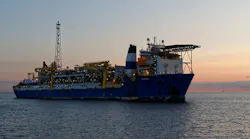
The Aoka Mizu FPSO, which was disconnected from the Lancaster oil field West of Shetland, is heading to a shipyard in Southeast Asia, where it is due to arrive in early September.
Otherwise, manufacturing continues of long-lead items for the NDA, including flexible flowlines, wellheads and subsea xmas trees.
Assuming Navitas completes its acquisition of the adjacent offshore PL001, the company plans to drill a multi-target exploration well on the acreage during the development drilling campaign.
Eco Atlantic Oil & Gas, which has an indirect interest in PL001, said the prospect could hold 640 MMbbl of oil. If commercial, it could be tied back to the Sea Lion platform.
In May, Navitas agreed to farm into Block 1 CBK offshore South Africa, subject to the government’s approval. The company and Eco have been assessing the block’s prospective resource with a view to future development scenarios.
Block 1 CBK is thought to contain about 4.5 Tcf of gas and more than 3,600 MMbbl of liquids.
 FPSO in the North Sea
Equipment issues restricting production on Barossa FPSO
Vessel operator BW Offshore is addressing technical issues that have impacted operations onboard the BW Opal FPSO, which handles gas-condensate from the Barossa Field in the Timor Sea, according to the company's half-year 2026 report.
At present, the vessel is producing at 85% of its nameplate capacity, having started service earlier this year.
As production increased, certain problems came to light that have been attributed to third-party delivered equipment, related to:
- An underperforming CO2 removal system, with a need to replace the membrane;
- Cleaning of the lean methanol tank due to trace contamination; and
- Inspection of welds in the steam system.
Long lead times for membranes, and the imperative to minimize the impact on production in close coordination with project operator Santos, means that replacement work will likely take place in first-quarter 2027.
BW Offshore expects to incur about $65 million of incremental investment until Practical Completion, the company added, although this will be offset by additional revenue generated prior to the start of the firm contract.
Practical Completion, which is targeted for second-quarter 2027, will signal the commencement of the 15-year fixed contract for the FPSO.
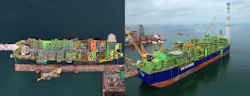
FEED activities include progressing the FPSO design, finalizing the project execution plan and delivery schedule, and selection of major subcontractors and vendors ahead of a firm offer to Equinor.
BW Offshore is also working on a local content plan in line with the frame agreement and the Atlantic Accord, having recently opened a local office in St. John’s.
Finally, the company has acquired a barge hull for conversion to a floating desalination unit, under its BW Elara joint venture with BW Group.
FPSO market snapshot
-
Brazil continues to add large-scale presalt production capacity through Petrobras' P-Series developments.
-
Guyana's growth trajectory remains supported by new FPSO deployments.
-
Emerging regions such as the Falklands are advancing plans for additional floating production capacity.
-
Operators remain focused on reliability, emissions reduction and digitalization of FPSO assets.
About the Author
 Jeremy Beckman
Jeremy Beckman
Staff Writer / Editor, Europe
Jeremy Beckman has been Editor Europe, Offshore since 1992. Prior to joining Offshore he was a freelance journalist for eight years, working for a variety of electronics, computing and scientific journals in the UK. He regularly writes news columns on trends and events both in the NW Europe offshore region and globally. He also writes features on developments and technology in exploration and production.
Related
