Longitude releases live mooring line monitoring system for FPSO operations
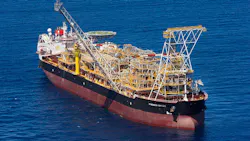
Longitude has secured its first contract with an undisclosed oil and gas operator for a newly developed live mooring line tension monitoring system for FPSO operations.
The Proper Live Load (PLL) system provides continuous monitoring of the real-time tension of the mooring lines on floating offshore units. The contract covers a one-year deployment on an FPSO offshore South America.
According to Longitude, undetected mooring line degradation or failure can lead to high offsets, riser damage, production shutdown, and environmental incidents.
However, some established monitoring approaches still rely on load cells that deteriorate over time and are not replaced, as well as periodic inspections and disconnected data sources. These, the company claims, leave operators with limited real-time visibility.
“We address this gap by providing an always-on monitoring platform that combines real-time sensor data with predictive analytics and comprehensive integrity management—enabling operators to shift from reactive to proactive mooring management,” said Icaro Reis, naval architect and marine engineer at Longitude.
PLL can collect data from geo-positioning sensors on board the floating facility. The AI-driven system processes this data using a representative mooring analysis model, calibrated via ROV UWILD inspection results and as-laid line conditions.
It then performs real-time tension calculations, excursion tracking and alarm generation.
Capabilities include:
- Position and excursion monitoring: continuous tracking of the vessel’s position relative to operational and alarm watch circles.
- Mooring line tension monitoring: real-time tension estimation using a validated mooring model.
- 6-degree-of-freedom (6DOF) motion monitoring: full vessel motion tracking (surge, sway, heave, roll, pitch, yaw) via combined GNSS and inertial data.
- Structured alarm system: multi-level excursion alarms, mooring line loss detection, unusual tension pattern alerts.
The system “also integrates wind, wave and current data with historical operational records and machine learning models to predict vessel and mooring line behavior under forecast conditions, supporting proactive decision-making," Reis added. “Additionally, tension history analysis of mooring lines combined with real-time fatigue tracking allows us to anticipate inspection or replacement needs.”
Longitude is an ABL company, which was recently renamed Aqualis.
Exclusive content:
 FPSO Bacalhau
 FPSO in the North Sea
 offshore FPSO operations
 mooring
 Floating wind turbine
About the Author
 Jeremy Beckman
Jeremy Beckman
Staff Writer / Editor, Europe
Jeremy Beckman has been Editor Europe, Offshore since 1992. Prior to joining Offshore he was a freelance journalist for eight years, working for a variety of electronics, computing and scientific journals in the UK. He regularly writes news columns on trends and events both in the NW Europe offshore region and globally. He also writes features on developments and technology in exploration and production.