TGS, SeaBird advance offshore seismic programs across emerging basins
Why this news matters:
- The projects reflect continued exploration interest in frontier offshore basins, with operators investing in higher-quality seismic data to identify and de-risk new opportunities.
-
Modern acquisition and reprocessing technologies can deliver clearer subsurface images, supporting more informed drilling and development decisions.
-
The activity signals ongoing demand for offshore geoscience services, from seismic vessels and OBN surveys to advanced data processing and interpretation

Offshore exploration companies are investing in new seismic acquisition campaigns, advanced data reprocessing and ocean-bottom node survey programs. Recent announcements from TGS and SeaBird Exploration point to an industry focus on enhancing subsurface imaging and reducing exploration risk offshore Brunei, Sierra Leone and West Africa.
TGS awarded Brunei 3D seismic survey
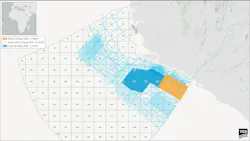
Petroleum Authority of Brunei Darussalam has commissioned TGS to acquire, process and market a new multi-client 3D seismic survey offshore Brunei.
The modern, 3D data should lead to improved understanding of reservoir potential, de-risk leads and support investment decisions ahead of future licensing rounds, TGS said.
The project also supports the Petroleum Authority's wider goal of securing further international investment for the development of the oil and gas upstream sector in Brunei Darussalam.

TGS launches Sierra Leone reprocessing campaign
TGS has started work on the offshore Sierra Leone 2D and Mabesi 3D Vision reprocessing projects, in partnership with the Petroleum Directorate of Sierra Leone.
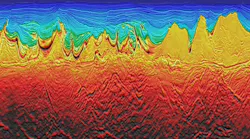
The goal is to deliver modern, depth-imaged seismic data with improved subsurface clarity, allowing operators to better assess hydrocarbon plays and exploration opportunities from the shelf out to deepwater areas.
TGS will reprocess 24,000 km of 2D data and 4,155 sq km of Mabesi 3D seismic by applying pre-stack depth migration, machine learning-based de-noise and de-ghosting, adaptive de-multiple and advanced depth imaging, including DM-eFWI.
It will also merge the results with the Fusion 3D Vision reprocessing, completed last December, to produce a unified 3D volume. This, the company said, should improve insight into depositional systems and understanding of the structural and stratigraphic traps across Sierra Leone’s offshore basin.
Another priority for the team will be to balance amplitudes and preserve AVO fidelity throughout the processing sequence, supporting reservoir characterization and allowing E&P companies to better assess Upper Cretaceous AVO plays.
Interim results from both projects should be available later this year, followed by final products from Mabesi 3D Vision in first-quarter 2027, and from Sierra Leone 2D Vision in third-quarter 2027.
“Sierra Leone remains an underexplored basin with significant potential, as shown by recent new entrants to the offshore area," said David Hajovsky, executive vice president of multi-client at TGS.
SeaBird secures West Africa OBN source contract
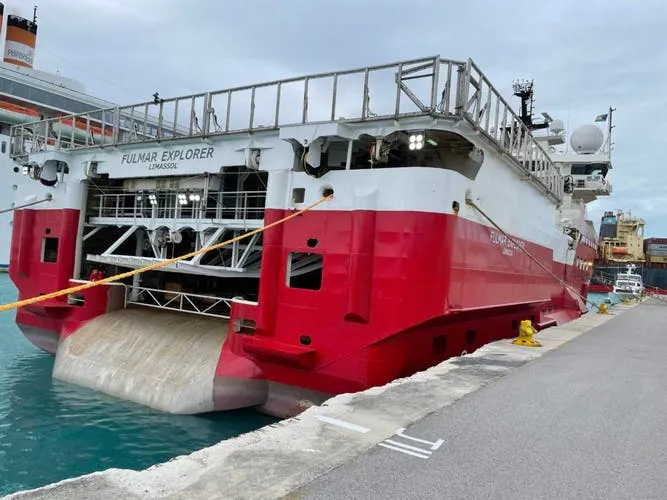
SeaBird Exploration has won a three-month contract for an ocean-bottom node (OBN) source program offshore West Africa.
The company will deploy the Fulmar Explorer for the campaign, with mobilization expected to start following completion of the vessel’s five-year classing, currently scheduled for August.
About the Author
 Jeremy Beckman
Jeremy Beckman
Staff Writer / Editor, Europe
Jeremy Beckman has been Editor Europe, Offshore since 1992. Prior to joining Offshore he was a freelance journalist for eight years, working for a variety of electronics, computing and scientific journals in the UK. He regularly writes news columns on trends and events both in the NW Europe offshore region and globally. He also writes features on developments and technology in exploration and production.