OBN and FWI improve subsurface imaging and reduce offshore exploration risk
Key takeaways:
- Long-offset OBN data and FWI are expanding the use of transmitted energy, resolving velocity-depth ambiguity and improving imaging in low-reflectivity and complex geologies.
- FWI and emerging elastic FWI workflows are advancing beyond traditional migration, delivering improved structural clarity and more reliable reservoir amplitudes.
- Improved subsurface models are translating directly into reduced exploration risk, better development planning, and more efficient capital allocation.
By Offshore staff, based on responses from Viridien
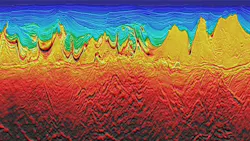
Advances in ocean-bottom node (OBN) acquisition and full-waveform inversion (FWI) are reshaping how offshore operators image and understand the subsurface.
In this exclusive Q&A interview with Offshore, Viridien’s Rongxin Huang, vice president of US Imaging, discusses how these technologies are improving velocity model accuracy, reducing uncertainty in complex geology, and enabling more confident and faster exploration and development decisions.
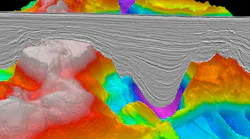 subsurface interpretation
Editor's note: The following Q&A section was provided by Viridien. The responses have been edited and condensed for clarity and length by the Offshore editorial team.
Can you outline the current state of seismic technologies and how they have evolved?
Huang: The central theme in seismic technology has always been the interplay between data and algorithms. Better imaging algorithms extract more value from existing data, while better data enable the development of more advanced algorithms.
Today, the leading developments are low-frequency, full-azimuth, long-offset OBN acquisition on the data side and FWI on the imaging side. Together, these advances mark a shift toward physics-based, data-driven Earth modeling, redefining the limits of what seismic technology can resolve.
How did OBN technology transform the field, what new capabilities did it enable, and what advances have followed since?
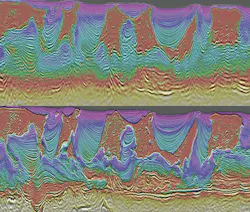
Huang: The introduction of OBN technology, particularly long-offset configurations in recent years, has fundamentally reshaped seismic imaging by transforming how velocity models are built and how accurately they represent the subsurface. Long offsets enable the recording of diving waves and other transmitted energy that penetrate far deeper than conventional streamer and earlier OBN data, reaching reservoir depths and beyond. The transmitted energy helps resolve the long-standing ambiguity between reflector depth and interval velocity that is inherent in reflection-based velocity model building, as well as challenges in areas with low reflectivity where limited or no reflection energy is available to constrain the velocity model, resulting in the most accurate velocity models to date.
FWI is the technology that most effectively utilizes this transmitted energy for velocity model building, and the advent of OBN data has helped to accelerate the evolution of FWI. The result is unprecedented accuracy in subsurface modeling and significantly clearer seismic images. Low-frequency and full-azimuth characteristics that typically come with OBN data further stabilize FWI by reducing cycle-skipping (modeling misfit errors) and improving illumination and the signal-to-noise ratio (S/N). The synergy between OBN acquisition and FWI has created a paradigm shift in seismic imaging, especially in geologically complex regions, delivering subsurface clarity previously considered unattainable.
What technologies and methods are used today, and how are they improving exploration below the seabed?
Huang: Seismic imaging is advancing rapidly across four key objectives:
- Accurate velocity model building;
- Reliable structural imaging;
- High-resolution detail; and
- Quantitative amplitudes and attributes.
The combination of long-offset OBN acquisition and FWI has already transformed velocity model building, delivering kinematic accuracy that conventional velocity model building methods could not achieve. These velocity models form the foundation for all subsequent imaging improvements.
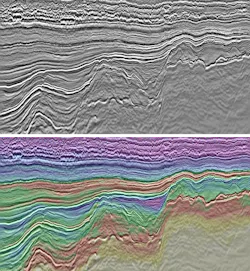
Building on that foundation, FWI imaging has emerged as a major step beyond traditional seismic migration algorithms used to form the images of the subsurface. By using the same full-wavefield physics that drive FWI velocity updates and extending them to higher frequencies, FWI imaging can directly produce clearer, more geologically consistent structural images, particularly in complex settings where conventional approaches often fail even with an accurate velocity model. Compared to traditional migration, FWI imaging also provides more accurate amplitudes for reservoirs.
Further, by incorporating more accurate elastic wave physics, elastic FWI (EFWI) better addresses elastic effects present in the recorded data, particularly in areas where they are significant (e.g., around salt or carbonate bodies), providing more accurate structural images and reservoir amplitudes than its acoustic counterpart.
EFWI also has the potential to go beyond structural imaging and directly invert for P-wave velocity, S-wave velocity and density, attributes tied to reservoir lithology and fluid content. However, this is still very challenging (e.g., due to crosstalk among different attributes) and remains a focus of current seismic imaging research.
What have these advances meant for offshore players in terms of better exploration outcomes, lower risk and improved returns, and where do the remaining technology gaps lie?
Huang: The combined advances in OBN acquisition and FWI technology have significantly improved exploration success rates and reduced subsurface uncertainty for operators. The ability to generate accurate velocity models and high-fidelity structural and amplitude images directly translates to improved reservoir characterization, higher confidence in volumetric estimates, and better well placement, each of which reduces financial and operational risk.
For exploration, the step-change accuracy in velocity models and structural imaging means prospects can now be evaluated with far greater confidence, even in areas once considered too complex for reliable interpretation, such as subsalt plays or carbonate provinces.
For development, the higher-resolution images with better amplitude fidelity delivered by FWI reduce uncertainty in reservoir connectivity, fluid distribution and seal integrity, allowing for better field development planning and optimized well placement.
These technological advances have also reshaped investment strategies. With more predictable outcomes, operators can commit capital earlier in the exploration cycle and shorten decision timelines.
What is the business case for investing in these technologies, and what advice would you give companies adopting them?
Huang: The business case for investing in modern seismic technologies, such as OBN acquisition and FWI, is clear: they directly reduce exploration risk and improve capital efficiency.
High-fidelity subsurface models enable better-informed drilling and development decisions, leading to higher exploration success rates, fewer dry wells and more efficient field development. The return on investment also comes from faster decision cycles, creating a more reliable and accelerated path from data to business success.
Conclusion
As offshore projects move into increasingly complex geological environments, the integration of advanced acquisition and imaging technologies is becoming essential rather than optional.
The combination of long-offset OBN data and FWI is pushing the boundaries of subsurface resolution, enabling operators to make more informed exploration and development decisions with greater confidence.
While challenges remain, particularly in fully unlocking elastic inversion capabilities, the direction of travel is clear: more data-rich, physics-driven workflows will continue to redefine what is possible in offshore seismic imaging.
Exclusive content:
 Trials of the OD OBN technology
About the Author
 Ariana Hurtado
Ariana Hurtado
Editor-in-Chief
With more than a decade of copy editing, project management and journalism experience, Ariana Hurtado is a seasoned managing editor born and raised in the energy capital of the world—Houston, Texas. She currently serves as editor-in-chief of Offshore, overseeing the editorial team, its content and the brand's growth from a digital perspective.
Utilizing her editorial expertise, she manages digital media for the Offshore team. She also helps create and oversee new special industry reports and revolutionizes existing supplements, while also contributing content to Offshore's magazine, newsletters and website as a copy editor and writer.
Prior to her current role, she served as Offshore's editor and director of special reports from April 2022 to December 2024. Before joining Offshore, she served as senior managing editor of publications with Hart Energy. Prior to her nearly nine years with Hart, she worked on the copy desk as a news editor at the Houston Chronicle.
She graduated magna cum laude with a bachelor's degree in journalism from the University of Houston.