Douglas CCS platform installed for Liverpool Bay carbon storage network

The Douglas CCS platform will serve as the offshore hub of the HyNet carbon transportation and storage network, distributing captured industrial CO₂ to depleted gas reservoirs beneath Liverpool Bay for permanent sequestration.

Why this news matters:

  • The project repurposes legacy offshore oil and gas infrastructure to support the long-term storage of captured CO2 beneath the seabed.

  • The installation marks a significant milestone for one of the UK's largest CCS developments and moves the HyNet network closer to commercial operation.

  • The Douglas CCS platform highlights how offshore infrastructure can play an increasingly important role in supporting large-scale industrial decarbonization efforts.
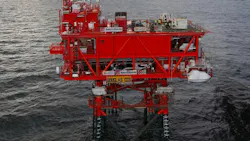
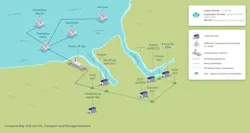
Eni CCUS Holding’s new Douglas CCS platform has been installed at Liverpool Bay, offshore north Wales/northwest England.

This is a major component of the CO2 transportation and storage (T&S) project for the HyNet industrial decarbonization cluster.

According to Eni, joint owner of Eni CCUS Holding with Global Infrastructure Partners (part of Blackrock), the Douglas CCS facility is the first purpose-built offshore platform dedicated to carbon capture and storage (CCS).

It replaces the former Douglas Process platform, part of the former Liverpool Bay oil and gasfields development, and will operate as the offshore hub of the Liverpool Bay T&S system, receiving CO2 captured from industrial facilities across the region.

The CO2, delivered from a new terminal at Point of Ayre, north Wales, will then be distributed via new sections of pipelines with connections to existing subsea pipelines: these are being repurposed for transporting the CO2 to depleted natural gas reservoirs for permanent subsurface storage.

Rosetti Marino in Ravenna, eastern Italy, built the new Douglas CCS 35-m tall, 1,755-mt jacket and 1,885-mt topsides and eight foundation piles (730 mt). The company is also constructing new topsides for the Hamilton Main, Hamilton North, and Lennox wellhead platforms, with respective weights of 1,070, 950 and 1,370 mt.

These will then serve to inject 109 Mmt of CO2 for permanent storage into the Hamilton Main, Hamilton North, and Lennox reservoirs.

The offshore program also includes drilling and re-completion of injection and monitoring wells through side-tracking existing production wells.

The wider construction program across the entire Liverpool Bay CCS network is now about 50% complete, Eni added. 

Contributors:

About the Author

Jeremy Beckman

Jeremy Beckman

Staff Writer / Editor, Europe

Jeremy Beckman has been Editor Europe, Offshore since 1992. Prior to joining Offshore he was a freelance journalist for eight years, working for a variety of electronics, computing and scientific journals in the UK. He regularly writes news columns on trends and events both in the NW Europe offshore region and globally. He also writes features on developments and technology in exploration and production.

Sign up for our eNewsletters
Get the latest news and updates