Rystad: Deepwater capex could peak around 2030
Deepwater capital spending could top out around 2030 unless companies score significant new discoveries soon, a senior Rystad Energy analyst told an Offshore audience last week.
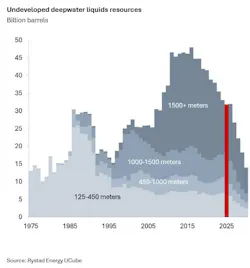
On a webinar discussing the spending outlook for various elements of the energy sector, Rystad's Senior Vice President Matthew Hale pointed out that the industry’s inventory of undeveloped deepwater liquids peaked in the mid-2010s after major discoveries in Brazil and Guyana. Rystad data shows that the amount of undeveloped resources has fallen steadily since then (see Figure 1 below) and will soon fall to about 27 Bbbl, below its level of the late 2000s.
Barring notable new discoveries, Hale said that will show up soon in companies’ spending.
“The deepwater capex as it stands today is peaking in this decade or towards the end of this decade,” Hale said on a Nov. 10 webinar hosted by Offshore. “If we find resources today, then potentially that peaks higher, in the early 2030s. If not, I think it’s shale or heavy oil […] that’s going to make up those volumes and supply the market.”
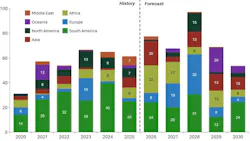
That’s not to say that the sector’s near-term project pipeline is running dry. Rystad teams are forecasting that operators will take final investment decision on nearly $80 billion worth of deepwater capex this year, an increase of some 25% from 2025. That figure will drop next year but then jump to nearly $100 billion in 2028 (see Figure 2 above), analysts say, when spending is expected to climb by at least $10 billion in each of North America, South America and Europe.
“You still have a wave of projects coming through the pipeline,” Hale said, noting that the economics of that work are still attractive to operators even though the resource mix will shift. “It ends up being more of a mix of gas relative to oil […], and the other piece is that you’re really getting slightly higher breakeven prices on these developments.”
Among the other topics Hale discussed during his talk were:
- A significant expected increase in offshore wind capacity in the early 2030s: The number of newly installed turbines globally will continue to rise steadily during the next decade, Hale said. But as companies continue to put in place more powerful units, Rystad expects that new capacity will grow quickly in the early 2030s; 2032 should be the first year in which more than 1,000 turbines are installed while an average of 15 gigawatts of capacity—roughly 50% more than this year or next—is expected to brought online annually from 2033 through 2035.
- An expected late-’20s carbon capture and storage investment boom: Offshore CCS capex is on pace to be a little more than $1 billion this year. By 2028, Rystad expects that number to be about $2.5 billion before—driven by North Sea activity focused on depleted natural gas fields—popping to nearly $6 billion in the following year and reaching $7 billion in 2030.
To watch Hale’s presentation and Q&A session on demand, which features more charts and data points, click here to register for free.
About the Author
Geert De Lombaerde
Senior Editor-at-Large, Healthcare Innovation Magazine
Related
 Offshore energy capex to grow again in 2025 led by Asia, Middle East
 offshore_oil_and_gas
