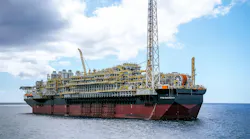
STS JV, the joint venture between SBM Offshore and Technip Energies, and TotalEnergies EP Suriname, have agreed to co-develop, install, test and operate a wind-assisted towing system on the GranMorgu FPSO.
Also collaborating in the project is France-based Beyond the Sea, which developed kite traction solutions as a scalable alternative to traditional propulsion for all types of vessels.
The main aims for the GranMorgu will be to reduce the duration of the tow duration and fuel consumption by adding a kite traction system during towing of the FPSO from the yard in China to Suriname.
This will also help validate the technology for deployments on large-scale vessels. In this case, the selected system will be Beyond the Sea’s SeaKite 2400 system, which could provide automated traction throughout the journey (depending on wind conditions).
Kite-assisted towing planned for GranMorgu voyage
The partnership plans a phased R&D approach for the project, covering technology development and qualification, costs, operational readiness, and a shore test program prior to integration on the FPSO in China.
A progression thereafter to further stages will depend on the development fulfilling predefined technical and safety criteria.
Technology qualification and shore testing come first
Other goals are to validate the kite’s wing launch and recovery system, as to collect data for optimizing the system sizing, using digital modeling.
As this is a first-of-a-kind application of kite traction towing for an FPSO, there will be a strong emphasis on risk management, SBM reported, due to the nature of the vessel.
Project aims to validate kite traction for large offshore vessels
Beyond the Sea describes SeaKite as an intelligent ship traction system, comprising a kite, traction sensors and an autopilot, and said it is capable of towing a wide range of ships including large merchant Navy vessels.
Its combination of mixed engine/kite propulsion is said to reduce fuel consumption by about 20% on average. An automated kite-pulling system is in use onboard the catamaran Le SeaKite.
The technology is designed for fast, straightforward installation. The AI that guides the system is said to constantly adapt the positioning of the sail in the wind to allow for optimized traction and performance.