Analysis: Iranian attacks on shipping having impact on Persian Gulf E&P
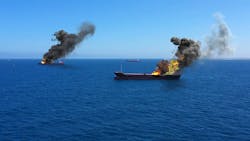
Iranian attacks on six commercial vessels over the past two days have effectively closed commerce through the Strait of Hormuz, and raises the prospect of a larger reduction in oil and gas E&P operations in the Persian Gulf.
The vessels attacked have included two bulk carriers, two container ships and two fuel/crude oil tankers. The attacks have been carried out via projectiles, drones and explosive unmanned boats. Crews have been evacuated in several cases, but fatalities and injuries have occurred.
The recent vessel attacks bring the total number of commercial ships targeted to 14 to 16-plus since the conflict began. The US Navy has reportedly indicated that it is not yet ready to provide escorts for commercial ships through the area.
Shipping attacks effectively close Strait of Hormuz
It should be noted that the direct physical impacts on offshore E&P remain limited. There have been no major confirmed hits on active offshore oil or gas platforms or production installations in the Persian Gulf. The attacks have primarily targeted:
- Commercial tankers and ships in transit or at anchor;
- Onshore refineries/storage (e.g., Ras Tanura in Saudi, Ruwais in UAE, Ras Laffan processing in Qatar); and
- Some industrial zones or port-related infrastructure.
Nevertheless, the conflict has had a severe, negative impact on Persian Gulf E&P, far beyond just shipping disruptions. The combination of Iranian drone/missile strikes on infrastructure, the effective closure of the Strait of Hormuz (preventing exports), and precautionary safety measures has forced widespread output cuts, refinery shutdowns and project delays across the region. Storage tanks are being filled rapidly with nowhere to send the oil/gas, creating a classic “no outlet” crisis.
Export blockade triggers upstream production cuts
For example, QatarEnergy has delayed the start of first exports from the massive North Field East project (aimed at adding 32 million tons per year of LNG capacity) to at least early 2027. This follows an Iranian drone attack that shut down the Ras Laffan LNG complex—Qatar’s primary export hub—forcing a full suspension of LNG production and exports. The country had already pushed the timeline once before the war; the drone strike made further delays unavoidable. This is a major setback for Qatar’s goal of becoming the world’s top LNG exporter.
Offshore UAE, ADNOC’s upstream operations continue but at reduced rates overall; the UAE has cut total oil output by 500,000–800,000 b/d due to the export blockade. Offshore fields, which make up a large portion of UAE’s production capacity, are being curtailed and suspended not from physical damage, but because there is nowhere to send the oil without Hormuz access.
Offshore Saudi Arabia has seen production cuts too. The nation’s Safaniya field, the world’s largest offshore oil field, is part of the broader output cuts (2-2.5 million b/d total reduction), driven by export halts and storage limits. There have been no direct platform strikes reported, but precautionary reductions are being applied offshore as well.
Similarly, southern Iraq’s offshore-linked fields have seen cuts due to lack of export outlets. Iraq’s overall southern output is down some 70%, with offshore components affected indirectly.
Regional offshore impacts extend beyond current production
In the broader Persian Gulf region, offshore drilling, seismic surveys and new field appraisals have seen far less public reporting, but industry sources indicate a near-halt; high insurance costs, worker evacuations from platforms and security risks have paused or slowed several projects. The QatarEnergy delay is the clearest example of an expansion/development program being frozen.
The fallout from the US-Iran conflict is already slashing offshore output across the region, and prolonged Hormuz issues could lead to more aggressive shut-ins or pauses in new offshore projects.
Not just a shipping crisis
Persian Gulf offshore infrastructure has not been directly impacted by kinetic attacks (but this could change quickly), but rather by the logistical/export blockade forcing production curtailments to manage storage overflows.
The conflict in the Persian Gulf is no longer a “shipping only” story—it is having a direct and negative impact on offshore upstream production and infrastructure.
 Offshore and OGJ coverage on the conflict in the Middle East
About the Author
 Bruce Beaubouef
Bruce Beaubouef
Senior Lead Reporter / Managing Editor
Bruce Beaubouef is Managing Editor for Offshore magazine. In that capacity, he plans and oversees content for the magazine; writes features on technologies and trends for the magazine; writes news updates for the website; creates and moderates topical webinars; and creates videos that focus on offshore oil and gas and renewable energies. Beaubouef has been in the oil and gas trade media for 25 years, starting out as Editor of Hart’s Pipeline Digest in 1998. From there, he went on to serve as Associate Editor for Pipe Line and Gas Industry for Gulf Publishing for four years before rejoining Hart Publications as Editor of PipeLine and Gas Technology in 2003. He joined Offshore magazine as Managing Editor in 2010, at that time owned by PennWell Corp. Beaubouef earned his Ph.D. at the University of Houston in 1997, and his dissertation was published in book form by Texas A&M University Press in September 2007 as The Strategic Petroleum Reserve: U.S. Energy Security and Oil Politics, 1975-2005.