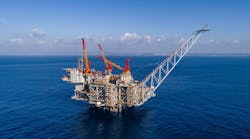
QatarEnergy suspends work on North field expansion due to US-Iran conflict
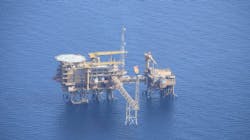
QatarEnergy has suspended work on its the North Field Expansion (NFE) project due to the US-Iran conflict in the Persian Gulf that began on February 28, 2026.
The suspension of the NFE project is part of a cessation of LNG production at Qatar’s Ras Laffan and Mesaieed industrial cities following targeted Iranian drone strikes on these facilities.
While the onshore processing plants were physically struck, offshore expansion activities (drilling and platform installation) have been effectively paralyzed by the closure of the Strait of Hormuz. Iran’s Revolutionary Guards have declared the waterway closed to all traffic, and most international marine insurers have canceled war risk cover for vessels in the Gulf.
The North Field is a shared reservoir with Iran (where it is known as South Pars). Intensified military activity around this shared border has forced the evacuation of non-essential personnel from offshore rigs and construction barges.
The North field expansion project is divided into two primary offshore-to-onshore phases, both of which are currently affected by the regional crisis.
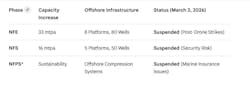
The North Field East (NFE) phase is the first and largest phase, involving four mega-trains with a total capacity of 33 mtpa. It includes the drilling of approximately 80 new wells and the installation of eight offshore wellhead platforms.
Prior to the conflict, NFE was roughly 85% complete with production expected to start in late 2026. Current hostilities have halted the final stages of subsea pipeline laying and platform commissioning.
The second phase, North Field South (NFS), is aimed at adding two additional mega-trains for a further 16 mtpa. It involves five production platforms and approximately 50 wells, connected to the onshore complex via new subsea pipelines.
NFS was in an earlier stage of offshore construction when the conflict began. Major contracts for offshore compression (worth ~$4 billion) were being executed by Saipem and McDermott before the security situation deteriorated.
The official timelines for the North field expansion have become highly uncertain due to the immediate suspension of operations following military strikes in the region. Prior to the recent escalation, the projects were already navigating revised schedules.
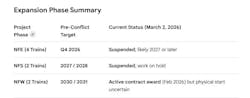
Before the production halt, the NFE phase had been scheduled for a 4Q 2026 startup. Previously, QatarEnergy had aimed for a mid-2026 start, but internally pushed this back in early February 2026 due to final engineering adjustments and global supply chain bottlenecks. The four mega-trains were expected to come online sequentially, reaching full operational status by mid-2028.
The NFS phase had been targeted for a late 2027 or early 2028 in-service. Per the original schedule, the NFS phase would follow the NFE phase, and was on track for its first LNG production roughly 12 to 18 months after the first NFE train.
These phases of the North field expansion project now face indefinite delay. There is currently no official new date for when NFE or NFS will resume construction or commissioning. The halt is described as a response to an “unprecedented” security threat.
Officials say that operations cannot resume until a full damage assessment of the onshore facilities is completed and the safety of the offshore shared field area is guaranteed.
Some industry analysts suggest that the NFE startup could now slip into 2027 if regional tensions prevent the return of international technical staff required for the final commissioning of the trains.